
by Eric J. Weiner
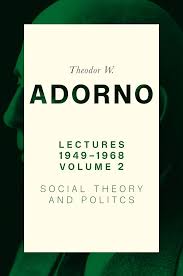
Many people familiar with Theodor Adorno and his work in sociology, philosophy, psychology, and cultural studies might not know about his work as a public intellectual in postwar Germany. For those readers who are not familiar with his legacy, this book is a perfect introduction to some of his most important ideas concerning free will, self-determination, and the persistence and influence of authoritarian structures in democratic and capitalistic systems. As a public intellectual, Adorno steps out of the shadow of academia and the Institute for Social Research. The lectures in this book, all delivered between 1949-1963, are not only accessible to lay readers but remain relevant to our world today. The insights he offers in reference to postwar German society are remarkably still applicable to 21st century neoliberal democratic societies. However different the 21st century is to the 20th, especially regarding technology and globalization, his analyses remain relevant to our current times. In some instances, they are even more relevant today than when he first delivered them.
In 2025, as authoritarian discourses arise like ghosts from what might appear to be the cold ashes of 20th century fascism, Adorno’s work suggests that maybe they never really disappeared in the first place. From his perspective, what we are seeing in the United States and across the globe is a continuation of a hegemonic system of thought and behavior–and the consciousness that it engenders–that was never fully eradicated. Just as the “end of history” thesis was premature in announcing the triumph of western capitalism and democracy in the 1980s over communism, announcing victory over the ideology of authoritarianism and fascism in the west at the end of World War II is also beginning to look politically naïve and willfully ignorant.
Defeating Hitler’s Third Reich militarily was not the same thing as extinguishing the ideas that fueled its popularity and fed its imperialistic and murderous imagination. Indeed, as the work of the Institute for Social Research consistently revealed, the proverbial rock from under which Hitler and Nazism crawled was made from a familiar and seemingly innocuous amalgam of science, philosophy, education, nationalism, and culture none of which, together or separately, gave away the unforeseen terror that was hiding in plain sight. From the time of Adorno’s public lectures to our current time, the task during these transitional periods of history is not to predict, like astrologists mapping the stars for clues about what the future holds. In these times, speculative social science, for Adorno, is no better than a crystal ball. Trying to guess at what will be at the expense of understanding and changing what is, is a fool’s goal. For Adorno, resistance to the rise of neo-fascist discourses in the postwar era is first and foremost to ask, “How these things will continue, and [taking] responsibility for how they will continue” (186). This doesn’t mean we shouldn’t have a social imagination. But this is decidedly different than believing that we can actually know what the future holds. We should imagine what could be, as any tangible notion of educated hope depends on a vibrant social imagination, but we first must change, according to Adorno, our relationship to what is.
In what follows, I will discuss several points of entry from Adorno’s lectures into how and why right-wing extremism continues to thrive in the 21st century and the central role of education and culture in combatting or perpetuating these extremist ideologies. The clarion call to unfreedom from the podium of authoritarianism grows more insistent every day. What seemed impossible to many only ten years ago seems inevitable to them now. Neither assumption was or is true; yet, our ability to critically analyze how social structures support and engender certain behaviors and mindsets says a lot about our ability to transform them.
Adorno’s insights into these issues arise out of the interlocking theoretical frameworks of sociology, philosophy and psychology. Typically called Critical Theory, his research focused on the primacy of free will and self-determination for human beings on one hand, and the social structures that limit or prevent human beings’ ability to be free and self-determining on the other. When applying his ideas to a 21st century context, it is important to remember these basic foundations of Critical Theory. It rejects relativism as a universal principle, aims to distinguish and disentangle knowledge from power, regards the individual as a vital subject of history, imagines sublimated consciousness as an engine of hope and agency, is committed to democracy, and invests in the critical potential of education. The ultimate goal of Adorno’s work is to help human being’s “wake-up” to the invisible social forces that keep them in a state of alienation and unfreedom. The dual forces of alienation and administration–externalized and internalized–are part of our objective reality and can be known. We just have to know where and how to look. It also follows from his work that once these things are known and understood, they can be resisted and transformed.
His primary “method” of critical analysis is dialectical which gives his work “intention,” propelling it forward; it never sits still, so to speak, as the dialectic is always pushing him further toward the universal or Spirit. His perspective is “modern” and rejects “post-modern” notions of relativity, power, knowledge, and truth. For Adorno, Truth is evasive but achievable. Power is tangible. Work is material. Knowledge is learned. Education matters. Consciousness can be sublimated. Social structures–from the buildings and parks that make up our cities and towns to cultural norms of thought and behavior–are enormously powerful and overwhelm the individuals that live and work within them. But domination is always leaky.
The first lecture in the collection is Adorno’s first public lecture after returning to Germany from the United States. He gave this lecture to a colloquium on urban architecture and planning at the Technische Hochschule in Darmstadt on December 9, 1949. Adorno’s critical analysis of architecture and development in postwar Germany presupposes that they are “inextricably connected with the particular sphere of society within which they transpire” (2). As such, cities and towns are not politically neutral inanimate constructs. They function primarily to serve the ideological interests of capital and other forms of power, which includes treating people like objects of architectural design as opposed to its subjects. In all cities and towns, the apartment buildings, sidewalks, roads, shopping districts, schools, houses, public parks, industrial/tech/trade centers, hospitals, centers for well-being, private/privatized spaces, etc. all discipline and structure our habits of body and mind so that we function in ways that appear to be free, yet, in reality, delimit (i.e., plan and administrate) our freedom in significant but subtle and imperceptible ways.
In Adorno’s formulation of the central role and responsibility of architects and designers, he moves from discussing architecture and design per se, to imagining the kind of social sphere that would support human beings as subjects, free to participate in the essential economic, political and cultural spheres of their lives. Architecture and design, in Adorno’s treatment, do not exist and function independently of the social sphere of which they are a part, and, maybe more to his point, should never be used as though they were ideologically neutral tools in the struggle for (or against) freedom.
Think about the modern-day cubicle-littered office; the assembly lines of the early 20th century; the tech worker in 2025 watching a computer screen for signs of life and potential profit as it watches and records him, mining his clicks as data to be sold further down the line or measuring his efficiency and surplus value; the masses of zombie commuters staring at their mini-screens, terrified to look up and around for only then will they truly understand how utterly alone they are; or the miles of big box-stores, strip malls, and chain restaurants, one no better or different than the next. One town looks and feels exactly like the one a few miles down the interstate, as do the stores and what they sell. The people drive cars that are superficially different yet are in all ways that matter exactly the same. Giant brick housing complexes, called “housing projects” in the United States, arise like mass graves for the disposable and expendable, sequestered outside the central business/design/arts districts, that seem designed to keep residents trapped in a reproductive system of generational poverty, violence and hopelessness. Even within the online “spaces” of social media, people’s curations are conditioned in the final analysis by the medium itself. Overdetermined by the limits set by the corporations that design virtual worlds–anti-social social spaces–they nevertheless “choose” from a predetermined and mediated set of ideas and objects for their imagined, perfect life, all the while celebrating their uniqueness and individuality.
From Adorno’s perspective, democratic societies should be designing democratic social structures in an effort to secure and reproduce democratic societies, i.e., structures that support forms of associated living consistent with the basic principles of substantive democracy. Democracy is only as strong and sustainable as its infrastructure. When our buildings and structures are designed in a way that objectifies and alienates those who live and work in them it “is nothing but the visible manifestation of the contradiction” (9) between believing you are free, yet, at the same time, have no relative power over your spaces of work, leisure and family.
He concludes his talk about the rebuilding of Germany’s cities by reiterating the idea that architects and designers must enter into “a concrete engagement with the people who are affected” (16), provide intellectual leadership and expertise in these engagements, but, most importantly, be “avant-garde” (16). The appeal to be avant-garde is his way of moving beyond the past; he recognizes that we need to be avant-garde before we can design and build cities and towns that will reflect a truly radical way of living freely within the principled constraints of democratic society.
The avant-garde requires an intellectual platform upon which to grow. But being able to release the imagination in the service of new social structures, requires specific kinds of epistemological and theoretical tools. For Adorno specifically and the Frankfurt School more generally, sociology is one of the essential intellectual tools of the avant-garde. It is also why Hitler and the Nazi party attempted to repress sociology. In 2025, Trump and MAGA are also trying to repress sociology. For authoritarian regimes, sociology has the power to disentangle truth from ideological state apparatuses, which makes it a dangerous discourse.
For example, In the United States “Florida’s board of education voted to replace the established course on the principles of sociology at its 12 public universities with its own US history curriculum. Education commissioner Manny Díaz insisted without evidence that sociology had ‘been hijacked by leftwing activists’ (Luscombe 2024). Díaz at the behest of Governor Ron DeSantis is at the forefront of a new kind of neo-fascist attack on education. Their repression of sociology, rationalized as an attack on “woke ideology,” is eerily similar to the National Socialists’ attempted suppression of sociology during their rise to power. Adorno reminds his audience that sociology was “definitely persona non grata in the eyes of the National Socialists and was effectively, if not officially, repressed or discouraged by them” (17). Notably, DeSantis and Díaz have gone further than the National Socialists in their official removal of sociology from the core curriculum of Florida’s 12 public universities.
In other ways, their hostility to sociology doesn’t go beyond the National Socialist agenda but is perfectly aligned with its intentions and purposes. Adorno is clear on the matter:
I would explain it in terms of the fact that National Socialists–precisely because they were essentially concerned with imposing on people a form of politics which was nonetheless fundamentally opposed to the interests, to the real interests, of the people in question–it took infinite pains to direct attention away from the actual life process of society from the effective collective processes that determine our existence. And sociology was already suspect…because it is not concerned with offering a replica of the reality they wished to impose on people precisely in order to play fast and loose with reality itself. (18)
By contrast, sociology is concerned with actual reality, not reality as it is superimposed on the people by an autocratic leadership and social structure, both operating in concert with few constraints.
Actual reality, according to Adorno, is made known through sociological/philosophical methods of research and evaluation that try to understand how social and political structures–the structured ontologies of being and human existence–are “entangled” in real social relations (19). Sociology, then and now, promotes not “wokeness” or some other ideological version of social reality, but “the very self-reflection on the part of society which the National Socialist regime wished to prevent” (18). Such self-reflection is the “precondition” of the emergence of a society that can nurture and sustain free human beings and protect against the world being “engulfed in unimaginable catastrophe” (18). Within the capitalist-authoritarian system, societal self-reflection is replaced by a cult of personality, policing and surveillance. Knowledge is policed for how consistently it aligns with the superimposed reality of established power. Sociology is a threat precisely because its central role is to disentangle truth from society, or stated another way, truth from the grip of power.
Regardless of human being’s relative relation to power in the form of capital (economic, educational, social, and cultural), their freedom is most notable for how limited and limiting it actually is within the social structure of the state. In such systems, almost every choice by the individual is influenced a priori by the state before the individual ever gets to choose anything. But because choices are being made on some level, the illusion of being free from state control plays into the consciousness of all human beings, trapping them blindly within the contradictions of the administered state.
By understanding the consciousness of alienation or, conversely, alienation as a form of consciousness within mass authoritarian-capitalist culture, sociology can help us overcome the “reified and ossified conceptual replication of life that increasingly characterizes the administered world” by awakening “the consciousness of human beings” precisely because the world “confronts them as an alien” and organizes their social and interpersonal relations in terms that are deeply inhuman and inhumane (23).
His call for grounded sociological research should not however be misinterpreted as a call for positivistic research or for an “empiricism devoid of concepts” (26). Positivism and the research that it supports is driven not by empirical facts, but by methods that supposedly avoid biases. Empiricism without concepts creates meaningless and impotent knowledge; secure and safe precisely because it says nothing of consequence about the world it studies. For Adorno, both positivism and speculative sociological discourses allow power to remain hidden behind the veil of ideology. As such, sociology driven by facts–objective reality–is the only tool–in combination with psychology and philosophy–that we have that can, ironically, get beyond the facts and reveal the truth outside of ideology (28).
According to Adorno, it’s essential to the project of disentangling truth from social structures that we devise investigative categories that allow sociologists to evaluate whether their understanding of the data–their theoretical models of interpretation and the results it discovers/creates–are true or false. Making this task even more difficult is that the practice of sociology is necessarily informed in relative measure by work in psychology, philosophy, history, linguistics, ethnology, cultural anthropology, cultural studies, and the sciences more generally. Sociology, as Adorno sees it, is an essential tool that can help human beings understand and resist authoritarian-capitalist efforts to alienate them from their labor, lives, each other, and most devastatingly, from themselves.
Alienated people are particularly vulnerable to developing the psychological character of the authoritarian personality. This mass psychology turns alienation into a potent tool of violence, discrimination, and other forms of domination. Sociology can help change the conditions that give rise to these kinds of behaviors and dispositions that were so instrumental in the evolution of the National Socialists in Germany and also in more contemporary contexts the neo-fascist social movements like MAGA in the United States.
Adorno’s avant-garde integration of sociology, psychology and philosophy framed his research on the characteristics of people who were susceptible to authoritarianism and dictatorial leadership. These people seemed predisposed to conflate truth and social structures, which made them good soldiers, but bad citizens. He named this disposition “the authoritarian personality.” In this collection, Adorno delivers a lecture entitled “The Authoritarian Personality” ten years after his book, The Authoritarian Personality, was published. His research on the authoritarian personality to this day remains one of the most important socio-psychological studies of the relationship between social structures and psychological character ever done. Its findings continue to inform our understanding of (un)consciousness, characterology, and their constitutive relationship to dominant social structures.
As the world becomes even less democratic and more alienated and administered than it was in 1960, his talk has much to say to readers in 2025. In our current historical conjunction, the emergence of the neo-authoritarian personality has arisen in the shadows of neoliberal capitalism, Large Language Model (LLM) technologies that infiltrate every level of society, and a concentration of wealth and power that far exceeds that which was accumulated and held by the world’s richest and most powerful men in the Gilded Age. Within this new context, the authoritarian personality of the 20th century–characterized by a blind obedience to authority and its propaganda, traditionalist beliefs or “conventionalism,” displays of aggression and violence toward the “other,” anti-intellectualism and irrationally driven behaviors/attitudes, manipulative/calculating, and rigid or dichotomous thinking–pales in comparison to the 21st century’s version of this same type.
An essential element of the authoritarian personality is how “pathic-nationalism” mediates the individual’s relationship to the state. Pathic-nationalism requires people to act irrationally in their sworn allegiance to the state and makes them unwilling to accept that the state is not superior. Historically, pathic-nationalism brings real misery to the people while, at the same time, uncoerced they wave flags, wear garrish uniforms to indicate their membership and fealty, and celebrate the greatness and superiority of their country and chosen leader. They do this with empty bellies, mounting debt, inadequate healthcare, crumbling infrastructure, and dim prospects for economic mobility. In the United States you’ll witness this during national holidays and sporting events in which the USA is playing another country’s team or at a political rally, regardless of party affiliation. Aggressive chants of “USA! USA! USA!” and signs proudly pronouncing “USA is #1” proliferate throughout the massive stadiums in which these events usually take place. This is in the face of the facts that the country, on every national index from infant mortality and educational knowledge to happiness is anything but number one. This is not unique to the United States, as it occurs in every country that makes militant nationalism–as distinct from patriotism–a requirement of citizenship. In all cases, the facts do not matter because aggressive nationalism demands that people sacrifice themselves to a certain kind of irrationality. More specifically, Adorno points out how the National Socialists did not promise the German people happiness and positive fulfillment, a rational (albeit no less problematic) motivation for national pride, but rather the “glorification of sacrifice, negative renunciation, and ultimately death” (99).
Adorno argues that the character traits of the authoritarian personality on one hand are converging with the authoritarian structures of the modern state, and on the other, creating a much smaller “space of freedom” than we might think exists. As these two related but separate expressions of authoritarianism converge, the space of sublimation–the chance to free the body and mind from the grip of the ideological apparatus of the state–grows increasingly tight. Under the leadership of Hitler, the consciousness of Nazism achieved an almost complete totality; that is, a near total eclipse of freedom in the synthesis of the authoritarian personality and the administered state. The fissures of freedom that appeared within the near total eclipse of reason helped people during Hitler’s reign to maintain their humanity and, in some cases, their lives.
Within dominant authoritarian structures, the authoritarian personality reveals itself most explicitly in the “phenomenon of prejudice” (103). Prejudice usually refers to attitudes about minorities or communities of people who are representative of some kind of recognizable or imagined “difference” to dominant culture, yet as a phenomenon it is not defined by which groups or individuals experience prejudice; it’s the fact that it is operating as a rational index of difference.
Adorno’s research on prejudice finds a “deeper” dimension that separates more harmless forms of prejudice from the kind that undergirds authoritarian personalities. He calls this form of prejudice “pathic,” and it is animated by irrational inflexibility. In other words, people who feel a pathic-prejudice toward another group or individual who they see as representative of the group don’t just reduce the individuals in that group to some stereotype, but refuse to be corrected–cannot be educated–even when their experiences challenge the veracity of their stereotypical assumptions. A pathic-prejudicial person who believes that all African American people are predisposed to violence will always believe this even after meeting African Americans and learning about African Americans who are not violent. Similarly, their own view of the group they belong to, regardless of experiences that show members of the group behaving in ways that counter the group’s perceived superiority to others, will never be convinced that their ideas and feelings about the group and its members are wrong. Adorno goes on to say that they “usually react to arguments with rage, violently rejecting the arguments and branding the person who dares to present them as a traitor and an intrinsically inferior person” (107). The inability to learn through experience, while investing in conspiracy theories, is what makes people who have this characteristic “truly dangerous” (105).
In 2025, the “deep state,” as well as many other conspiracy theories dominate the political imagination of MAGA and Trumpism. It provides their movement not only an enemy in those groups that challenge their will to power and worldview, but a deeper and darker enemy, one that can’t be seen or actually known, but is nevertheless always lurking in the shadows. Paranoid delusions grounded in stereotyping, pathic-prejudice, militant nationalism, and narcissistic tendencies move individuals in these in-groups to glorify and elevate themselves over and beyond everyone else. Adorno points out that these character traits are consistent with mental illness, yet are not evaluated as such because within the habitus of the authoritarian personality this all appears perfectly normal. To everyone else, it appears as it is: Dangerous and insane.
The political implications of the growth and development of the authoritarian personality, in the aftermath of Hitler’s regime, were obvious to Adorno. He recognized that Hitler’s reign was not due to a simple, but dangerous character trait. Militant nationalism required a certain degree of toleration for excess. But people’s “tolerance for excess,” even those of a “sycophantic nature,” is only as strong as those social structures that frame these excesses in socially acceptable and legal terms. The people’s tolerance for the excesses committed in their name must, in other words, be supported by juridical and political institutions. Hitler knew this and on June 30, 1934, declared the murder of Ernst Röhm to be a legal act. This move was essential at the time, according to Adorno, to help the people feel good about their tolerance for the Nazi’s increasingly brutal and violent excesses. “The whole political system typically involves the gratification that is produced when the controlled and contained instincts are released, albeit in the name of what formerly suppressed them, and one is permitted to indulge whatever one likes that one has otherwise denied oneself, and to do so with good conscience” (116). The modern corollary to this tolerance for excess can be seen in the recent arrest and “disappearance” of Kilmar Armando Abrego Garcia to a prison in El Salvador.
One of these social structures in capitalist democracies that continues to help shape the authoritarian personality is the school. Several years before Louis Althusseur coined the term “ideological state apparatus” to describe the relationship between the state and “unofficial” institutions that nevertheless support the reproduction of its ideological project, Adorno conceptualized education as a primary sphere of both reproduction and resistance. In three separate lectures in this collection, he turns his attention to the purpose of education and, relatedly, the need for higher education to think dialectically about research and teaching.
Higher education in Germany and the United States in 1957, under the pressures of capitalism, were quickly becoming instrumentalized institutions whose primary purpose was directed at training students to take their place in existing social structures. It had abandoned education for schooling. Higher education increasingly looked outside of itself to find purpose; that is, its purpose was no longer immanent in the process of education (64). Looking outside itself for its purpose, for Adorno, is problematic “on account of that remarkably abstract and arbitrary character which readily allows it to become nothing but ideology–another speech for the Kaiser’s birthday to assure his Highness that everything depends on the preservation of the True, the Good, and the Beautiful or, in the even more hideous language, on the ‘preservation of ‘cultural values’” (64).
In 2025, we again hear this “hideous language” coming from the Trump administration’s key educational consultant of higher education, Christopher Rufo, who explained in a recent New York Times interview with Ross Douthat that his goal for higher education is to enforce “a culture of civil debate and inquiry leading toward the true, the good and the beautiful. And continuing the great tradition of the Western civilization” (New York Times, 2025). What neither Rufo nor Ross said is what happens when the “great tradition” of Western civilization doesn’t always lead toward the true, good and beautiful? Or how these references were used in Nazi Germany to describe and hide their dystopian political project. The impulse in this seemingly common sense and democratic idea about civil debate and inquiry takes on an ominous tone in the hideous language of “cultural values” and “great traditions.” Imposed from on-high, these terms are clearly ideological signs that try to rewrite or erase a violent history. What it means that Rufo uses the same language to describe the educational project of Trumpism, I’ll leave readers to decide.
Within this discourse of pathic-nationalism, higher education becomes a blank slate on which any ideological interest or authoritarian-minded administration can project its own ideas about what its purpose should be. Case in point, in the United States, the Trump administration continues to infiltrate the university in both direct and subtle ways. From threatening to pull grant funding from research and dictating policies concerning student conduct to policing curriculum, Trumpism recognizes higher education’s arbitrary character, abstracted from any immanent value because of decades of capitulation to capitalist or other competing ideological interests, and therefore is poised to serve its cultural agenda of white, Christian, capitalist-nationalism. In a devious hypocritical move, Trump has accused many elite universities of antisemitism and vowed to punish them for it, while his base is built on his promise to return the nation to a time when white, Christian nationalism reigned. Trumpism’s attack on “wokeness” apparently doesn’t include anti-antisemitism as a dimension of being “woke.” Anti-racism is woke; being against antisemitism not so much.
Supporting this conception of education, Adorno sees the need to unify research and teaching in higher education. His central thesis regarding this unity is two-fold. First, that without a synthesis of research and teaching in the modern university there can be no “formative” education [Bildung]. If these two dimensions of knowledge production remain separate, “the university is inevitably split into a specialist training school on one hand and a research institute on the other.” Second, the concept of education is in an “acute state of crisis” (119).
The crisis in the concept of education arises, in part, from a crisis in the autonomous individual. Without autonomous beings, who, in the alienated and administered state, are few and far between, education at the university cannot operate at the level of cultural formation. Education as the “attainment of independence” is undermined by the university’s hierarchical bureaucracy in relation to teaching and research. In other words, the bifurcation of teaching and research makes education as cultural formation impossible. By decoupling teaching from research we are essentially severing theory from practice. The consequences of doing so is no less than our ability to comprehend the world “from the inside out” (125).
Adorno describes the kind of research that he believes would support this index of consciousness in formative education. Research must not be “encapsulated in different branches and fetishized, that is, be blind to society” (130). The hegemony of positivism, within the hierarchy of research orientations in the university, is one way that research rationalizes its social blindness. This approach to research cuts off researchers from doing research on issues that are not easily or readily quantifiable. Psychology and sociology, for example, are two fields of research that will never be able to define what is True at the level of physics or chemistry. But their attempt to model their research on these “hard” sciences have led them to embrace a “rigid dogmatism” regarding what constitutes actual scientific research. Another way to say this is positivism reduces the scope of our inquiries to such a radical degree that whatever we do discover via its methods resists generalization. Oversimplification makes these “discoveries” both true and meaningless.
The kind of teaching Adorno imagines would avoid being “dogmatic, dead, cut and dried, result-like, but would instead stand in a living relationship to its audience and would itself be a living thing. It would lose that pejoratively authoritarian element…the less teaching is separated from research, the more it will become self-criticism and also, thereby, a critique both of reality and of the consciousness which that reality oppresses” (131). His conceptualization of teaching lays the foundation for what would later be called in the United States and throughout the world, Critical Pedagogy. Conceptualizing the idea of teaching as a “living relationship” between students and teachers is to understand their relationship dialectically. From a similar albeit different time and place, the great Brazilian educator, Paulo Freire, characterizes the dialectic of teaching/learning by acknowledging that those who teach learn in the act of teaching and those who are students, teach in the act of learning. The dialectic of teaching conceptualizes the student as a subject and not an object of education. As such, the pejoratively authoritarian elements in traditional models of teaching are disrupted and transformed by the formative culture of an educational structure that is dialogical.
Studying sociology, for Adorno, is one way students can begin to disentangle democracy from the grips of the authoritarian imagination. When students learn to think critically and dialectically about social structures and their impact on human consciousness, his research at the Institute for Social Research showed that they typically reject authoritarian expressions of power. From this perspective, a political education is one in which students learn how to investigate the relations between the political sphere and the consciousness of individuals and groups who live and work within those spheres. It does not matter who the elite in these spheres are or what they believe in on an ideological level. If they ascribe to a theory of elites as a form of governmental power, then they are administering an anti-democratic state, as well as nurturing an authoritarian personality and consciousness, both of which significantly limit the power of the individual, free will and self-determination. Democratic consciousness is sacrificed at the altar of a form of power that rationalizes its authority in authoritarian terms. Adorno tells his audience that a meaningful sociology of this kind would ideally “awaken the consciousness of the objective social relations and to spread this same consciousness more widely” (166).
But Adorno recognized that schools were only one site of education in the postwar era, and not necessarily the most powerful. Anticipating the work of the Birmingham School of Cultural Studies, for Adorno and Max Horkeimer, the “culture industry” represented a powerful pedagogical machine that overwhelmed human consciousness by “teaching” as it entertained. Its lessons were not formulated in terms of curriculum and teaching in the scholastic sense. The pedagogical work of culture transgressed consciousness. People were rarely aware that they were “learning” anything of any importance when they sang along to a song, watched a film or television show, barely noticed an advertisement, or flipped through a magazine. But as Adorno and the Institute’s research revealed, the pedagogy of culture and the culture of pedagogy is not innocent and works on the consciousness of individuals in subtle and complex ways. It helps shape and condition feelings, attitudes, and beliefs. A competing force in the education of human beings in the postwar era and into the 21st century, the culture industry continues to challenge, and, in most ways, dominate formal and official models of schooling. The more that schools function as training facilities and the more instrumental they become as a consequence, the less impactful they will be in shaping the feelings, emotions and beliefs of students. While schools turn students into consumers, the culture industry turns consumers into students.
This collection of lectures, as most readers will immediately see, speaks to our own time as much as it gives us a window into some of the most pressing issues that troubled postwar Germany. So much of what Adorno talks about could be addressed to audiences today who are trying to make sense of the resurgence of right-wing extremism and the appeal of authoritarians in the 21t century. There’s an urgency in his call for people to develop resistance to the social “blindness” that comes from identifying with the aggressor (97). He sees people turning into the “executants of what blindly befalls them rather than trying to change the situation itself” (93).
In regards to our understanding of Hitler and the Third Reich, Adorno argued that “our consciousness of these things has become so repressed” that many people actually believe that the systematic murder of millions of human beings was just some kind of glitch on the “continuing path of progress” (86). He vehemently disagrees with this assumption and sees it as dangerous because it “harbours this destructive potential” behind a veil of progress and exceptionalism. In 2025, in the United States and throughout the globe, we are experiencing various expressions of anti-democratic power superimposing itself on previously established democracies; the people seemingly impotent to do anything to shift the arc of history away from a return to a newly reimagined fascist ideology. The repression of consciousness about the holocaust and authoritarianism more generally continues to concretize within the mass of educational programs, books, films and other artifacts within Germany, Europe, and the United States, among others.
The ubiquity of these educational programs and pedagogical projects have worked, against intentions, to abstract the true horrors of Hitler’s rule from history. As such, many people learn about the horrors of the holocaust while at the same time never “recognize Hitler as a piece of ourselves, as it were, as the legitimate child of our society, rather than simply regarding him as a kind of monster who somehow broke into the civilized world from the outside” (86-87). The farther we get from the time of Hitler, the easier it is to repress our consciousness, not about Hitler per se, but about the social structures that made his rise to power possible, and perhaps, probable. The oversimplified juxtaposition of “civilization” and the Third Reich belie their dialectical relationship just as it reinforces a them/us discourse that severs us from them, as if history and culture were so easily delineated as chapters in a school textbook. The repression of consciousness in this regard also makes it impossible to think reflectively about how social structures continue to seed the fascist imaginary and entangle truth within the social structures of highly administered societies that are, nevertheless, perceived, through the lens of repression, as free.
In the United States, it’s not uncommon to hear people make connections between Hitler and Trump, or Nazism and Trumpism, and indeed, there are some interesting and disturbing connections between the two men, their politics, and the social structures that helped create them. But the real issue is not the similarities or differences between the two. Adorno’s work suggests that the real issue is the willful refusal on the part of “intellectuals” and the political class to understand how Nazism (and Trumpism) was an extension–not an aberration–of the consciousness that predatory capitalism and pathic-nationalism engendered. This, among a handful of converging variables, was what finally allowed facism to take root and grow into the behemoth that it eventually became.
In the final analysis, Adorno believes the best and only thing human beings can do to resist the rise of fascism in the postwar era is to develop a critical consciousness about how social structures work to indoctrinate people to believe they are free when they are not. For Adorno, this is an important form of resistance to the administered state and the feelings of alienation it induces. If we are to have any chance at resisting our alienation from the world, our labor, each other, and ourselves; if we hope to survive the despair and feelings of discontent from living in a perpetual cycle of negative freedom, then there is “little more we can do,” says Adorno, “than strengthen this resistance through consciousness–that is, remain true and responsible to ourselves in thought. And perhaps that might still give rise to forms of realization that could halt the disaster” (97).
Can developing consciousness about our relation to social structures with the tools of sociology, philosophy and psychology help us see into the long dark shadows of ourselves, communities and governments? Yes. Will it be enough to hold off the disaster of another Hitler, or worse? Maybe. Will a transformation of consciousness lead to a different kind of psychic pain, one not caused by repression, but through sublimation? Remember the story of Oedipus who, after seeing that he has unknowingly killed his father and married his mother, gouges out his eyes. Or Mr. Kurtz from Joseph Conrad’s novel Heart of Darkness, after witnessing the savagery of European colonialism in Africa, who can only repeat, ”The horror, the horror,” in the face of what he has witnessed. Will we be able to process what our awakened consciousness reveals not just about the world, but about ourselves? Perhaps.
Work Cited
Douthat, R. interview with Christopher Rufo. “The Anti-D.E.I. Crusader Taking Aim at Education.” The New York Times (Sunday, March 9, 2025). https://www.nytimes.com/2025/03/07/opinion/chris-rufo-trump-anti-dei-education.html
Luscombe, R. “Ron DeSantis condemned as Florida removes sociology as core college class.” The Guardian. (January 26, 2024): https://www.theguardian.com/us-news/2024/jan/26/florida-sociology-classes-ron-desantis-condemned
Moscow Times, The. Kremlin Spokesman Says Russia Has ‘Best’ Democracy. (March 6, 2024): https://www.themoscowtimes.com/2024/03/06/kremlin-spokesman-says-russia-has-best-democracy-a84356
Perry, Samuel. “Why Trump and His Supporters Keep Calling Democrats ‘Fascists’”. Time Magazine (August 22, 2023): https://time.com/6306945/donald-trump-democrats-fascists/
Enjoying the content on 3QD? Help keep us going by donating now.