
by Mike Bendzela
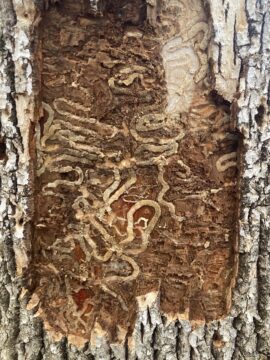
We recently found out we have new neighbors. Millions of them. I had seen signs in the blond appearance of the upper limbs of some trees on the other side of the field across from our Maine farmhouse. I have been waiting a long time for them to show up, so I tell my spouse I will be right back, cross the street with my jack knife in my pocket, and stroll to the other side of the pasture to check it out for myself.
I can still remember the phone call from my mother in Ohio about twenty years ago, when she told me the city had cut down the three white ash trees in front of the house where I grew up — along with all the ash trees in the city of Toledo. Those trees, standing on the grassy strip between the concrete sidewalk and the street, were important to my growing up. I had taken one of my first nature photographs in one of those trees when I was thirteen: I climbed up a tree and got a shot of two blurry blue eggs inside a stick cup. My first botany lesson was discovering that these trees of the genus Fraxinus are among the first deciduous trees to turn yellow in the fall and the last to bud out in the spring.
Toledo was near ground zero of the emerald ash borer infestation that took hold in the United States a little over twenty-five years ago. The beetle entered the country near Detroit, Michigan after having hitched a ride on some shipping pallets from somewhere in its native Asia. Agrilus planipennis is branded an invasive species, but it’s not their fault; they aren’t invading anything. They have been inadvertently introduced to a new hemisphere and are just embracing their Malthusian duty like any good species. There were many quarantines issued throughout several states in the Midwest and Eastern seaboard as the borer spread, county by county. These quarantines proved fruitless and have all since been lifted. “Let ‘er rip,” as the cynical expression has it. As if we have a choice in the matter.
I use my pocket knife to peel back the bark on a dead tree. I uncover abundant larval “galleries,” feeding trails that look like dune buggy tracks viewed from the sky. I snap a picture with my phone and take it back to the house to show my spouse. His response is just to squint at it in resigned silence.
In his seminal book Overshoot: The Ecological Basis of Revolutionary Change, American sociologist William R. Catton, Jr. describes “irruptions” as the rapid exponential increase of a population after it suddenly gains access to an abundance of the resources it requires, such as a whole new hemisphere of mixed hardwood forests.
Irruptions can happen to any species that gains access to a previously inaccessible but highly suitable habitat. All it takes is [. . .] for there to be little population-checking pressure from predators and little or no competition from other species having similar niche requirements and living in the same area.
Such times of population expansion into a new habitat are called “ecological exuberance,” and right now this little green beetle is as exuberant as a creature may be: It has fresh woods, eats well, and can make lots of predator-free beetle larvae. The ash trees in the borers’ native region — Mongolia, China and environs — coevolved with Agrilus for millions of years and have acquired resistance to the beetle’s depredations. There are also native birds and wasps in East Asia that like to dine on the larvae that live in the bark, so the species has a long history of being persecuted in its homeland. No wonder they like it here in North America, even in cold-ass Maine. (They can withstand temperatures down to -30°C!)
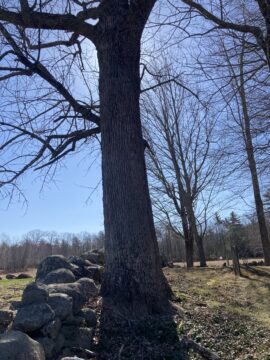
There are three huge ash trees nearby that I am going to try to save. I have ordered a quart bottle of emamectin benzoate (about 500 dollars’ worth) from an arborist supplies company and five tree injectors. Come late spring, when we have a sunny, breezy day and the ash trees are in full leaf, I will drill holes around the bases of these big old trees (the one pictured is 130 inches in circumference), one hole every six to eight inches, then I’ll insert injectors full of insecticide into the holes and allow the natural capillary action of the sapwood tissue to take it up into all the live portions of the tree. Having only five injectors, I’ll have to repeat the treatment several times around the tree. It’s systemic and works sort of like a fipronil flea-and-tick treatment for a cat or a dog. An adult beetle need only take one bite of a leaf, or a larva a single nip from the inner bark, and it’s curtains for them.
This does not mean we have found the cure for emerald ash borer infestation. Billions of trees are already dead. Whole woodlands are experiencing the big squeeze even as I write. We can only save a few favorite trees. It’s really just shoveling shit against the tide at this point.
In his essay “The Star Thrower,” anthropologist Loren Eiseley describes strolling along a beach early one morning and coming upon a man picking up a live starfish stranded on the sand and flinging it back into the sea. “It may live,” the man says to the incredulous Eiseley. He picks up another starfish and flings it. “One can help them.” Struck by the man’s compassion for life, rueing the pointlessness of saving beached starfish, Eiseley mutters, “I do not collect. Neither the living nor the dead. I gave it up a long time ago. Death is the only successful collector.”
*
Oral commentators like to accent their contempt for the ecological view of existence by referring to it as Malthooosian. “Everyone knows” that Thomas Robert Malthus‘s ideas have been debunked as backwards and racist. Such comments are baffling as it’s no secret that Malthus’s ideas were instrumental to Charles Darwin when he was formulating his theory of natural selection. And it wasn’t just Darwin: Alfred Russel Wallace, too — the co-discoverer of evolution by natural selection — experienced a similar epiphany upon reading Malthus. (Wallace never mentions Malthus in his early writings but claims much later to have been influenced by him.)
So what, exactly, does “Malthusian” mean?
That [human] population cannot increase without the means of Subsistence, is a proposition so evident, that it needs no illustration. […] That population does invariably increase, where there are the means of subsistence, the history of every people that have ever existed will abundantly prove.
I have inserted the word “human” to clarify that that was his focus in “An Essay on the Principle of Population” (1798). Furthermore:
. . . the power of population is indefinitely greater than the power in the earth to produce subsistence for man.
Therefore, as Malthus saw it, human “misery” — meaning repeated famines — was inevitable. Assisting the destitute (“Poor Laws”) only encouraged more reproduction and further misery down the line. He keenly recognized that the health of the state hinged directly on its ability to provide sustenance.
Over two hundred years later, it’s clear he overstated the inevitability of natural “checks” on human numbers: “Only” one billion people were alive on the planet at the time Malthus died in 1834; now there are over eight billion. Where did he go wrong? The answer lies in that phrase, “the power of the earth to produce subsistence for man,” which he claimed grew only geometrically while population grew exponentially.
Malthus barely lived to witness the industrial era. During his time, farming was still conducted on soils broken by iron plows drawn by teams of livestock. Fertilization consisted of animal manures and mined guanos spread on fields. That is what earth meant to Malthus — soils cultivated through human and animal labor, which raises the carrying capacity of a place to a degree, in order to sustain more people than it would naturally. But today, “earth” includes the finite deposits of fossilized plant matter that lie under the ground as well: coal, oil, and natural gas. Hence, Malthus’s earth no longer solely bears the burden of supporting human life: It is all buttressed with fossil fuels. Human “exuberance” now involves the whole surface of the planet, not just both hemispheres but its crust as well. This is carrying capacity on steroids.
There is no contemporary agriculture without the fossil fuels propping up the “four pillars of civilization,” as described by environmental scientist Vaclav Smil: “cement, steel, plastic, and ammonia.” There is no farming infrastructure without coal to kiln the cement and smelt the metals that make up that infrastructure; there is no farm machinery without diesel to mine the ores that make up that machinery and to run all those tractor and truck motors; there is no soil “fertility” (that is, ammonia) without the hydrogen stripped from natural gas molecules to fix atmospheric nitrogen through the Haber-Bosch process; there are no pesticides without petroleum-based chemical feedstocks; and no polyethylene row mulching, irrigation systems, refrigerated storage, greenhousing, or packaging without coal- and gas-fired electricity and oodles of petroleum-based plastics. It would seem the fire-bearing hominins who first left Africa about two million years ago have escaped those Malthusian natural checks on subsistence.
The problem is that people think the adjective “Malthusian” refers only to the apocalypse of human misery that he believed he foresaw, when it is more properly a description of things in the state of nature. We err to our own detriment when we pounce on where a thinker goes wrong while simultaneously ignoring where he is right. As it turns out, Malthus was more right than he could have ever imagined:
Among plants and animals the view of the subject is simple. They are all impelled by
a powerful instinct to the increase of their species; and this instinct is interrupted by
no reasoning, or doubts about providing for their offspring. Wherever therefore there
is liberty, the power of increase is exerted; and the superabundant effects are
repressed afterwards by want of room and nourishment, which is common to animals
and plants; and among animals by becoming the prey of others.
In one of the most important scientific papers ever published, appearing in Biological Journal of the Linnean Society in 1858, Darwin acknowledges his debt to Malthus (as well as to Swiss-French botanist De Candolle):
De Candolle, in an eloquent passage, has declared that all nature is at war, one organism with another, or with external nature. Seeing the contented face of nature, this may at first well be doubted; but reflection will inevitably prove it to be true. […] It is the doctrine of Malthus applied in most cases with tenfold force.
Darwin saw beyond Malthus’s mere human focus to recognize that high reproduction rates (“biotic potential,” as Catton calls it) is a general principle of all of nature’s offspring. (“Be extra-fruitful and multiply”!) Population pressures are great enough to outstrip sustaining resources, thereby ensuring competition among members, and it is this competition that leads to the sieving effect of selection. Malthus’s “doctrine” thus becomes the very spear point of the theory of evolution by natural selection. As Catton says, “The fact that evolution does operate shows that the Malthusian principle is valid.”
Sometimes the full biotic potential of a species is unleashed — that is “unchecked” — during an irruption. Such as when a little green beetle is introduced to a new, relatively predator-free region of the globe.
*
When I was ordering the emamectin benzoate pesticide and tree injectors over the phone, I was advised by the representative of the arborist supplies company to repeat the pesticide treatment in two years to keep the trees safe from re-invasion by beetles.
“How long will I have to keep doing it?” I asked.
“You have to keep treating as long as there are infested trees around,” the representative said. “The beetle won’t disappear until all the other trees in your area are dead.”
Until all the other trees are dead. The words still ring in my ears.
The emerald ash borers’ exuberant invasion is thus a self-terminating enterprise. That provides little solace to us tree-huggers in the meantime.
__________________________
Sources
References are all included in hyperlinks in the text.
Loren Eiseley’s essay has gone on to achieve the status of a parable in the popular imagination.
Images
All photographs by the author.
Enjoying the content on 3QD? Help keep us going by donating now.