
Category: Recommended Reading
Interview: Bilal Tanweer
Ollie Brock in Granta:

OB: You’re both a writer and a translator. Which came first? Do they exercise completely different parts of your brain, or is it similar work?
BT: Fiction writing came first, although it came very late – during the sophomore year of my undergraduate studies. I started translating even later, when I wanted to win a translation competition during my MFA at Columbia. Much to my surprise, I enjoyed it immensely and have been translating ever since. It also anchors me, keeps me thinking about words, writing and language.
For me, translating is very much like writing itself; and like every other translator, I also feel that literary translation is underrated and underappreciated (and underpaid) for the amount of imaginative and technical labour it requires. One has to make a lot of choices that are similar to writing fiction, and many that are specific to translation itself. On the whole, it could be as imaginative an enterprise as any other creative endeavour. William Weaver once used the metaphor of a performance for translation: you must act out the text in a different language. Ultimately, I feel every good translator is a writer first. Yes, translating can be tedious and oppressive if you don’t find some kind of personal affinity with the work you’re translating, or if you don’t believe in it. If you love the work, it’s like travelling to a new country with the person you love.
More here.
Thursday, January 27, 2011
Alan Page and Asad Raza Discuss the Art of Tino Sehgal
the skinny part of maryland

Some people live in Frostburg, the college town on the cold ridge that has a Main Street, an old movie theater, a coffee shop for professors and poets. Some live in the hard George’s Creek towns where the Scottish and German coal miners settled 150 years ago. They live in Ellerslie and Mount Savage and Midland and Lonaconing, where their last names are Sloan, Kitzmiller, Snyder, DeHaven. They live on the other side of Dan’s Mountain, in the big Potomac valley, in LaVale and Pinto and Bel Air, where we lived, in Cresaptown, where we lived for a little longer, and in Rawlings, where Mom and Dad built a house for us. A few live out east of Cumberland, on the edges of the great rolling forest there, in Flintstone and Little Orleans. Even fewer live in Oldtown, which used to have its own high school, the one that graduated a class of four the year I left for the big city. Some people live on the sides of those old hills, on Will’s Mountain, Irons Mountain, Dan’s Mountain, Polish Mountain, hillsides where the wind just goes and goes, where winter hangs on through Easter, through the start of baseball season, until you’re ready to scream, and where, when summer does come, it comes in easy and cool like a kiss on the cheek from your grandmother.
more from Seth Sawyers at The Morning News here.
The new neurosexism

Wandering wombs, an anatomically conferred destiny of penis envy and masochism, smaller brains, smaller frontal lobes, larger frontal lobes, right-hemisphere dominance, cross-hemisphere interaction, too much oestrogen, not enough testosterone – all have been invoked to explain why women are intellectually inferior to men, more emotional, less logical, better at asking for directions, worse at map reading, hopeless at maths and science, and ever so much better suited to jobs involving finger dexterity, nappies and dishes. Today we look back with amusement at the efforts of nineteenth-century scientists to weigh, cut, split or dissect brains in their pursuit of finding the precise anatomical reason for female inferiority. How much more scientific and unbiased we are today, we think, with our PET scans and fMRIs and sophisticated measurements of hormone levels. Today’s scientists would never commit such a methodological faux pas as failing to have a control group or knowing the sex of the brain they are dissecting – would they? Brain scans don’t lie – do they? Well, yes, they would and they do. As Cordelia Fine documents in Delusions of Gender, researchers change their focus, technology marches on, but sexism is eternal. Its latest incarnation is what she calls “neurosexism”, sexist bias disguised in the “neuroscientific finery” of claims about neurons, brains, hormones. Fine was spurred to write her critique, she says, when she found her son’s kindergarten teacher reading a book that claimed a young boy’s brain was incapable of forging the connection between emotion and language.
more from Carol Tavris at the TLS here.
‘Hosni Mubarak, the plane is waiting’
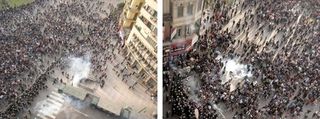
Egyptians have many grievances, with sectarian strife, police brutality, inflation and skyrocketing prices, and the vicious clampdowns by the government on any dissent topping that list. In the lead-up to last November’s parliamentary elections, press freedoms were curbed and dozens of opposition members were jailed. The elections themselves were widely seen as a sham, yielding a sweeping victory for president Hosni Mubarak’s ruling National Democratic Party. Then, on the eve of the New Year, a suicide bombing outside a church in Alexandria left twenty-two people dead and eighty injured.
The activists’ plan for January 25 was to send tens of thousands of Egyptians into the streets, and to have them stay there until Mubarak gave in to demands: justice, freedom, citizen rights, and an end to his thirty-year rule. The organizers—comprised, largely, of public university graduates in their twenties—had called on Cairenes to gather at several locations across the city, prepared for nights in the streets and armed with cameras—to document any police brutality, which has come to be expected at any public protest here.
To lobby support, the activists used Twitter and Facebook, targeting above all the 60 percent of Egypt’s 80 million people who are under the age of 25. A rap song was made and circulated, a video plea by the mother of the slain activist Khaled Said recorded, and Facebook groups formed to encourage people to join the protest.
On the 25th, I had made a plan with a journalist friend to head out early and stop by several of the designated protest locations—the Supreme Court, Cairo University, the popular Mustafa Mahmoud Mosque, and Shubra—before deciding where to go. Admittedly, we were skeptical. Just weeks before, in a similar call for demonstrations in Egypt in solidarity with the Tunisian uprising, I had arrived at a downtown square to find it barricaded by 200 shielded riot police. Inside were only nine protesters holding up three small banners.
But this time was different.
‘Mubarak, Your Plane is Waiting’

Mahmoud, my driver in Cairo when I reported from Egypt last year, didn’t talk much about politics, and – an understandable precaution – kept his views to himself unless he was asked a direct question. But when he dropped me off at the airport, he launched into a sharp attack on the Mubarak regime. ‘The Egyptians are a very patient people by nature, but their patience is running out,’ he said. ‘They could explode.’ (Once his calm returned, he begged me not to mention his name, which isn’t in fact Mahmoud.)
I thought Mahmoud’s warning was the sort of crystal-ball punditry you hear from taxi drivers throughout the developing world, where life continues to grind on as usual even though autocratic governance, corruption and poverty give people every reason to revolt. Leftist militants, reformist politicians, Muslim Brothers and human rights activists had been telling me for the previous two weeks that, for the moment, the regime had been reasonably successful in neutralising dissent, that Egyptians were too caught up in everyday worries to mobilise politically, and that the hopes raised by the Kifaya protests of 2005 had collapsed.
But that was before the murder of Khaled Said, a 28-year-old Alexandrian beaten to death last June by plainclothes officers for asking whether they had a warrant when they searched him. That was before the flagrant rigging of the parliamentary elections in December, which left the Muslim Brotherhood – the country’s largest opposition movement – without a single seat. That was before the New Year’s Day bombing of a Coptic church in Alexandria, in which 23 died, followed by the usual official claims that there are no sectarian tensions in Egypt. And that was before the popular uprising against the regime of Zine Ben-Ali in Tunisia.
Yesterday, tens of thousands of demonstrators – men and women, young and old, working and middle-class, religious and secular – took to the streets in a ‘Day of Rage’ protest against Mubarak, who has ruled the country since 1981. The protests weren’t restricted to Cairo: there were demonstrations in Alexandria, Suez and the Nile Delta village of Mahalla, a centre of labour insurgency in recent years.
Scientific American editors respond to Obama’s State of the Union address
Nabokov Theory on Butterfly Evolution Is Vindicated
Carl Zimmer in the New York Times:

Few professional lepidopterists took these ideas seriously during Nabokov’s lifetime. But in the years since his death in 1977, his scientific reputation has grown. And over the past 10 years, a team of scientists has been applying gene-sequencing technology to his hypothesis about how Polyommatus blues evolved. On Tuesday in the Proceedings of the Royal Society of London, they reported that Nabokov was absolutely right.
More here.
Slavoj Zizek: Living in the End Times
The Vilambit and the Drut
Anjum Altaf in The South Asian Idea:
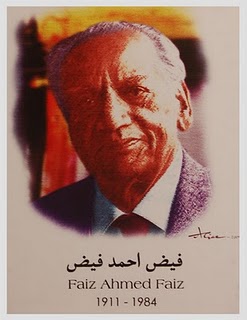
I belong to a group that exchanges thoughts on Urdu literature, and one topic of discussion has been the poet Faiz Ahmed Faiz, the difficulties of translating his work, and its place in the canon.
More here.
New Voices: announcing Bilal Tanweer
From Granta:
Granta is delighted to announce the next instalment in its New Voices series, which showcases short fiction from emerging writers exclusively on the website. The first New Voice of 2011 is Bilal Tanweer, with ‘After That, We Are Ignorant’. We chose the story for its captivating atmosphere and highly convincing voice, both of which are sustained with a rare confidence.
After That, We Are Ignorant

Hahaha! Whatshisname, Comrade, he turned red, even though technically that wasn’t possible because he was so dark, but oh, you should have seen his face – imagine a dry, savage brown flashing with colour! At first Comrade Sukhansaz didn’t reply, just turned his face and stared at the back of the seat. After a few moments, he began bumbling in a low voice. ‘In this country, everything is either Muslim or non-Muslim, everything, everything. Is your shoe Muslim? This cap, does it go to the mosque with you? Does your spoon and knife say their prayers on time? Everything, bloody everything is Muslim or non-Muslim! Is this colour a Muslim colour? And then no one can talk about religion … Names, now names are Muslims and non-Muslims!’
More here.
Apologies Fail to Live Up to Our Expectations
From Scientific American:

“The expectations for an apology to make us feel better and even forget about the bad things that have happened are overestimated,” says study co-author David De Cremer of the Rotterdam School of Management, Erasmus University. After having a wrong committed against them people who imagined receiving an apology were more satisfied than people who actually got one, the study found.
More here.
Vivek Menezes

 | Vivek Menezes is a widely published writer and photographer. He was born in Bombay, went to high school in New York, and holds degrees from Wesleyan University and the London School of Economics. Previous career highlights include driving the safari train at the Bronx Zoo, serving as Jacques Cousteau’s personal economic advisor, and building Sachin Tendulkar’s first official website. He lives in Goa with his wife and three sons. Email: vmingoa [at] gmail.com List of writings at 3QD, in reverse chronological order:
|
Wednesday, January 26, 2011
Edward B. Rackley
 | Trained as an academic philosopher, Ed works in conflict and post conflict countries, mostly in Africa. His work involves setting up emergency aid programs, running them, or evaluating them. He keeps a blog on issues related to whatever country he happens to be working in, called ‘Across the Divide: Analysis and Anecdote from Africa’. Blog: http://rackleyed.blogspot.com List of writings at 3QD, in reverse chronological order:
|
The Greek Engineer Who Invented the Steam Engine 2,000 Years Ago

Hero, or Heron, of Alexandria, on the other hand, had the astonishing bad taste to be born around 10 CE, which made his inventions so far ahead of their time that they could be of little practical use and, in time, were forgotten. If he had been born in, say, 1710, his engineering prowess and incredible creativity might have made him the richest person in the world. As it is, he'll just have to settle for the posthumous reputation of being the greatest inventor in human history. Seriously, unless you invent a warp drive tomorrow, there's no way you're catching up to Hero.
We know precious little about where Hero came from, and it's only in the last century that we actually became certain which century he lived in. The best guess is that he was an ethnic Greek born in Egypt in the early decades of the first century CE, one of the many people whose ancestors had emigrated from Greece after the conquests of Alexander the Great.
Hero probably taught at the Musaeum at Alexandria, an institution founded by the Greek rulers of Egypt – you can see an artist's conception of it above. The Musaeum was unlike anywhere else in the ancient Mediterranean, a gathering place for scholars and the sciences that would remain unique until the rise of universities centuries later.
But still, Hero doesn't really need a lengthy biography to explain why he's important – his inventions and theories do that quite well. His most famous achievement was a primitive steam engine, which was known as the aeolipile. Others before Hero had mentioned aeolipiles, but he was the first to actually describe in any sort of detail how to make one, and it's unclear whether his predecessors had actually been talking about the same device anyway.
RIP Daniel Bell, 1919-2011
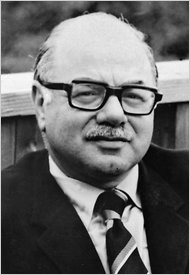
Mr. Bell’s output was prodigious and his range enormous. His major lines of inquiry included the failures of socialism in America, the exhaustion of modern culture and the transformation of capitalism from an industrial-based system to one built on consumerism.
But there was room in his mind for plenty of digressions. He wrote about the changing structure of organized crime and even the growing popularity of gangsta rap among white, middle-class, suburban youth.
Two of Mr. Bell’s books, “The End of Ideology” (1960) and the “Cultural Contradictions of Capitalism” (1978), were ranked among the 100 most influential books since World War II by The Times Literary Supplement in London. In titling “The End of Ideology” and another work, “The Coming of Post-Industrial Society” (1973), Mr. Bell coined terms that have entered common usage.
In “The End of Ideology” he contended — nearly three decades before the collapse of Communism — that ideologies that had once driven global politics were losing force and thus providing openings for newer galvanizing beliefs to gain toeholds. In “The Coming of Post-Industrial Society,” he foresaw the global spread of service-based economies as generators of capital and employment, supplanting those dominated by manufacturing or agriculture.
In Mr. Bell’s view, Western capitalism had come to rely on mass consumerism, acquisitiveness and widespread indebtedness, undermining the old Protestant ethic of thrift and modesty that writers like Max Weber and R.H. Tawney had long credited as the reasons for capitalism’s success.
He also predicted the rising importance of science-based industries and of new technical elites. Indeed, in 1967, he predicted something like the Internet, writing: “We will probably see a national information-computer-utility system, with tens of thousands of terminals in homes and offices ‘hooked’ into giant central computers providing library and information services, retail ordering and billing services, and the like.”
The Book of Destruction: Gaza – One year After the 2009 War
From The Guardian:

The award-winning Wiedenhöfer, whose exhibition moves to London this week, is not unaccustomed to such charges and finds them ridiculous. They first emerged in 2005 during discussions with Berlin's municipal authorities for a project – which never saw the light of day – involving affixing giant prints of Israel's West Bank separation wall on to what remains of the Berlin Wall. During talks, a local politician informed him that the panoramic images in his book, Wall, which were to be used for the project, were “antisemitic photography“. “I asked him to define antisemitic photography,” says Wiedenhöfer. “He replied that I had pictures in the book that showed Israeli soldiers being violent against Palestinians.” Sitting in his bare Berlin apartment, Wiedenhöfer is suddenly animated and goes to fetch a copy from his bookshelf. “I know every picture in this book. There is not a single image of an Israeli laying a thumb on a Palestinian. So I said, 'Show me!'” Wiedenhöfer flicks through the pages. “This is the only image of violence in the whole book – it's an Israeli soldier removing Israeli peace protesters.”
More here.
How words get the message across
From Nature:

Zipf believed that the relationship between word length and frequency of use stemmed from an impulse to minimize the time and effort needed for speaking and writing, as it means we use more short words than long ones. But Steven Piantadosi and colleagues at the Massachusetts Institute of Technology in Cambridge say that, to convey a given amount of information, it is more efficient to shorten the least informative — and therefore the most predictable — words, rather than the most frequent ones. Zipf's original association is roughly correct, as implied by how much more often 'a', 'the' and 'is' are used in English than, say, 'extraordinarily'. And this relationship of length to use seems to hold up in many languages. Because written and spoken length are generally similar, it applies to both speech and text.
More here.
How birds (and bird-watchers) compute the behavior of a flock on the wing
Brian Hayes in American Scientist:
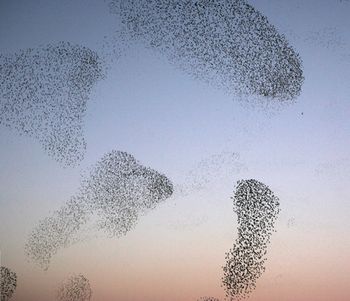
The graceful aerial displays of starlings and other flocking birds have long inspired admiration and wonder. Lately they have also inspired serious work in mathematics, computer science, physics and biology. A theoretical framework for explaining the behavior of tightly clustered flocks emerged in the 1980s. The key idea, which came from computer simulations, is that purely local interactions between nearby birds are enough to hold the group together. Similar mechanisms are thought to operate in schools of fish, herds of grazing animals, swarms of insects and even crowds of people.
More here.