
Paige Williams at The New Yorker:
 U.S. Steel mines iron ore in Minnesota and sends it across Lake Superior on freighters a thousand feet long. At Sault Ste. Marie, Michigan, the ships enter the Soo Locks, which provide passage to the lower Great Lakes. Five hundred billion dollars’ worth of ore (and ninety-five per cent of the United States’ supply) annually moves through the locks, which have been managed by the U.S. Army Corps of Engineers since 1881. The Minnesota ships travel the long, dangling length of Lake Michigan and dock at its southern tip: Gary, Indiana.
Two days after Christmas, a ship called the Presque Isle sat in the slip at U.S. Steel’s Gary Works, the largest integrated steel mill in North America. “Looks like it just came in—it’s riding low,” Daniel Killeen, the vice-president of Gary Works, told Eddie Melton, the mayor of Gary. Melton and I were in a company van, touring the steelyard—eternal mud, crisscrossed with the tire tracks of massive machines. We passed conical piles of raw materials—the plant uses manganese, limestone, sinter, coke—and neat stacks of the finished product, steel slabs. Each slab measures about nine inches thick, six feet wide, and thirty feet long, and can be heated to twenty-four hundred degrees and pressed like pasta dough to make panels that are used in automobile manufacturing.
more here.
Enjoying the content on 3QD? Help keep us going by donating now.
 O
O Shocking if not surprising investigations from the
  Sexual partners transfer their distinctive genital microbiome to each other during intercourse, a finding that could have implications for forensic investigations of sexual assault.
 The year 2014 was a heady moment in the economic policy world. That spring, French economist Thomas Piketty’s Capital in the Twenty-First Century was published in English to astounding commercial and intellectual
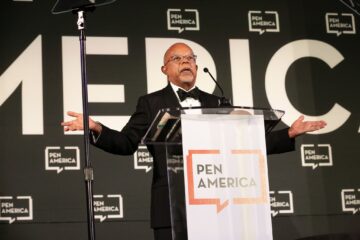 “The freedom to write”: PEN America’s
  Questions concerning the differences between Schelling’s and Hegel’s philosophical systems have always been of intense interest. This has been the case since Hegel decisively ended their friendship and collaboration by critically describing the early Schelling’s concept of the Absolute (the identity of identity and non-identity, or A=A [Dews, 75–76]) as the night “in which all cows are black” in the Phenomenology of Spirit in 1807 (Hegel 1977, 9, cf. Dews 75). Schelling’s Absolute, on Hegel’s account, was an abyss of darkness within which the dynamic development of real difference did not emerge. In contrast, Hegel thought his own dialectical system could lift difference out of the night, capturing the “reality of the finite” and the dynamic process of becoming (77). While Schelling quickly moved on from the “Identity System” in question, Hegel nevertheless remained an inescapable shadow haunting Schelling’s philosophical career.
 The further we get from Elvis Presley’s death, the more a crude music industry frame takes hold: the blinding flash of his Sun Records youth, the snowballing Hollywood banality, and the celebrity pill junkie slumped on his toilet, dead at 42. Praise Allah for recent documentaries like Elvis Presley: The Searcher (Thom Zimny, 2018), and the Reinventing Elvis: The ’68 Comeback (John Scheinfeld, 2023), where the performer’s radical charisma speaks for itself. In the same way that historic recreations always comment on their contemporary context, the Elvis Presley of Sun Studios and early RCA singles between 1954 and 1958 will always sound tantalizingly out of reach to 21st-century ears—another 80 years of laissez-faire racism will do that.
 The advent of advanced AI systems capable of generating academic text — including “chain-of-thought” large language models with test-time web access — is poised to significantly influence scholarly writing and publishing. This review discusses how academia, particularly in quantitative social science, should adjust over the next decade to AI-assisted or AI-written articles. We summarize the current capabilities of AI in academic writing (from drafting and citation support to idea generation), highlight emerging trends, and weigh advantages against risks such as misinformation, plagiarism, and ethical dilemmas. We then offer speculative predictions for the coming ten years, grounded in literature and present data on AI’s impact to date. An empirical analysis compiles real-world data illustrating AI’s growing footprint in research output. Finally, we provide policy and workflow recommendations for journals, peer reviewers, editors, and scholars, presented in an exhaustive table. Our aim is to inform a balanced approach to harnessing AI’s benefits in academic writing while safeguarding integrity