Category: Recommended Reading
current debates about aa and science
Meghan O'Gieblyn at The Point:
Alcoholics Anonymous is notoriously difficult to evaluate scientifically. Several observational studies have been quite favorable to the program—finding, for instance, that the longer people attend twelve-step meetings, the more likely they are to achieve long-term sobriety, or that engagement in meetings, as opposed to mere attendance, can be correlated with sobriety. But for many such studies are innately compromised by the fact that their members self-select. In The Sober Truth, Lance Dodes dismisses the observational studies wholesale. The kinds of people who go to AA—moreover, the ones who stick around—are those who find it useful. What about everyone else? To really understand the effectiveness of AA, Dodes suggests, we must consider everyone who walks into the rooms, including those reluctant attendees who sulk into the back rows of speaker meetings, nod off during the Serenity Prayer and never return. AA’s literature claims that those who fail to fully participate in the twelve steps tend to relapse, but for Dodes such warnings are little more than community propaganda, a way of blaming the participant when the program fails them. “Imagine if similar claims were made in defense of an ineffective antibiotic,” he writes.
As the comparison makes clear, Dodes conceives of AA as a “treatment” for alcoholism, a term that assumes patient passivity and is at odds with how members often describe the program—as a spiritual discipline that requires its participants to engage in a series of actions and rituals. Yet it is the discussion of attendance versus participation that lays the groundwork for Dodes’s conclusion about AA’s inefficacy. Citing data from the NIAAA that claims up to 31 percent of people who go to AA stick around for a year or more, Dodes then modifies those numbers to reflect attendance rather than involvement.
more here.
what is a robot, really?
Adrienne Lafrance at The Atlantic:
The year is 2016. Robots have infiltrated the human world. We built them, one by one, and now they are all around us. Soon there will be many more of them, working alone and in swarms. One is no larger than a single grain of rice, while another is larger than a prairie barn. These machines can be angular, flat, tubby, spindly, bulbous, and gangly. Not all of them have faces. Not all of them have bodies.
And yet they can do things once thought impossible for machine. They vacuum carpets, zip up winter coats, paint cars, organize warehouses, mix drinks, play beer pong, waltz across a school gymnasium, limp like wounded animals, write and publish stories, replicate abstract expressionist art, clean up nuclear waste, even dream.
Except, wait. Are these all really robots? What is a robot, anyway?
This has become an increasingly difficult question to answer. Yet it’s a crucial one. Ubiquitous computing and automation are occurring in tandem. Self-operating machines are permeating every dimension of society, so that humans find themselves interacting more frequently with robots than ever before—often without even realizing it. The human-machine relationship is rapidly evolving as a result. Humanity, and what it means to be a human, will be defined in part by the machines people design.
more here.
Israel: The Broken Silence
David Shulman at the NYRB:
Israeli human rights activists and what is left of the Israeli peace groups, including joint Israeli-Palestinian peace organizations, are under attack. In a sense, this is nothing very new; organizations such as B’Tselem, the most prominent and effective in the area of human rights, and Breaking the Silence, which specializes in soldiers’ firsthand testimony about what they have seen and done in the occupied territories and in Gaza, have always been anathema to the Israeli right, which regards them as treasonous.1 But open attacks on the Israeli left have now assumed a far more sinister and ruthless character; some of them are being played out in the interrogation rooms of Israeli prisons. Clearly, there is an ongoing coordinated campaign involving the government, members of the Knesset, the police, various semiautonomous right-wing groups, and the public media. Politically driven harassment, including violent and illegal arrest, interrogation, denial of legal support, virulent incitement, smear campaigns, even death threats issued by proxy—all this has become part of the repertoire of the far right, which dominates the present government and sets the tone for its policies.
There is now a palpable sense of danger, and also an accelerating decline into a situation of incipient everyday state terror. Palestinians have lived with the reality of state terror for decades—it is the very stuff of the occupation—but it has now seeped into the texture of life inside the Green Line, as many on the left have warned that it would. Israelis with a memory going back to the 1960s sometimes liken the current campaign to the violent actions of the extreme right in Greece before the colonels took power, as famously depicted in the still-canonical film Z.
more here.
Power of the pen: Scientists must unite to stop Turkey from removing the right to freedom of expression
From Nature:
When he labelled outspoken academics as terrorists, Turkey’s increasingly authoritarian President Recep Tayyip Erdoğan was probably not thinking of Voltaire’s eighteenth-century philosophical maxim: “To hold a pen is to be at war”. Erdoğan sent shivers down the spines of those who care about human rights by declaring on 14 March that those who support terrorists are as guilty as those “who pull the trigger”, and that Turkish law should be changed to reflect this. “The fact that an individual is a deputy, an academic, an author, a journalist or the director of an NGO does not change the fact that that person is a terrorist,” he said. One the same day, three academics from universities in Istanbul were hauled into police custody and then refused bail while prosecutors considered charges of making propaganda for a terrorist organization. Their crime? In January, they had signed a petition that called for an end to violence in the southeast of the country, where government forces have been fighting Kurdish separatists. The petition was signed by 1,128 academics, mostly from Turkish universities, when it was publicly launched on 11 January. It immediately sparked Erdoğan’s rage. Many politically appointed university rectors leapt into line, launching disciplinary investigations into members of their staff who had signed — more than 500 so far. Dozens of signatories were brought in for police questioning. The harsh response attracted a shocked solidarity. Another 1,000 people signed the petition, including a large number of Western scientists, before it was closed on 20 January.
An atmosphere of uncertainty and fear prevails. None of the signatories knows whether they, too, will be arrested, and several have had death threats. Some have actively sought sabbaticals abroad; those working outside the country are afraid to return even to visit family. Meanwhile, Turkey is playing a major part on the world political stage, in a role that is overshadowing the fate of the academics. Turkey is a geopolitical fulcrum. On one side it borders war-torn Middle East, on the other, strife-ridden Europe that is struggling to cope with the refugee crisis. When the country reached a historic agreement with the European Union last week to take back migrants who were crossing into Europe illegally, many in the EU complained bitterly about making a deal with Erdoğan because of his worrying human-rights record.
More here.
Wednesday, March 23, 2016
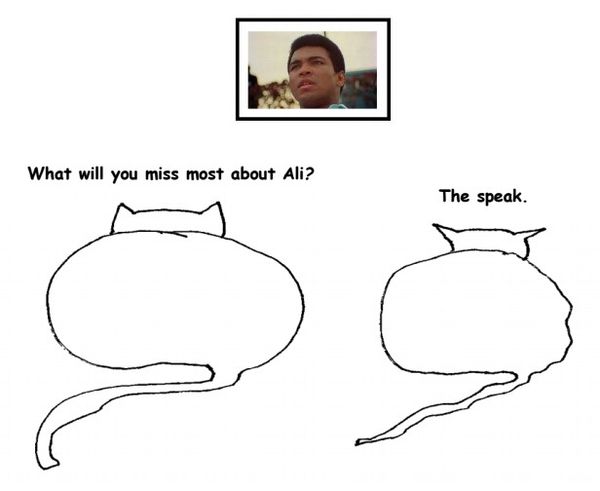
Blood Brothers: The Fatal Friendship Between Muhammad Ali and Malcolm X
Gordon Marino in the New York Times Book Review:
There is today a thriving industry of hagiography on Muhammad Ali. It is, however, not easy to explain how the Louisville Lip morphed from a blarney-filled boxer into a global symbol of racial pride and self-respect. According to Randy Roberts and Johnny Smith in “Blood Brothers,” the chrysalis was Ali’s intense but tragic friendship with Malcolm X.
As early as his high school years, Cassius Clay had been intrigued by the Nation of Islam. In 1962, the heavyweight contender traveled to Detroit to listen to the Nation’s “Supreme Minister,” Elijah Muhammad, and Malcolm X.
For African-Americans, the Nation represented a militant alternative to picket lines, fire hoses and attack dogs. Elijah Muhammad and Malcolm sneered at Martin Luther King’s strategy of nonviolence, supported segregation and declared that the white man was the Devil. How did this hostile-to-paranoid worldview attract the people-loving boxer who was bankrolled by a lily-white investment group?
More here.
How Do You Say “Life” in Physics? A new theory sheds light on the emergence of life’s complexity
Allison Eck in Nautilus:
Jeremy England is concerned about words—about what they mean, about the universes they contain. He avoids ones like “consciousness” and “information”; too loaded, he says. Too treacherous. When he’s searching for the right thing to say, his voice breaks a little, scattering across an octave or two before resuming a fluid sonority.
His caution is understandable. The 34-year-old assistant professor of physics at the Massachusetts Institute of Technology is the architect of a new theory called “dissipative adaptation,” which has helped to explain how complex, life-like function can self-organize and emerge from simpler things, including inanimate matter. This proposition has earned England a somewhat unwelcome nickname: the next Charles Darwin. But England’s story is just as much about language as it is about biology.
There are some 6,800 unique languages in use today. Not every word translates perfectly, and meaning sometimes falls through the cracks. For instance, there is no English translation for the Japanese wabi-sabi—the idea of finding beauty in imperfection—or for the German waldeinsamkeit, the feeling of being alone in the woods.
Different fields of science, too, are languages unto themselves, and scientific explanations are sometimes just translations. “Red,” for instance, is a translation of the phrase “620-750 nanometer wavelength.” “Temperature” is a translation of “the average speed of a group of particles.” The more complex a translation, the more meaning it imparts. “Gravity” means “the geometry of spacetime.”
What about life?
More here.
A man’s discovery of bones under his pub could forever change what we know about the Irish
Peter Whoriskey in the Washington Post:
Ten years ago, an Irish pub owner was clearing land for a driveway when his digging exposed an unusually large flat stone. The stone obscured a dark gap underneath. He grabbed a flashlight to peer in.
“I shot the torch in and saw the gentleman, well, his skull and bones,” Bertie Currie, the pub owner, said this week.
The remains of three humans, in fact, were found behind McCuaig’s Bar in County Antrim, Northern Ireland. And though police were called, it was not, as it turned out, a crime scene.
Instead, what Currie had stumbled over was an ancient burial that, after a recent DNA analysis, challenges the traditional centuries-old account of Irish origins.
More here.
Huw Price – What is Time?
In the Capital of Europe
Ian Buruma in The New York Review of Books:
Brussels has frequently had a bad press. Already in the 1860s, Baudelaire, who fled there from the French censors, called the Belgian capital “a ghost town, a mummy of a town, it smells of death, the Middle Ages, and tombs.” To a growing number of Europeans, “Brussels” is a byword for bureaucratic bullying by the so-called Eurocrats. Donald Trump called Brussels a “hellhole.” Perhaps he was thinking, if that is the right word, of Molenbeek. Densely populated by immigrants, mostly from North Africa, this district has become a symbol of seething European jihadism. Last year’s mass murders in Paris were apparently plotted there; the number of young men and women (around a hundred) who have left Molenbeek to fight for ISIS in Syria and Iraq is relatively high.
Still, much of the negative reputation of Brussels is undeserved and overblown. Brussels is not a dangerous city—not even Molenbeek, which is shabby, sullen (unemployment 30 percent), socially cut off, but not especially menacing. Many non-Muslim hipsters live there as well. Parts of Brussels are actually quite beautiful. The city has many fine examples of Art Nouveau and Art Deco, as well as the more famous sixteenth- and seventeenth-century gold-gabled buildings on the magnificent Grand Place. But Brussels is indeed rather chaotic, a political mess of nineteen different municipal districts, each with its own public authorities competing for funds, with an uncoordinated police force prone to conspicuous failures, and different political parties, linked to different language groups, operating their own more or less corrupt systems of patronage. Brussels, which has its own government, is mostly Francophone, but it is also the capital of Dutch-speaking Flanders and the capital of the European Union, whose own “Quartier Européen” is almost like a separate city within the city.
More here. (Note: Thanks to Asad Raza)
THE SUICIDE NOTE AS LITERARY GENRE
Dustin Illingworth at Literary Hub:
“Everything has gone for me but the certainty of your goodness. I can’t go on spoiling your life any longer. I don’t think two people could have been happier than we have been.” So ends Virginia Woolf’s poignant suicide note, addressed to her husband, Leonard Woolf. It is a throbbing document, hauntingly beautiful, in which a decision is made to part with a rote anguish. I’ve read it dozens of times over the years with fascination, even obsession. I picture her writing these final words in a thin ring of lamplight at a worn desk; walking deliberately down the road’s mellow dust; bending to fill her coat pockets with smooth river stones; the crisp blue cold of the Ouse biting at her ankles. But I always return to the contents of the note: the impossible task of a writer attempting to explain herself—to say goodbye to both a companion and an existence—with words grown suddenly insensate, rebellious. “You see I can’t even write this,” it reads at one point, a line that has always seemed, to me, the most tragic part of a tragic letter—that the mind capable of crafting To the Lighthouse should recoil at its own halting articulation.
This, then, is the morbid fascination of the literary suicide note: that it is, perforce, the final written work of the author in question. If we believe that writers possess a special relationship with language—one in which the incommunicable is somehow voiced—we might be forgiven our curiosity for what these moments of literary extremity are able to reveal of the inviolate mystery of death.
more here.
dance in detroit
Mark Stryker at The Detroit Free Press:
At first glance, Eastman Johnson's large-scale painting “Negro Life at the South” (1859) looks like a sentimental genre picture of a large group of slaves enjoying themselves outdoors at their urban quarters in Washington D.C., during the antebellum period.
A close reading of the painting, a key work in the Detroit Institute of Arts' exhibition “Dance! American Art 1830-1960,” reveals a complex symphony of subtext and symbols. In the center, a dancing boy holds the hands of his mother while a banjo player nearby provides the soundtrack: markers of the centrality of music and dance within African-American culture. Up above a woman and child peer out the window of the dilapidated shack, while back on the ground, a young man makes time with a light-skinned girl who coyly keeps her eyes down on her domestic work. Way off to the side, a privileged white woman in a pretty dress enters the frame, eavesdropping.
These and others in the painting connect to each other through fleeting looks and enigmatic stares. Myriad subtle skin tones among the slaves allude to the reality of forced miscegenation — rape. A ladder from the master's house to the roof of the slave dwelling suggests a passageway; a rooster and hen add other symbolic clues. Southerners seized on the pleasantries in the painting, rendered in soft-focused brushwork, as confirmation of their view that the impact of slavery was benign. Abolitionists, however, interpreted a very different meaning, one affirming their belief that slavery was evil.
more here.
‘Formalism and Historicity’, by Benjamin H. D. Buchloh
Graham Bader at Artforum:
ALMOST EXACTLY MIDWAY through his new collection of essays, Formalism and Historicity, Benjamin H. D. Buchloh quotes El Lissitzky’s late-1920s description of the revolutionary “demonstration rooms” for abstract art he’d designed earlier that decade in Dresden and Hannover, Germany:
Traditionally the viewer was lulled into passivity by the paintings on the walls. Our construction/design shall make the man active. . . . With each movement of the viewer in space the perception of the wall changes; what was white becomes black, and vice versa. Thus, as a result of human bodily motion, a perceptual dynamic is achieved. This play makes the viewer active.
Not just the literal midpoint of Buchloh’s book, Lissitzky’s passage can be understood to crystallize the volume’s analytical heart as well. For if the Russian describes a desire to awaken viewers’ critical capacities through his material reformulation of artistic work—moving from the production of discrete objects to integrated environments, following a paradigm not of static presentation but dynamic activation—so Buchloh has long sought to rouse his readers by articulating a model of historical inquiry driven by the twin engines of critical negativity and utopian anticipation, and motivated by a primary concern with the radically shifting conditions of possibility by which art in the modern period has been repeatedly redefined.
If the demonstration rooms proposed a fundamentally collaborative aesthetic model in which isolated authorship was rendered obsolete, so Formalism and Historicity departs from Buchloh’s 2000 essay collection, Neo-Avantgarde and Culture Industry: Essays on European and American Art from 1955 to 1975, in focusing not on individual makers but on historical repetitions (figuration, portraiture, the monochrome) and episodes (the development of Conceptual art and the interwar Soviet avant-garde, as well as the latter’s postwar reception) that cut across the span of twentieth-century art.
more here.
Controversial New Push to Tie Microbes to Alzheimer’s Disease
Melinda Wenner Moyer in Scientific American:
Scientists have long puzzled over the root causes of Alzheimer's disease, a devastating and typically fatal condition that currently denies more than five million Americans their cognition and memory. But in a provocative editorial soon to be published in the Journal of Alzheimer’s Disease, a cadre of scientists argue that the complex disease may have a surprisingly simple trigger: tiny brain-infecting microbes. This controversial view, which is not new, has long been dismissed as outlandish, but a growing body of work suggests it may be worth considering and further studying. If researchers can prove the theory and iron out the many argued-over details—both formidable tasks, as brain infections are difficult to study—Alzheimer's could become a preventable illness.
The editorial, signed by 31 scientists around the world, argues that in certain vulnerable individuals—such as those with the APOE ε4 gene variant, a known Alzheimer’s risk factor—common microbial infections can infect the aging brain and cause debilitating damage. These microbes may include herpes simplex virus 1 (HSV-1), the ubiquitous virus that causes cold sores as well as Chlamydophila pneumoniae and Borrelia burgdorferi, the bacteria that cause pneumonia and Lyme disease, respectively. The controversial idea butts heads with the long-standing theory that amyloid-beta proteins and tau tangles, both of which build up inside the brains of those with Alzheimer’s, are the main drivers of disease-induced cell death. Instead, supporters of the pathogen hypothesis, as it is called, posit that either pathogens induce brain cells to produce the amyloid proteins and tau tangles or that nerve cells that have been damaged by infection produce them as part of an immune response.
More here.
Tuesday, March 22, 2016
After Brussels: Once again thinking through terror
Kenan Malik in Pandaemonium:
‘Solidarity and anger. Those were my immediate emotions’. So I wrote last November after the Paris attacks: ‘Solidarity with the people of Paris, anger at the depraved, nihilistic savagery of the terrorists.’ My emotions are much the same after the savage attacks in Brussels this week. ‘But, beyond solidarity and anger,’, I observed in November, ‘we need also analysis.’ I have written much over the past few years about why conventional views about radicalization and the making of European jihadis are wrong. So here, some of the main themes of my articles on jihadism.
Terrorists often claim a political motive for their attacks. Commentators often try to rationalize such acts, suggesting that they are the inevitable result of a sense of injustice created by Western foreign policy or by anti-Muslim attitudes in the West. Yet most attacks have been not on political targets, but on cafes or trains or mosques. Such attacks are not about making a political point, or achieving a political goal – as were, for instance, IRA bombings in Britain in the 1970s and 1980s – but are expressions of nihilistic savagery, the aim of which is solely to create fear. This is not terrorism with a political aim, but terror as an end in itself.
More here.
LAWRENCE OSBORNE
Christopher Bollen in Interview:
Once, when I was feeling disenchanted with contemporary fiction and complaining that no one ever writes great books set in exciting foreign locales anymore, a friend suggested Lawrence Osborne. I can't remember who that friend is, but I owe her tremendous thanks. I dove headfirst into Osborne's 2012 Moroccan novel The Forgiven and was blown away not only by the jarring, mysterious story of careless Western vacationers caught in circumstances from which that they can't buy or talk their way free, but also by Osborne's wizardry with descriptions. He is almost unrivaled among living novelists in his ability to reanimate weather and nature-transforming sunsets, deserts, parties, and even the hands of locals into rare and ferocious marvels. Osborne's novels are full atmospheres, they continue to engulf as you read, and the worlds he creates never feel like creaking painted backdrops rolled out to separate scenes. He's often compared to Graham Greene, but I find him holding his own with Patricia Highsmith—the morality of his books are more ominous and shifting.
His latest novel, Hunters in the Dark (Hogarth), which arrived in the U.S. earlier this year, concerns a young British traveler who journeys over the boarder from Thailand into Cambodia. Flush with a win at a casino, Robert Grieve quickly falls into the passing hands of a wily American ex-pat, corrupt police officers, a beautiful young Cambodian student, and an opportunity to strip himself of his own past. It isn't so much a simple game of cat-and-mouse, as a ruthless and gorgeous chessboard. The dark history and deep humidity of Cambodia practically warps the pages.
More here.
Obama visits Cuba
More pictures here.
Earth to Economics: Welcome to Science 101
David Sloan Wilson in Evonomics:
I welcome the attention that Noah Smith has drawn to two “big think” pieces,one by Nick Hanauer and Eric Liu and the other by myself, which are both cut from the same broad cloth of evolutionary and complexity theory. Smith comes across as an open-minded skeptic. He likes some aspects and is unimpressed by others. Most of all, he insists on empiricism. Here is how he ends his critique.
“But I think that more important than any of these theoretical changes – or the evolutionary theory suggested by Wilson – is the empirical revolution in econ. Ten million cool theories are of little use beyond the “gee whiz” factor if you can’t pick between them. Until recently, econ was fairly bad about agreeing on rigorous ways to test theories against reality, so paradigms came and went like fashions and fads. Now that’s changing. To me, that seems like a much bigger deal than any new theory fad, because it offers us a chance to find enduringly reliable theories that won’t simply disappear when people get bored or political ideologies change.
So the shift to empiricism away from philosophy supersedes all other real and potential shifts in economic theory. Would-be econ revolutionaries absolutely need to get on board with the new empiricism, or else risk being left behind.”
I can’t help but remark on the irony of this stance. By Smith’s own account, the field of economics is experiencing an empirical revolution. Unlike the past, it has become necessary to test theories against reality. That places the field of economics many decades behind the field of evolution and numerous fields in the human social sciences that have been rigorously evidence-based all along. Earth to the economics profession: Welcome to Science 101!
More here.
HUMEYSHA’S VIDEO FOR “FOR LOVE, FROM THE LAW” IS ODD IN ALL THE RIGHT WAYS
the erotic modernism of Rut Hillarp
Saskia Vogel at Music and Literature:
When her debut novel Blood Eclipse arrived in the mail, I barely dared touch it. A slim, brittle volume from an antiquarian bookseller in Stockholm. One of two available for sale online. Self-published in 1951. Number 27 in an edition of 500, with one of 50 covers hand-painted by the author and signed to Nils Ferlin (the poet, I assume). It was love at first line. I let the sun burn my shoulders as I devoured her words on the balcony wearing white gloves, so as not to mar the stiff, yellowed pages.
The novel begins with a man’s reply to his female lover’s letter:
It’s true, I didn’t come. I never intended to.
And I can’t accept the discreet excuse you offered me in your letter.
I don’t believe you waited long enough for me . . . I asked for you to wait as a period of gestation during which your desires would consolidate, your emotions coagulate. Until now any man has been able to satisfy these desires in you, but after this waiting period, they will be devoted only to Man.
Because waiting shapes his story and gives him his reality . . .
Like hunger, waiting is creative. It rouses new senses and needs, and so it offers Man an infinitesimal keyboard and a palette with metaphysical resonance.
Waiting entices the desired man, and he comes more quickly when he is late than when he is on time.
It is tempting to make a case for Rut Hillarp as Sweden’s Anaïs Nin. In response to Anaïs Nin’s notoriety, she wondered in a 1951 letter if she too couldn’t do just as well. Indeed, they have a similar erotic project. Like Anaïs Nin, Rut Hillarp’s works trace a map of the psyche’s movements through love, lust, and desire.
more here.