Do You See What I See?
by Tim Sommers Children are natural philosophers. Some combination of imagination, maybe, and lack of knowledge. Philosophy is all theory and no data, after all. In any case, in my experience, one of the most popular philosophical puzzles among young people is this. When I look at something red, it looks red to me. But…
What if there’s Life on Mars?
by Tim Sommers Perseverance, the fifth NASA/JPL rover to land successfully on Mars, is currently looking for life there. What if it finds it? The discovery of life on Mars would provide evidence that life is ubiquitous and likely to arise spontaneously under moderately favorable circumstances. It would be evidence that life everywhere is very…
What Do You Call a Republican Who Smokes Pot?
by Tim Sommers A libertarian. Old joke. I mean, marijuana is not even illegal in a lot of states anymore. How about this one? A libertarian walks into a bear. Okay, that’s not really a joke. It’s the title of a recent book by Matthew Honogoltz-Hetling, subtitled “The Utopian Plot to Liberate an American Town…
Do you have a right to own a microwave oven?
The Falling Person
by Tim Sommers The Medieval Arabic philosopher Ibn Sina – Avicenna to Europeans – was rivaled in renown as a thinker in the Islamic world only by Al Farabi and hailed as “the leading eminent scholar” (ash-Shaykh ar-Ra¯sı ) of Islam. He worked in virtually every area of philosophy and science and influenced subsequent Jewish…
Cosmology for the Broken-Hearted
by Tim Sommers Cosmology is a young science. Maybe the youngest. Some people say it started in the 1920’s when these little glowing clouds visible at certain points in the sky were found, by better and better telescopes, to be composed of billions and billions of stars, just like our own galaxy – the Milky…
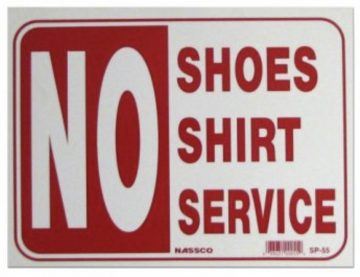
No Shoes. No Shirt. No Mask. No Service.
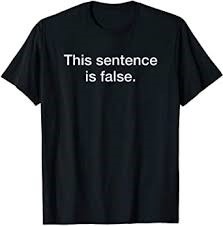
This sentence is false.
by Tim Sommers There’s something wrong with the sentence, “This sentence is false.” Is it true or false? Well, if it’s true, then it’s false. But then if it’s false, it’s true. And so on. This is the simplest, most straightforward version of the “Liar’s Paradox”. It’s at least two thousand five hundred years old…
Economic Inequality is Intrinsically Bad
by Tim Sommers In Democracy in America (1848), Alexis de Tocqueville concluded from his travels in the United States that “The particular and predominating fact peculiar to” this democratic age “is equality of conditions, and the chief passion which stirs men at such times is the love of this same equality.” Indeed, “The gradual progress of…
Kafka / ”After Hours”
by Tim Sommers In high school, I attended a “debate camp” at a small university in southeastern Missouri. I was thrilled to visit my first college bookstore while there and I bought a cheap, slender volume out of the remainders bin called “Parables and Paradoxes”. It was written by Franz Kafka. I am embarrassed to…
The Supreme Court is Right
by Tim Sommers Some good news, amongst all the bad this month. Our medieval Supreme Court took a break from being irredeemably awful to decide a case in the right way for the right reason. In Bostock v Clayton County, Georgia, Neil Gorsuch – yes, that Neil Gorsuch, the one nominated to the court by…
Against Contrarianism
by Tim Sommers Philosophy’s original contrarian hero was, of course, Socrates. He believed in Truth and the Good and refused to back down from the pursuit of the these – even when his life was on the line. He had no patience for ‘just whatever people tend to say about such and such’. The unexamined…
How to Avoid Paradoxes While Traveling Thru Time
by Tim Sommers Stuck inside? Unable to travel? Have you considered traveling through time instead of space? Time travel is impossible, you say? Wrong. We are, each and every one of us, time travelers, traveling forward second by second, hour by hour, day by day into the future. Why not consider traveling in the other…
Utopian AntiHierarchicalism
by Tim Sommers Suppose that we are better at recognizing and diagnosing injustices than we are at imagining what an ideal society looks like – much less redesigning our social institutions to achieve that ideal. Elizabeth Anderson, for one, has argued that egalitarians “have always been better at criticizing inequality than at devising a coherent…
Words of Wisdom for Troubled Times: Epictetus or Taylor Swift?
by Tim Sommers Here’s a story that is almost certainly not true, even though I have heard it many times. A philosopher, or anyway a philosophy professor, is on an airplane listening to a businessperson explain what they do. There’s a lull in which the businessperson asks, “By the way, what do you do?” “I’m…
The Unbelievable Moral Progress Game
by Tim Sommers So, here’s a game. Try to imagine: “What unbelievable moral achievements might humanity witness a century from now?” Now, discuss. “The trick, of course, is that if you can seriously contemplate its occurring, you are thinking too small, or so history suggest.” So says David Estlund who proposes “The Unbelievable Moral Progress…
This Title Only Appears to Convey Information
by Tim Sommers What if most speech is worthless? Or, rather, what if most speech that purports to count as a contribution to “free expression” is mostly worthless? Take the internet. What’s on it? Lots of great information and great journalism and even art. But, also, pornography. Lots of pornography. Between 15% and 80% of…
What Should the Distribution of Wealth be?
by Tim Sommers A 2011 survey by Michael Norton and Dan Ariely, of Harvard’s Business School, found that the average American thinks the richest 25% of Americans own 59% of the wealth, while the bottom fifth owns 9%. In fact, the richest 20% own 84% of the wealth, and the bottom 40% controls only 0.3%.…
Parallel Universes and Eternal Return Again
by Tim Sommers Suppose you had some undeniable proof of the Everettian or Many-Worlds Interpretation (MWI) of quantum mechanics. You would know, then, that there are very many, uncountably many, parallel worlds and that in very many of these there are many, many nearly identical versions of you – as well as many less-closely related…