‘A Condition for Survival’
by Jeroen Bouterse “For many years now a division has been established in our universities between the sciences and the humanities. This division is probably more absolute now than it has ever been before.”[1] Thus complains, in 1946, the British Marxist scientist John Desmond Bernal. It is a worry that seems to anticipate C.P. Snow’s…
“Oh, the humanities!”
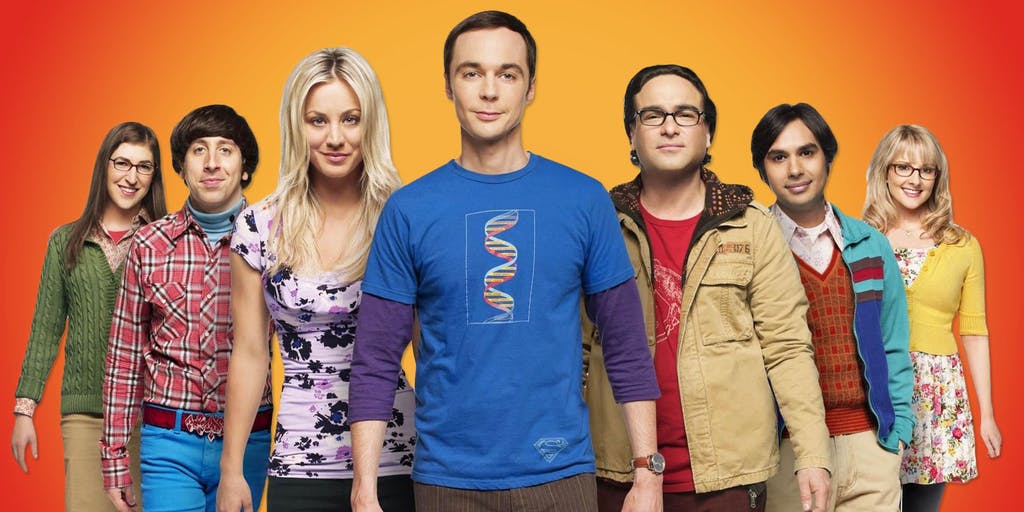
by Jeroen Bouterse The Big Bang Theory has been one of the most successful sitcoms in TV history. Last month it ended. In many ways, it ended a long way from where it had begun; many commentators have noticed how the show has evolved together with cultural norms in the past decade. Its first seasons…
On Visiting Max Weber’s Gravestone
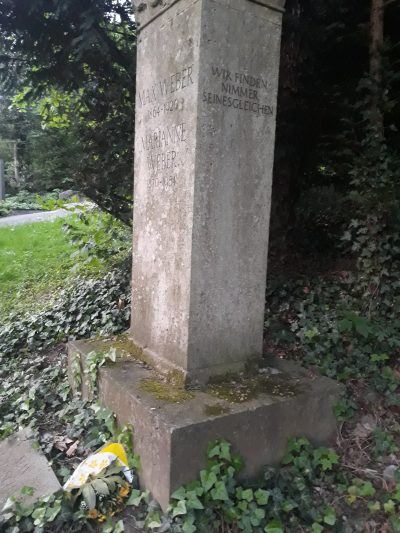
by Jeroen Bouterse In the school vacation, I finally decided to go on what is probably my only-ever academic pilgrimage: I visited Max Weber’s tombstone in the Bergfriedhof cemetery in Heidelberg. I had intended to go for some time. In my original plans, I’d go on foot (from the Netherlands) like a proper pilgrim, but…
Socrates and his Bones
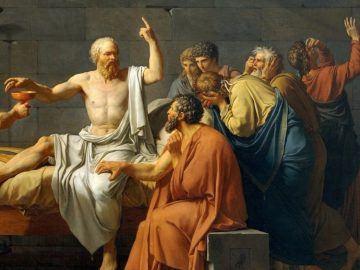
by Jeroen Bouterse When Socrates’ students enter his cell, in subdued spirits, their mentor has just been released from his shackles. After having his wife and baby sent away, Socrates spends some time sitting up on the bed, rubbing his leg, cheerfully remarking on how it feels much better now, after the pain. The Phaedo,…
Philosophy: A Dialogue
by Jeroen Bouterse “…And now to introduce our second panelist: Martha. Martha does believe that academic philosophy is worth pursuing, and she has – of course – written a book about it. Martha, can you briefly summarize your argument?” M: “Thank you. Yes, well, you can imagine that, though I told my publisher that my…
That Time Petrarch Yelled at a Doctor for Dozens of Pages
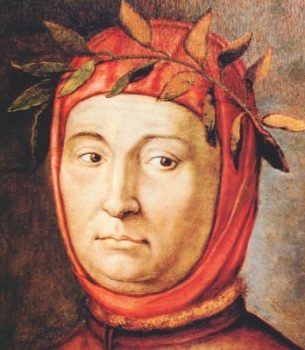
by Jeroen Bouterse I don’t know how much you know about Petrarch. My guess is that you know him as a poet, primarily for his sonnets. Maybe you associate him with early Italian humanism and its reinvigorated dedication to the wisdom of classical Antiquity. Or perhaps you think of him as someone who expressed transcendental…
Why Teach Math? Two Voices from the 1920s
by Jeroen Bouterse “Am I ever going to use this later?” As a math teacher, I seem to be getting this question about once a month (which is actually less frequently than I would have predicted). It is asked with varying degrees of openness to the idea that a satisfying reply is even conceivable, but…
n + 1 Types: Atheism and Historical Awareness
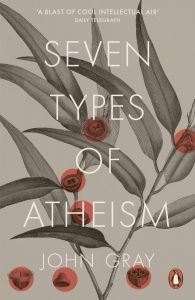
by Jeroen Bouterse It is simultaneously awkward and exciting to read about your own consciously and responsibly adopted beliefs as something to be anatomized. It is also something atheists are not always much disposed to. On the contrary, perhaps: many forms of atheism present themselves as a consequence of free thought, of emancipation from tradition.…
Sciences and Humanities: Moving on from the ‘Two Cultures’
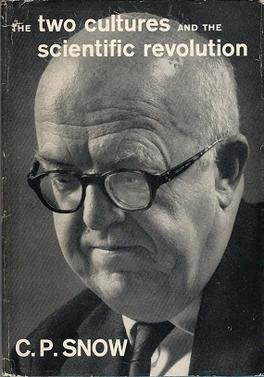
by Jeroen Bouterse It is a commonplace to say that a divide has occurred in modern academia between the sciences and the humanities. In the anglophone world, this diagnosis is often traced back to a lecture by the British scientist-novelist Charles Snow, who pointed out in 1959 what he saw as a lamentable gap between…
Bad Arguments On Bad Arguments: the Sokal Squared Hoax as an Unfortunate Cliché
by Jeroen Bouterse What do you prove by fooling somebody? What did Alan Sokal prove when he got his bogus paper on ‘quantum hermeneutics’ published in Social Text? What did Helen Pluckrose, James Lindsay and Peter Boghossian prove when they got several bogus papers published in several different journals? Earlier this month three authors (to…
History of Science and the ‘Conflict Thesis’
by Jeroen Bouterse One of the most simple, elegant and powerful formulations of the conflict between science and religion is the following bit of reasoning. ‘Faith’ is belief in the absence of evidence; science demands that beliefs are always grounded in evidence. Therefore, the two are mutually exclusive. This is an oft-repeated argument by modern…
Letters in the Age of Science: A 19th-century Case for Optimism
by Jeroen Bouterse The past years have seen many debates about the limits of science. These debates are often phrased in the terminology of scientism, or in the form of a question about the status of the humanities. Scientism is a notoriously vague term, and its vagueness can be put to the advantage of either…
A ‘Gulf of Misunderstanding’: Steven Pinker and the Two Cultures
by Jeroen Bouterse Steven Pinker’s 2018 book Enlightenment Now is a reasoned defense of the values of the Enlightenment: of reason, science, humanism and progress. Pinker uses most of his space to demonstrate, positively, how the attitudes and institutions associated with Enlightenment thought have done good in the world. However, he has also woven through…