
by Jim Hanas
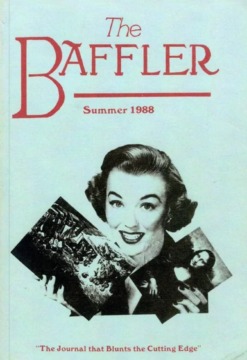
It is hard to overstate how moribund the leftist press was in the 1990s. Printed on rustic newsprint and bound with staples, magazines like The Nation and In These Times smelled of both patchouli and mothballs. The Berlin Wall had come down, a Democrat was in the White House, which had seemed impossible only a few years earlier. There was a budget surplus. Socialism was embarrassed to show its face. Political theorist Corey Robin recalls what a dead letter Marx was in those days:
When I was in graduate school in the 1990s, a fairly well-known Marxist political theorist at the Yale political science department said, ‘We don’t really read Marx anymore except for antiquarian purposes.’ There was this idea that the real questions of politics were questions of being and belonging—you know, nationalism, multiculturalism, recognition, and so on. That’s the environment in which I came intellectually of age.
This was also the age into which Thomas Frank and Keith White launched The Baffler. Though still publishing—and routinely grouped among other “little magazines”—the early Baffler was something else. In an era when the options were decaying Boomer rags that thought graphic design was bourgeois or the Day-Glo neo-Babbitry of Wired, The Baffler paved a third way based on a simple premise:
Business can never, ever be cool.
Not really. Because, I mean, of course it can, cool being a deeply secondary quality. It has clearly become so for a lot of people. But The Baffler knew, and clearly articulated—alongside alternative weeklies, various ’zines, and some early websites—that if business succeeded in being hip, the results would be both ridiculous and materially bad for a lot of Americans. Almost 40 years later—The Baffler launched in 1988—the results are in.
Frank returns to this story in his new book, The Creativity Con: How Innovation Became America’s Biggest Racket.
Most famous for his book What’s the Matter with Kansas?—has Kansas finally figured it out?—Frank has always been much more Mencken than Marcuse, reaching back before the Boomers to the populist and progressive traditions of the late 19th and early 20th centuries. This made him the right voice for a moment when Boomers were reinventing the ’60s counterculture as Silicon Valley libertarianism, when—as he and his fellow editors wrote at the time—“certain modes of cultural dissidence that arose in the Sixties are today indistinguishable from management theory.”
In his current book he retraces the incantations of “creativity” and “innovation” as magic words that justify anything, really, from the government-funded space race in the ’60s to the gutting of government in the ’80s. As he writes:
While others found creativity in artists, children, universities, and the counterculture, Reagan tended to locate it in one specific activity: business. Less than a month after his inauguration in 1981, for example, Reagan rolled out his signature tax-cut proposal. The official introduction to the initiative declared that it aimed to do nothing less than “rekindle the Nation’s entrepreneurial instincts and creativity.”
Creativity is a movable heist. And it didn’t even work, according to Frank. “I was born into a world of jet planes and classic rock—and I still inhabit a world of jet planes and classic rock,” he quips. This underplays, I think, the impact of the internet alone—for good or ill—but his larger point is well taken. Industrialization pulled a lot of people into the middle class, while post-industrialization has become synonymous with inequality.
In the second half of the book, Frank dives into the industries and cities that went all in on creativity, only to find them worse off, especially for those not in the creative class prioritized by influential business gurus like Richard Florida. “Creativity was a novel way of rationalizing elitism,” according to Frank. He continues:
In the past, ruling groups had been propped up by traditional hierarchies of race, blood, seniority, and social standing. But creativity was different: It was a critique of society, not a defense of it. It was not a conservative idea. It lifted up a cohort of talented people while simultaneously railing against conformity, the organization, mass-produced TV entertainment, and the canned architecture of suburbia. It extolled freedom and even rebellion; it demanded that we be allowed to actualize our individuality in a consumption-glutted, overorganized mass society; and it consciously fostered a new ruling class.
I am most certainly a member of this class. My first job in New York City was as the online editor of Ad Age’s Creativity, which covered the creative directors, directors, and production houses who make commercials. Still, it looks like The Paris Review compared to what passes for creativity coverage today. Even then, it was starting. “Media is the new creative,” the advertising business began telling itself in the ’00s, moving the locus of whatever creativity was left in the ad business away from the artists who were making ends meet—Spike Jonze, Michel Gondry, Errol Morris, and David Fincher among them—to the suits (now wearing quarter-zip pullovers) who cut deals with networks and platforms. And, of course, it got much worse. Frank devotes an entire chapter to the uses and abuses of “innovation” in the weapons industry.
Frank tries at various points to pin down exactly what creativity and innovation are supposed to mean in these contexts. He suggests “complexity” and “bullshit,” both of which are solid candidates, though I think they might be even emptier than that. Change, newness, or maybe just negation. They are fig leaves for the permanent revolution that consumer capitalism requires. As Frank points out, the lending practices that led to the 2008 financial crisis were both creative and innovative. It is as if yet another plank in the post-war consensus has been discovered to have been abandoned. You used to be able to be rich or hip, but never both, which produced something like a healthy separation of powers.
Flash forward. Socialism has its own Wired, to which Frank sometimes contributes, and the latter-day little magazines—n+1, The Drift, The Point, and The Baffler itself—are accused of cultural snobbery and creative class careerism. Wired meanwhile covers the launch party and later death of another useless AI assistant, of which, you can be sure, there will be many, many more.
Enjoying the content on 3QD? Help keep us going by donating now.