
by Ashutosh Jogalekar
Credit: Iowa State University
A cylinder of metal
In late September 1942, a chemist named Harley Wilhelm boarded the overnight train from Ames, Iowa, to Chicago carrying a small traveling bag. Inside lay a cylinder five inches long and two inches across. The cylinder was uranium. It weighed eleven pounds. Somewhere along the journey the bag gave way, and Wilhelm arrived at the University of Chicago with the metal clutched beneath his arm. It was the kind of minor indignity that rarely enters the histories of the atomic bomb.
At Chicago, Wilhelm found Frank Harold Spedding, the chemist directing the Metallurgical Laboratory’s chemical work. Together they presented the ingot to Arthur Compton, the Nobel laureate and head of the Met Lab charged with making a nuclear reactor work. Compton had never seen so much sound uranium in one piece; “I’ll bet there is a big shrinkage cavity inside”, he said with a twinkle in his eye. They sawed the metal open. Its interior was solid. The episode marked a turn: a material that had scarcely existed in observable quantities was becoming something one could hold in his hands and manufacture.
The usual geography of the Manhattan Project is littered with familiar landmarks: Chicago, Oak Ridge, Hanford, and of course, Los Alamos. Ames, Iowa, is harder to find. Yet without reliable, clean uranium metal, both Enrico Fermi’s experiments and the reactors built to make plutonium would have faced a severe materials bottleneck. Spedding occupies a footnote in standard project histories; he did not design the bomb or discover nuclear fission. But he did something without which the larger enterprise could not have proceeded on schedule: he assembled and directed an improbable university-based factory that made uranium metal reliably and helped teach American industry how to do the same.
The boy who distrusted an explanation
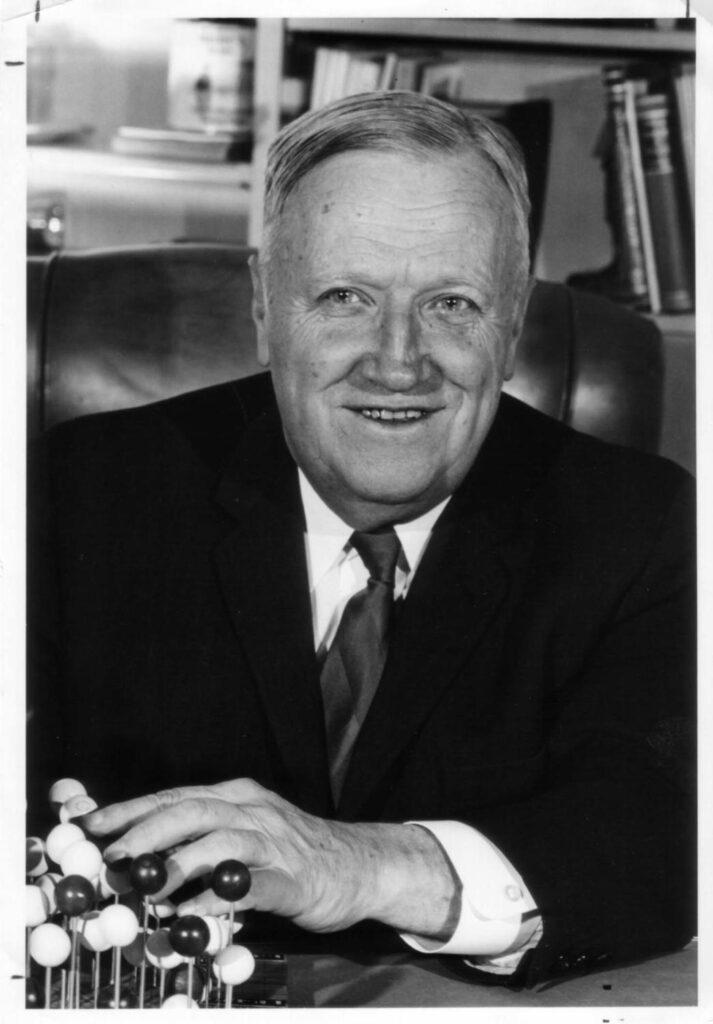
Frank Spedding was born on October 22, 1902, in Hamilton, Ontario, to Howard Leslie Spedding and Mary Ann Elizabeth Marshall Spedding. His family moved through southeastern Michigan and Chicago before settling in Ann Arbor in 1918, where his father established a photography business. The son entered the University of Michigan in 1920. He earned a bachelor’s degree in chemical engineering in 1925 and a master’s in analytical chemistry the following year. The combination gave him a practical acquaintance with metals and a chemist’s allergy toward impurities – two skills that would later turn out to be matters of national urgency.
One undergraduate incident exemplifies Spedding’s curiosity and willingness to question established wisdom. Spedding found the conventional explanation of how the six carbon atoms in benzene were held together unsatisfying. He sketched an alternative and took it to Moses Gomberg, the distinguished Michigan chemist. Gomberg told him, kindly enough, that he had reinvented a nineteenth-century structure proposed by another chemist. The proposal was not new, but the impulse was telling: the young man was unwilling to accept an attractive diagram merely because it was familiar. Gomberg helped him gain a place with Gilbert N. Lewis at Berkeley.
Lewis was then the dean of American chemists, a formidable chemical thinker and a pugnacious interlocutor, and Berkeley in the late 1920s was a center of the new physical chemistry. Lewis had pioneered theories of chemical bonding and acids and bases -now standard textbook concepts – and he was known both for his research acumen and his pedagogy. Spedding began probing the absorption spectra of rare-earth salts: obscure compounds whose elements were maddeningly hard to separate but whose sharp optical lines could reveal hidden order. He earned his doctorate in 1929. Working with Simon Freed and later Hans Bethe, he pursued the relationship between the shielded electrons of rare-earth ions, their surrounding crystal environments, and the light they absorbed. The research was specialized, even esoteric, but it taught him to look for decisive differences among substances that appeared almost identical.
The substances themselves were scarce. Spedding later said he had practically begged B. Smith Hopkins of Illinois for a few tenths of a gram of rare-earth salts. Those loans helped him make observations important enough to win the 1933 Langmuir Award, then a distinguished American prize for a young chemist. The recognition brought a gold medal and a thousand-dollar honorarium – a small fortune in Depression-era America. At the Chicago World’s Fair, where he was to explain his work, he briefly froze at the lectern, then recovered and gave his talk. What happened afterward would prove decisive for his future.
An elderly chemist with a white beard approached and offered Spedding pounds – not milligrams – of europium and samarium rare-earth compounds. Spedding doubted the stranger but responded politely. Soon a box arrived in California containing fruit jars of rare-earth oxides. The donor was Herbert McCoy, a retired University of Chicago chemist who had spent years separating such elements. McCoy’s generosity changed the scale of Spedding’s research; nine years later McCoy would help recommend him to Compton.
An uncertain start
Prizes did not immunize a young scientist against the Depression. Spedding’s years after Berkeley were a succession of temporary fellowships and precarious appointments. He recalled that Gilbert Lewis, once Spedding had won the thousand-dollar prize, cut his annual pay by five hundred dollars. Frank and Ethel Annie MacFarlane, whom Frank married in 1931 after meeting on a hiking trip, found inexpensive pleasure in camping and mountain climbing. A Guggenheim fellowship finally gave them a year abroad in 1934–35. To stretch the grant, they went to Europe the long way: across the Pacific aboard a Japanese liner, through Asian ports and the Suez route, reaching England after roughly four months. Spedding visited Cambridge and other European centers of physics, hearing scholars whose ideas were changing the understanding of matter.
Back in America there was still no secure position. In 1937, after a disappointment at Ohio State, the Speddings drove on to Iowa State College. The chemistry department offered Frank an assistant professorship. He had had enough temporary posts. He held out for an associate professorship with tenure, an audacious demand for a man without an alternative. The couple continued west toward Yellowstone while administrators deliberated. A telegram, its address garbled, finally reached them at the park: his terms had been accepted. Iowa would be Spedding’s professional home for the rest of his career.
There was little money for apparatus at Ames. Spedding fitted his program to what he could obtain, returning repeatedly to the miserable business of separating rare earths. Scrounging around for resources and equipment meant that Spedding could not easily publish world-class work, but it was precisely this forced habit – finding a useful method with imperfect equipment – that made him an unlikely but effective wartime organizer. He understood not only whether a reaction could occur, but what prevented a fragile laboratory result from becoming routine practice.
Two rooms in Chicago
By the winter of 1941–42, Compton’s Chicago group had to build a pile of uranium and graphite large and pure enough for neutrons to sustain their own multiplication. The difficulty was not merely finding uranium. Natural uranium metal was then an expensive rarity. The Smyth Report, issued just after the war, described the small experimental quantities made before 1942 and a commercial process at Westinghouse that had cost about one thousand dollars per pound. Even as Westinghouse improved its method, the engineering obstacles remained daunting.
Compton invited Spedding in February 1942 to organize the chemistry work. The invitation traced in part to his former benefactor McCoy’s recommendation. Spedding rapidly discovered that the space available to the chemists at Chicago was inadequate. Iowa State, meanwhile, had furnaces, a metallograph, technical colleagues, and students ready to work. He proposed to build a second center there while splitting his own week between Iowa and Chicago. The wartime Ames Project thus grew out of an expedient: use the tools already at hand, and do not wait for an ideal laboratory.
He enlisted Harley A. Wilhelm and I. B. Johns as senior associates and recruited colleagues and graduate students. Wilhelm, whose particular strength lay in metallurgy and practical experimentation, directed much of the critical uranium-production work. Wayne Keller and other Ames researchers contributed to the reduction studies, while C. F. Gray helped develop the casting. Spedding later regarded the chance to work with Wilhelm as a piece of extraordinary luck. The process that followed cannot fairly be credited to one man, even though Spedding supplied the leadership and held together the larger program.
The chemistry that held the project hostage
The basic chemistry of uranium purification hinges on the fact that uranium compounds can be made to part with their precious uranium by adding what chemists call a reductant. For instance, if you take uranium oxide ore and add an element like carbon in the form of graphite as a reductant to it, the carbon will strip away the oxygen atoms and leave behind pure uranium. The purity of this uranium is especially critical for a nuclear chain reaction. A chain reaction lives or dies by neutron economy. Every neutron absorbed by a contaminant is a neutron unavailable to make another uranium nucleus fission. The more uranium atoms there are around, the fewer neutrons are lost. Uranium oxide was part of the early experimental program, but because the oxygen in it was a neutron absorber, pure uranium metal was prized for the larger density of uranium atoms it put into a limited space. In addition, carbon could react with the uranium to form uranium carbides. Both the metal and the graphite used to purify it needed to be extraordinarily clean. The difficulty was that uranium is a chemically demanding metal: it takes up impurities, reacts with containers, and had almost no established large-scale manufacturing practice in the United States.
The Ames group first solved a casting problem. By controlling the interaction of molten uranium with graphite, Wilhelm and his coworkers learned to melt and shape larger pieces without excessive contamination. But a second obstacle remained. How could enough uranium be liberated from its compounds in the first place? Early attempts to reduce oxides gave unsatisfactory results or metal spoiled by carbon.
The breakthrough came with uranium tetrafluoride, a green uranium compound being produced for other parts of the atomic program. A small sample reached the Ames laboratory through Chicago. The team used it in a strongly heat-releasing metal-reduction reaction that would separate the uranium from the fluoride. Uranium collected as a heavy coherent mass, distinct from the fluoride residue, and could then be remelted and cast. Earlier chemists had explored related reactions, but the Ames achievement was to turn a promising chemical idea into a controlled, repeatable, high-quality production. It was the difference between invention and innovation.
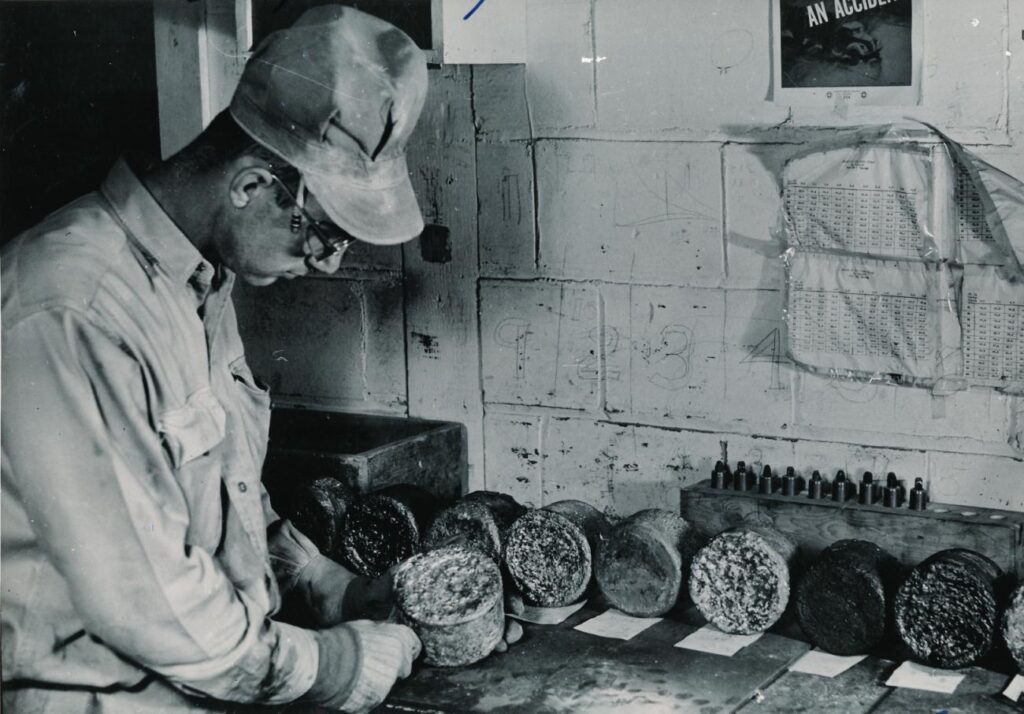
The reduction vessel was known as a “bomb,” in the older metallurgical sense of a strong container for a reaction; the term had nothing to do with a nuclear weapon. The engineering challenge lay in managing the vessel, the quality of feed material, and the finished metal through many successive charges. By late September 1942, enough uranium biscuits had been made for the eleven-pound demonstration ingot that Wilhelm carried to Chicago. In October the Ames operation was already reporting production on the scale of one hundred pounds per week.
What the pile required
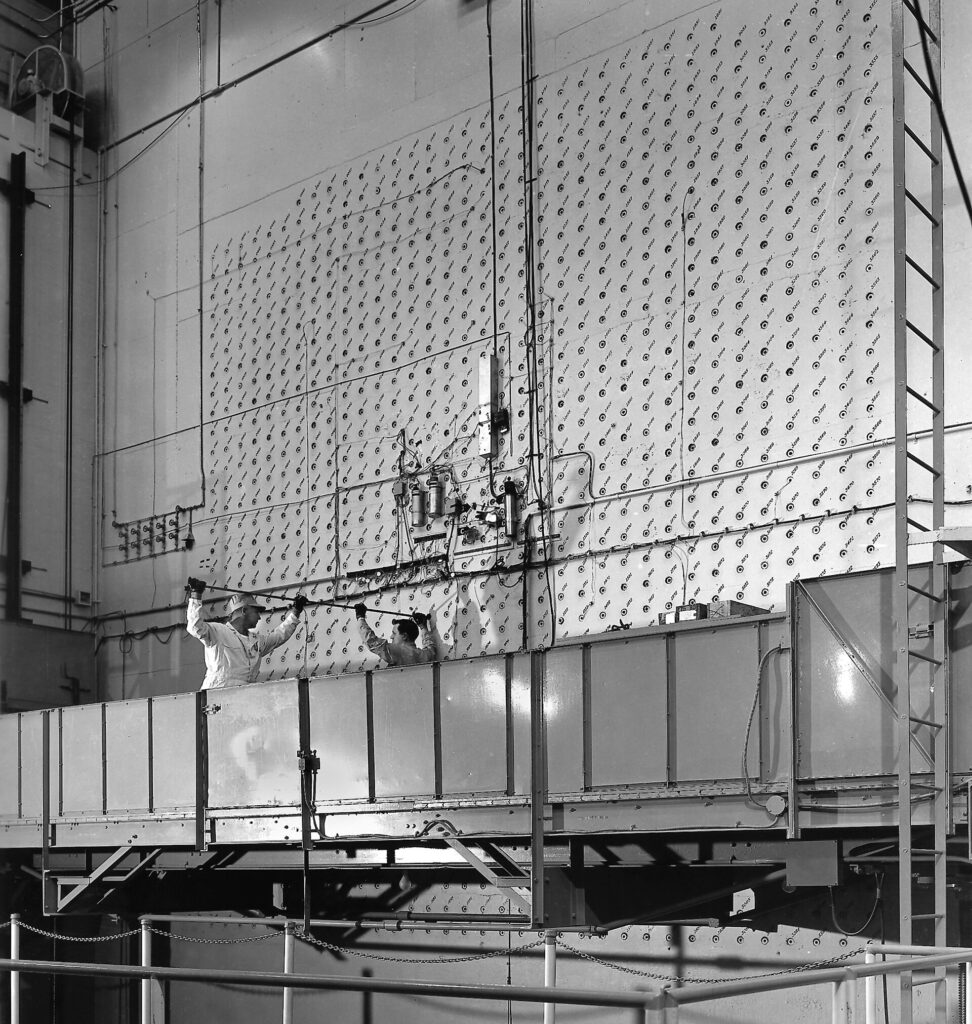
Fermi’s Chicago Pile-1 went critical under the stands of Stagg Field on December 2, 1942. Approximately six tons of uranium metal were included in the pile, along with much larger quantities of graphite and uranium oxide. By the end of November Ames had furnished about two tons of the metal, roughly a third of the total. The other metal came from Westinghouse and Metal Hydrides. Spedding was in Chicago for the experiment. The event is famous as an experimental triumph of Fermi and his fellow physicists, but it was equally a confirmation that several groups of chemists and metallurgists had made the reactor’s ingredients possible.
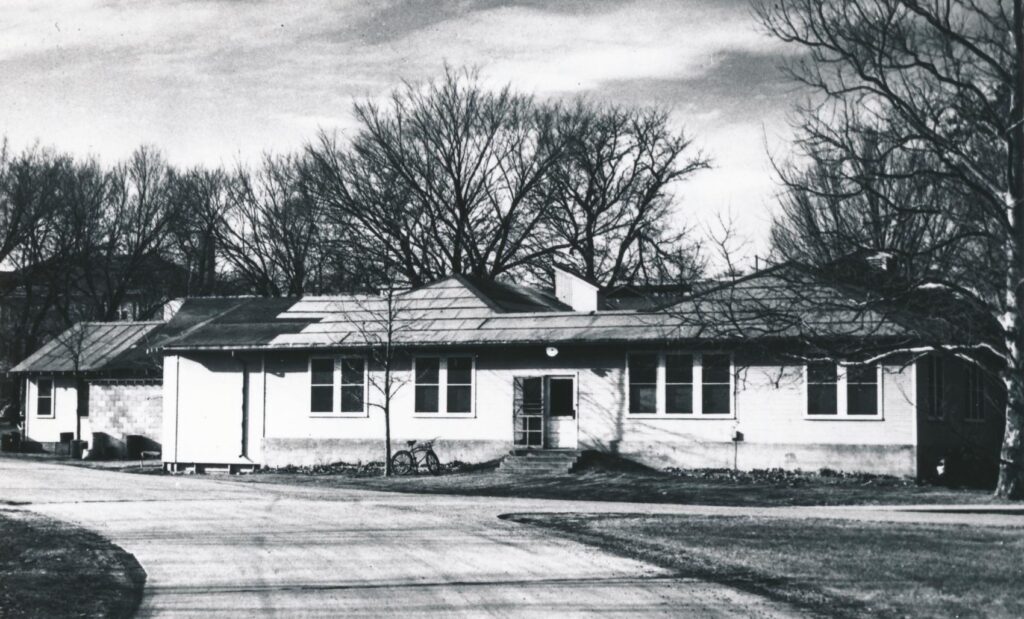
Success immediately enlarged the assignment. The experimental pile proved that controlled fission was possible; production reactors would need far more uranium. The government asked Ames to make what it could while industry learned the process. A temporary one-story campus building, called Little Ankeny or the Physical Chemistry Annex, became an around-the-clock uranium factory. It had previously served such prosaic uses as a garage and a popcorn laboratory. This was not the image of a university laboratory most Americans had in mind, but it functioned well as such. Sunday meetings acquired the nickname “Speddinars.” Spedding demanded long hours, partly on the argument that men deferred from military service owed an exceptional effort. He himself kept the pace.
Credit: Ames National Laboratory / U.S. Department of Energy.
The night shift had its hazards. Uranium is a pyrophoric metal; metal turnings and powder could spontaneously catch on fire. Reduction vessels sometimes failed. In one remembered incident a blast displaced part of an annex wall; workers promptly returned it to place before production resumed. A second comic moment arose from the sheer density of uranium: an express driver reportedly thought that a modest crate had been fastened to a desk because he could not lift it.
The secrecy could be equally absurd and comical. The project needed to ship large amounts of uranium turnings and residues for recovery. As a cheap mode of delivery, Wayne Keller suggested that they use a thousand bourbon barrels from his Kentucky hometown. The secretary typing the order mistakenly said it was for a thousand barrels of Hiram Walker Whiskey. Spedding was summoned by the purchasing agent of the college to explain; why was he ordering so much whiskey in Iowa, a dry state? Spedding straightened out the matter and reassured him that he only needed the barrels.
From campus process to industrial infrastructure
Metals are better reductants than carbon. The first successful Ames reductions used calcium to separate uranium from elements like oxygen and fluorine in its oxides and fluorides. During the winter of 1942–43 the team improved a magnesium version. The magnesium route was more economical and better suited to large-scale procurement, although it required further process development. Mallinckrodt, a division of Union Carbide, and DuPont sent technical personnel to learn the Ames method, then built their own operations. Industrial production began in the summer of 1943 and grew while Ames withdrew from routine reduction work. The university group did not merely give industry a reaction equation: it gave it a tested production system, one that linked feedstock preparation, metal recovery, casting, inspection, and waste reclamation.
The familiar claim that the Ames Project “made more than two million pounds of uranium” is broadly right. A federal occupational-history assessment records more than 1.4 million pounds of newly produced, or virgin, uranium metal. Historical research also identifies more than 600,000 pounds of uranium recovered from scrap, bringing combined metal throughput beyond two million pounds. The Ames process was widely credited with reducing the cost of producing uranium metal by a factor of twenty compared with earlier methods. The contemporaneous Smyth Report, published after the war, shows that Westinghouse, working in parallel, had already reduced its own cost from roughly one thousand dollars per pound to twenty-two dollars by November 1942. A detailed historical study of Ames contracts records further reductions. The larger conclusion is beyond dispute: uranium metal became far more affordable and available thanks to work done at Ames.
The end of the war
Ames’s most direct connection to the weapons of 1945 ran through the reactor program. Its contribution was particularly important at Oak Ridge, where the X-10 graphite reactor, which began operating in November 1943, received approximately 90 percent of its uranium from Ames. X-10 was the crucial intermediate step between Fermi’s experimental pile in Chicago and the enormous plutonium-production reactors being built at Hanford. Using uranium metal supplied largely by Ames, it demonstrated that a reactor could produce plutonium in useful quantities, while its adjoining chemical separation plant established how that plutonium could be recovered from irradiated uranium. These experiments supplied essential operating experience, chemical-processing methods, and material for weapons research at Los Alamos. Hanford then took the next step, translating the lessons of X-10 into industrial-scale plutonium production, using uranium manufactured in part through processes pioneered at Ames. The plutonium produced at Hanford fueled the Trinity test in July 1945 and the bomb dropped on Nagasaki on August 9. Hiroshima, struck three days earlier, followed a different route: enriched uranium produced principally at Oak Ridge. Ames had not manufactured the uranium at the heart of Little Boy, but its metallurgy had helped make the plutonium route to the bomb an industrial reality.
By the summer of 1945 the university’s great production rush was largely over. Industrial plants had assumed the main metal-reduction burden. At the time of the Japanese surrender, Spedding and his coworkers could see that what had begun as a hurried metallurgical improvisation had become an integral part of a national system of factories and laboratories. Recognition came on October 12, 1945, when the Ames Project received the Army-Navy E Award for wartime production excellence, an extraordinary distinction for a small college.
What Spedding felt on learning of Hiroshima and Nagasaki remains substantially undocumented. No contemporaneous diary passage or securely dated interview testimony has been identified in the research for this essay that describes his immediate reaction. His colleague and biographer John Corbett later reported that Spedding spoke often of the project but did not express regret about his part in it and inferred that he believed the work justified by the conditions of the war.
The elements after the bomb
Iowa State established an Institute for Atomic Research in 1945, and in 1947 the Atomic Energy Commission formally created Ames Laboratory with Spedding as director. The new institution retained the wartime habit of bringing chemists, physicists, and metallurgists together to solve difficult materials problems. Spedding returned to the rare earths that had once been almost impossible for him to obtain. His group, including Jack Powell and other coworkers, developed powerful ion-exchange separations, later improved with EDTA chemistry. By the 1950s it could supply high-purity rare-earth materials in quantities that made systematic scientific and industrial work possible.
Former students recalled an impatient, demanding but often generous investigator, famous for his cigar and his insistence on a physical understanding of results. A student once found him working on Sunday and heard him say he would rather “wear out than rust out.” Behind the authority was a man with a long-standing ulcer; when a student offered blood for a transfusion, Spedding recoiled at the idea that he might appear to be taking blood from his own students. The memories show both the intensity of the lab he built and the rough humor with which he managed it. He directed Ames Laboratory until 1968 and remained active in science afterward. A National Academy memoir credits him with about 260 scientific papers, 22 government-assigned patents, and the supervision of 88 doctoral students, an outstanding track record for a man who had started his career at a provincial college investigating obscure rare-earth elements. He was elected to the National Academy of Sciences in 1952. He died on December 15, 1984, aged eighty-two.
Through the Ames Project, Frank Spedding turned uranium from a scarce laboratory curiosity that could be produced in milligram amounts to a highly repeatable product of an industrial-scale process that could be manufactured at scale. As a young researcher he had almost knelt to borrow a few grains of rare-earth compounds. He had spent the Depression moving between uncertain jobs, accepting inadequate equipment and learning to wring useful information from it. Then a war forced the United States to make large quantities of a metal that had scarcely existed outside specialist laboratories, and in Spedding they found the right man for the job. A few months later, an eleven-pound uranium cylinder lay on a physicist’s desk in Chicago. The desk is not one of the famous sites of the Manhattan Project.
Photographic sources:
The following photographs are authentic archival images from institutional collections.
Figure 1. Frank H. Spedding, circa 1944. Credit: American Chemical Society / Ames Laboratory. Open photograph Collection page
Figure 2. The Little Ankeny building on the Iowa State campus. Credit: Ames National Laboratory / U.S. Department of Energy. Open photograph Collection page
Figure 3. Wartime uranium billets being inspected at Ames. Credit: Ames National Laboratory / U.S. Department of Energy. Open photograph Collection page
Figure 4. Ames Project directors and section chiefs, including Spedding and Wilhelm. Credit: Iowa State University Special Collections and University Archives. Open photograph Collection page
Figure 5. Spedding beside a periodic table, in his later career. Credit: Argonne National Laboratory. Open photograph Collection page
Use of AI tools: AI tools were used in parts of the research and writing for this article. Their main use was to consolidate a number of sources in one place.
Source notes
[1] John D. Corbett, “Frank Harold Spedding,” Biographical Memoirs, vol. 80 (National Academy of Sciences, 2001), pp. 301–322. Principal biographical source; also later colleague recollections and the assessment of Spedding’s attitude after 1945. Read source
[2] Harley A. Wilhelm, A History of Uranium Metal Production in America, Ames Laboratory report ISC-1076 (1958; second printing 1960). Technical retrospective by a principal process developer; particularly valuable for provenance, dates, experiments, and the ingot anecdote. Read source
[3] Henry DeWolf Smyth, Atomic Energy for Military Purposes (1945), chapter VI, §§6.10–6.18. Near-contemporary official summary of uranium-supply difficulties, competing processes, and Westinghouse costs. Read source
[4] American Chemical Society, “Ames Laboratory and Uranium Production in World War II,” National Historic Chemical Landmark (2022). Source for the widely quoted twentyfold cost comparison. Read source
[5] Ames National Laboratory, “Manhattan Project Roots.” Institutional account of Chicago Pile-1 contribution, Army-Navy E Award and subsequent laboratory. Read source
[6] NIOSH/ORAU, “Response to SC&A Review of the Ames Site Profile Regarding Uranium Internal Exposures,” 2015, pp. 5–7. Distinguishes virgin uranium production from scrap recovery. Read source
[7] C. S. Payne, The Ames Project (historical dissertation, Iowa State University), esp. pp. 48–85 and chapter on costs/contracts. Based on Ames Project archives, oral histories and institutional documents. Read source
[8] Joanne Abel Goldman, “Frank Spedding and the Ames Laboratory: The Development of a Science Manager,” Annals of Iowa 67 (2008): 51–81. Scholarly secondary study utilizing Spedding papers and interviews. Read source
[9] National Park Service, “Manhattan Project Science at Hanford.” For the relationship of reactor fuel to plutonium production and weapons. Read source
[10] Iowa State University Special Collections and University Archives, Ames Project historical photograph and archival collections guide. Read source
[11] “Atoms Amidst the Cornfields,” Iowa Heritage Illustrated (2014), historical feature with participant interviews and photographs. Read source