Jasmine Nackash at The Pudding:
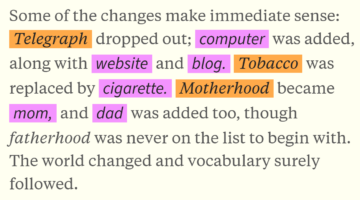 These “essential vocabulary” lists are called the General Service List (1953) and the New General Service List (2013, revised in 2023).
They were designed as teaching tools for people learning English as a second language, built from real-world usage data and extensively tested. The aim was a vocabulary list with as few words and as much coverage of everyday English usage. That coverage is high, over 90% for the 2023 list1 and about 84% for the 1953 list.2 To account for that much of the language, they had to track a significant portion of whatever people were actually reading and saying. A word earned its place by appearing often enough, across enough contexts, to be hard to avoid for the average person in an English-speaking society. Open the word lists panel on the right to browse through all the entries in both lists.
While these were practical tools, built to capture which words people need most, the answer also doubles as a snapshot of ordinary life, 70 years apart: what people were expected to engage with, and had to deal with, in their daily lives.
Treating the lists as an indirect record of day-to-day life, I went through the differences between them from a few angles: what the words were about, how tangible were they, and to which parts of speech they belonged.
More here.
Enjoying the content on 3QD? Help keep us going by donating now.