
by Charles Siegel
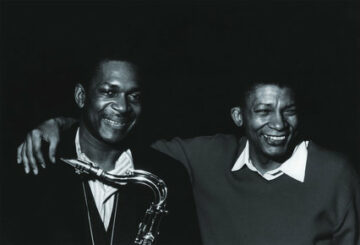
A couple of weeks ago, I was listening to the SiriusXM “Real Jazz” channel while driving. I had just pulled in to a grocery store parking lot, and was about to get out of the car, when the program host mentioned that they were celebrating John Coltrane’s 100th birthday, which was to occur on September 23rd. Then she played Coltrane’s version of “Lush Life,” which he recorded with singer Johnny Hartman, and I was transported, as I am every time I hear this recording. Even in a grocery store parking lot.
There isn’t anything I could possibly add to the many appraisals written for Coltrane’s centennial. Here are two good quotes I happened to catch: Ingrid Monson, a professor of African-American music at Harvard, said, “I would put it simply: There has never been a jazz artist more profound than John Coltrane, and that’s saying a lot.” And another saxophonist, Immanuel Wilkins, put it this way: Coltrane “shows you that more work actually gets us closer to the divine. He’s the North Star, for sure.”
As I said, I can’t add anything to the discourse about Coltrane’s legacy. I did write, a year ago, about the 65th anniversary of the Coltrane quartet’s recording of “My Favorite Things.” “Lush Life” is a different kind of experience, but just as sublime.
The song was written by Billy Strayhorn in the mid-1930s. Strayhorn is best known for his long collaboration with Duke Ellington; he wrote “Take the A-Train,” Ellington’s signature tune, and arranged or wrote music and lyrics for many other of his most well-known songs, such as “Satin Doll,” “Sophisticated Lady” and “Mood Indigo.” “Lush Life,” however, was written before Strayhorn began working with Ellington. In Ted Gioia’s excellent “The History of Jazz,” he writes that “Lush Life” was “the piece that caught Ellington’s attention” the night Strayhorn met Ellington when he played in Strayhorn’s hometown of Pittsburgh in 1938. After the show, Strayhorn played a few songs for Ellington.
“Lush Life” is like a jewel with many facets. But not a diamond — it’s something darker, like a ruby or a sapphire. Strayhorn famously composed it as a teenager, which is almost impossible to believe. He wrote both the music and the lyrics, either one of which would have counted as one of the great achievements of American music.
As for the music, it doesn’t sound like a typical jazz ballad, or even a typical jazz composition at all (if there is such a thing). Its chord progressions are unique, and it’s written in D♭. Gioia writes of its “yearning melody line” and its “sweeping harmonies more characteristic of classical music than of Tin Pan Alley.”
But the lyrics. Here they are in their jaded, weary, glorious entirety:
I used to visit all the very gay places
Those come-what-may places
Where one relaxes on the axis
Of the wheel of life
To get the feel of life
From jazz and cocktails
The girls I knew had sad and sullen gray faces
With distingué traces
That used to be there
You could see where
They’d been washed away
By too many through the day
Twelve o’clock tales
Then you came along
With your siren song
To tempt me to madness
I thought for awhile
That your poignant smile
Was tinged with the sadness
Of a great love for me
I guess I was wrong
Again, I was wrong
Life is lonely again
And only last year everything seemed so sure
Now life is awful again
A troughful of hearts could only be a bore
A week in Paris will ease the bite of it
All I care is to smile in spite of it
I’ll forget you I will
While yet you are still
Burning inside my brain
Romance is mush
Stifling those who strive
I’ll live a lush life
In some small dive
And there I’ll be
While I rot with the rest
Of those whose lives are lonely, too
How did a teenager — a teenager!—write this? For that matter, how could any lyricist, of any age, come up with the ruefully knowing “twelve o’clock tales” to rhyme with “cocktails”?
Coltrane recorded his quartet’s version with Hartman in 1963. I can’t find it anywhere online now, but I recall reading somewhere that Coltrane, or possibly Rudy van Gelder, the legendary producer/engineer, suggested the song to Hartman in the car on the way to the session. However it happened, this recording is one of the greatest of all time.
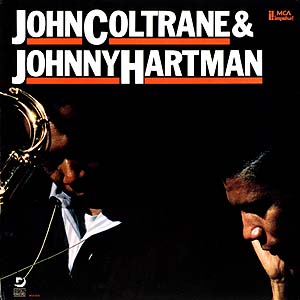
The quartet is almost the same as the group that had recorded “My Favorite Things” three years earlier: Coltrane, McCoy Tyner on piano, Jimmy Garrison on bass (Steve Davis had been on the “My Favorite Things” session) and Elvin Jones on drums. The take, https://www.youtube.com/watch?v=sgbLtG8PBv4&list=RDsgbLtG8PBv4&start_radio=1, starts out as a free ballad, with Hartman singing, in his inimitable warm, honeyed voice, over nothing but Tyner’s lovely chords and fills. Eventually we move into the C section of the form, starting with “Life is lonely again,” and the other instruments come in. Coltrane adds some low subtle phrases, curling inquisitively around the lyrics. Jones keeps a soft tempo with brushes. They go through to the end of the form, and return to the top for a Coltrane solo.
Jones now shifts into a spikier backing beat. The interplay between Coltrane and Tyner is just magical. This solo is unlike much of Coltrane’s playing — this is not the “sheets of sound” that he became so famous (or infamous) for. This is sprightly and romantic, but modest, playing, like a stream flowing among sun-dappled rocks.
Then, after just 75 seconds, the solo ends, and the band stops abruptly. Hartman comes back in at “Romance is mush.” He sings over quiet chords by Tyner, and those soft-again, low background notes from Coltrane.
Finally, they get to the last, desolate line: “And there I’ll be, while I rot with the rest, of those whose lives are lonely too.” Surprisingly, thrillingly, Hartman raises the pitch with each word, starting with “those,” and delivers a perfect high note on the last word, “too,” somewhere way up above all the others.
It’s just beautiful — pure, irreducible beauty. This isn’t one of Coltrane’s great, iconic songs, like “Giant Steps” or “A Love Supreme.” He didn’t write this song. And Hartman’s performance is just as essential a part of what makes this recording so transcendent. But surely this captivating five minutes and 30 seconds of music does get us a little closer to the divine.