
by Jim Hanas
 I met Derrida in Memphis in 1993. We were standing by a pool and he was smoking a cigar. I’m sure I was smoking a cigarette. I was twenty-four.
The encounter was brief, the pro forma handshake one could expect as a Ph.D. student at a state university that had lured such a luminary into the interior with a conference in his honor. He was the second most famous person I spoke to during the nine years I lived in Memphis. The most famous was Michael Jackson. (A story for another time.)
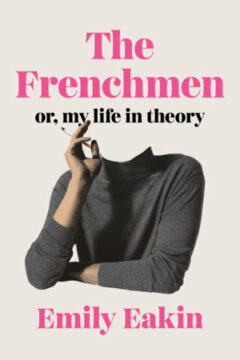
Like Emily Eakin, author of The Frenchmen: Or, My Life in Theory, I came of intellectual age in the late heyday—in America at least—of French theory, though from a slightly different vantage point. Far from the lit crit hothouses of the Ivy League—Eakin went to Harvard—I went to a state college where the philosophy department had as many LaRouchies as existentialists. Then I went to graduate school at what was then called Memphis State University (now the University of Memphis), which—the third year I was there—hosted a conference on “Derrida’s Interpretation of Husserl.” That’s where I met him, at a donor’s house near campus.
The event came two years after the publication of Strategies of Deconstruction: Derrida and the Myth of the Voice by American Husserlian J. Claude Evans, which caused a stir in my world, mirrored I’m sure in innumerable disciplines of the day as serious-minded scholars attempted to beat back the post-structuralist threat to their domains.
I understand exactly the thrill Eakin describes as French theory provided a new, often totalizing lens through which to see the world. Particularly thrilling was the insouciance with which Derrida flattened already flat-footed complainants like John Searle—himself defending his own sacred cow, J.L. Austin—in a book like Limited Inc, which I found to be every bit as hilarious as any Spy magazine takedown. Derrida was like the French knights in The Holy Grail, telling the stuffed shirts of Anglophone philosophy to run away lest he taunt them a second time.
Terry Eagleton notes in After Theory that there was a generation of liberal arts majors for whom The Order of Things was more exhilarating than any contemporary novel, and I was one of them. As an undergraduate, I boorishly read a paper on Foucault to an informal fiction writing group that met in my house. My formal literary ideal might still be Derrida’s first major publication, his introduction to Husserl’s short essay “Origin of Geometry,” which he translated into French. The introduction is not only filled with footnotes but is much longer than the essay it introduces. When Infinite Jest appeared, a footnote-laden tome written by a fan of set theory, I was ready.
That said, the world of theory Eakin describes was slightly different from the world I experienced, partly for institutional reasons. The vast majority of philosophy departments in America—and especially those at elite colleges—are analytically-oriented. Harvard’s department at the time would still have been dominated by the likes of John Rawls and Hilary Putnam. In such environments, theory became “lit crit,” housed in the departments of semiotics or “narratology,” a word I had not heard until reading Eakin’s book.
As Eakin well describes, this was done in an effort to place literary and cultural studies on a more rigorous basis, but—back in the philosophical hinterlands—these attempts already seemed faddish and unserious. There deconstruction lived in philosophy departments—usually boasting at least one prominent Heideggerian or post-Heideggerian—at schools like DePaul, Vanderbilt, SUNY Stony Brook, and Villanova. (At the latter, Pope Leo XIV—the “PoMo Pope”—took a class with John Caputo, a Derridean credited with pioneering post-modern Christianity. My socials are filled with memes about how the pontiff’s encyclical on AI reads like Baudrillard.)
And that is what brought Derrida to Memphis, where we were trying to get to the root of his thought, from the beginning, based not in transgressive figures like Bataille or Genet, but in an honest broker like Husserl, who started out as a logician, but wound up a proto-hauntologist.
Derrida and Foucault were philosophers, in other words, and should be treated as such. That there could be such a thing as deconstructive architecture seemed vaguely ridiculous. The MLA’s use and abuse of the term “deconstruction” was like Silicon Valley’s deployment of the term “disruption” two decades later. Opportunistic and suspect. Nothing more than marketing.
Eakin traces the history of that hype in a book that is equal parts introduction (or refresher course), group biography, and dishy exposé. The Frenchmen could serve as a complement to either Sarah Bakewell’s At the Existentialist Café or David Laskin’s Partisans, about the private lives of the New York intellectuals.
The picture that emerges is one of seductive ideas proposed by flawed men—the book dedicates significant attention to Barthes, Lacan, Althusser, Foucault, Derrida, and de Man—that gained purchase in young minds (Eakin’s included), peaked, faded, and have had an ambiguous afterlife in American culture. Eakin’s tone is abashed—how foolish we were!—apologetic, but in the end hopeful that theory contributed something positive to the world.
Theory certainly had its excesses. Decades later I readily admit that reading a Foucault paper in a writers’ group is pretentious and that I have very little idea what Baudrillard is talking about.
But I would argue that what the French theorists were getting at was both “real” and—perhaps most importantly—not theirs alone. The French theorists did not destroy stability, nor were they the first to describe its loss. They offered a description of an instability that was being independently reported elsewhere.
Analytic philosophy was simultaneously undergoing its so-called “linguistic turn” and developing theories that both pre-date and mirror those of the French theorists. Wittgenstein’s Philosophical Investigations appeared in 1953, destabilizing reference and dismissing the possibility of a total theory of language, as Derrida would ten years later. Thomas Kuhn’s The Structure of Scientific Revolutions, and its concept of incommensurable “paradigms,” rocked the idea of progress in 1962, eight years before Foucault’s “epistemes” landed in America with the 1970 translation of The Order of Things. I don’t say this to impugn the originality of the French theorists, but as corroboration, replicability being the measure of any theory. These parallels were hard enough to discern in American philosophy departments of the time, given the terminological walls erected between the so-called “continental” and “analytic” schools. That analytic philosophy even existed was likely a well-kept secret in lit crit departments of the day. Eakin, at least, never mentions it.
Whatever the cause—epistemic evolution, economic and social development, or the natural demise of empires—foundationalism unraveled throughout the twentieth century in a way the French theorists could not have caused, but for which they became easy scapegoats.
What, then, is the legacy of theory? At its best and most exhilarating, it was a key for seeing that things might be otherwise, that reality is malleable, an impulse to which the French—who gave us ’pataphysics, surrealism, and the exuberant carnival of May 1968—have given florid expression at least since their eponymous revolution. But, like that revolution, it couldn’t be sustained.
Rather than generating anti-essentialist fluidity, post-structuralism—by deconstructing master narratives—provided the opportunity and blueprint to create new ones, heedless of the fact that it was the form, not just the content, that was toxic (as we now say).
Theory thawed the glacier of Western thought, hoping to unleash a Heraclitean flux, only to see it refrozen into innumerable ice cubes. That risk was widely discussed at the time. Care was taken to not merely invert hierarchies or “reinscribe” essentialism, but it happened anyway, for entirely understandable reasons.
If it is difficult to think anti-foundationally, doing politics that way is practically impossible. As the feminist theorist Nancy Hartsock wrote in 1990, in a paper I vividly remember reading at the time:
Somehow it seems highly suspicious that it is at the precise moment when so many groups have been engaged in “nationalisms” which involve redefinitions of the marginalized Others that suspicions emerge about the nature of the “subject,” about the possibilities for a general theory which can describe the world, about historical “progress.” Why is it that just at the moment when so many of us who have been silenced begin to demand the right to name ourselves, to act as subjects rather than objects of history, that just then the concept of subjecthood becomes problematic? Just when we are forming our own theories about the world, uncertainty emerges about whether the world can be theorized. Just when we are talking about the changes we want, ideas of progress and the possibility of systematically and rationally organizing human society become dubious and suspect. Why is it only now that critiques are made of the will to power inherent in the effort to create theory? I contend that these intellectual moves are no accident (but no conspiracy either).
The abolition of the subject by male theorists looked like nothing so much as the victors pulling up the ladder behind them; industrialized countries going green and insisting that developing countries do the same.
That said, the long-term effects of leaving materiel on the field for further “nationalisms” are evident. It has fallen into all the wrong hands. The Dark Enlightenment’s articulation of “the Cathedral”—the totality of liberal thought—is little more than a vernacular fork of Foucault’s analysis of “power,” positing a pervasive but elusive force that controls (and conveniently explains) everything. As those like Eakin and me know, this can be an incredibly seductive way to think or—perhaps—not to.
Foucault won, but Derrida was right. If the former’s obsession was power, the latter’s was totality. Metaphysics, as he understood it, was the tendency to posit foundations, and deconstruction was aimed at demonstrating that these foundations were always a mirage. There was a method to his exasperating mode of presentation. His elusiveness—through which the same fundamental operation was constantly given new names—was an attempt to evade the millennia-old trap of foundationalism, which ends inevitably in catastrophe.
The project might simply be impossible. Foundational illusions are too compelling, too politically useful, the more so the more uncertain things become. And so, familiar ideologies reassemble themselves, confident in their claims to authority, to do battle once again.
Enjoying the content on 3QD? Help keep us going by donating now.