
by David Winner
Half a lifetime ago when I first got to New York, I saw a piece of performance art in Williamsburg at a place called The Bog. A young white woman dressed in some outlandish space-age smock (this was still the eighties) jumped menacingly up into the air, shouting, “oppressor,” then crumbled pathetically to the ground, shrieking, “oppressed” to try to interrogate that merciless duality.
Dario Soria, my great uncle, arguably exemplified both labels but never saw himself as either. An Italian Jew, he came to America in the late 1930s, fleeing the Mussolini/Hitler pact, but his move was always framed as American opportunity rather than European danger. The connections of his wealthy musical banking family (Mascagni, Giordano, and other verismo composers banking at the family bank near the Spanish Steps) indeed set him up in America, but Italian Jews were soon to be mortal danger back home.
Still, the whole clan appeared to have survived the Holocaust. The one family story that involved any danger was a comic anecdote about implicitly gay Uncle Arturo who, upon being arrested by the Fascist police, tried to send his manservant for his nightgown. The status of the Soria family in Italy may have felt compromised in Italy by the degree to which society had turned against them as Jews, an inconvenient truth that needed to be deleted from the narrative.
No doubt some embrace their status as victims, but sufferers of oppression can often be stigmatized. Holocaust survivors in Israel (The Seven Million by Tom Segev) were as likely scorned as celebrated. Which is really the thing about the proverbial playground. Kids spit upon those seen as pathetic, and what could be more pathetic than being sent to a concentration camp?
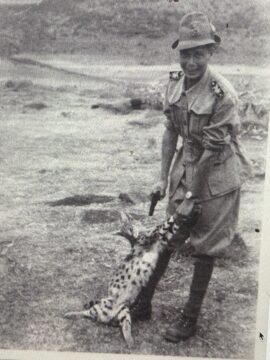
A decade or so before coming to America, Dario had been, along with many other Jews, an officer in the Italian Fascist army. A romantic family story made him an Alpino, serving adventurously in the Italian Alps, but after Dorle, Dario’s wife, died in 2001 and I got access to family mementos, I found a photo album depicting Dario’s time in Eritrea where Italians colonized and murdered countless Africans. Unable to defeat Ethiopia (from which Eritrea was not fully distinct) by conventional means, Mussolini massacred thousands near Addis Ababa, one of the first widespread examples of chemical warfare. But there was no more family discussion of colonialism than there had been about the Holocaust. Both “oppressor” and “oppressed” had been wiped from the story.
Ruben Gallego, the senator from Arizona, has argued that despite our awesome income gap, Democrats should not have pushed the idea of taxing the ultrawealthy nor laid the economic woes of the middle and working classes at their doorstep during 2024 election cycle. Voters, he argued, don’t wish to be viewed as victims who will be compensated if the rich are brought down to size. Rather than scorning them, they wish to join their ranks. They don’t want capitalism to be questioned but to have capitalism work for them, which they had imagined might happen in Trump’s pro-business America.
As America’s 250th summer draws to a close, we hear regret from some of the star progressives of the early 2020s – the passage from one political era to the next seeming to come faster and faster. AOC and others criticize ideas from “Woke 1.0” such as defunding the police or suggesting that God is non-binary as extreme and ill-conceived. Another notion, that Woke 1.0 overly stresses the victimhood of people of color, recalls the oppressed/oppressor excision from the Uncle Dario family story.
Except for on occasion listening to non-Jews stumble awkwardly around questions of Jewishness, I can’t conceive of what it might be like to be a person of color listening to white people talk about race.
Though something like it comes into play in my college classrooms in Jersey City, New Jersey, a working-class community with many Black American students. While many students are knowledgeable about history, more so than I am, others can be victims of inadequate high school curricula. For years, Jersey City public schools taught their students about the Holocaust without addressing basic Black American history, leading some Black students to be more familiar with Hitler and Dachau than Fredrick Douglas or Harriet Tubman. Assigning works by Black writers and leaders (Morrison, Baldwin, MLK, Ta-Nehisi Coates) which reference that history has let me into tricky territory as a white instructor, talking to Black students about Black history. When I’ve found myself trying to explain how Black people were sold down the river after reconstruction, a history that I only became aware of not so many years ago after reading a biography of W.E.B Du Bois, I got a bad taste in my mouth as if I were trying to be a white savior. “Look at all this shit,” I felt as if I were telling Black students, “Look what they/we did to you!”
Which is obviously problematic because our historic experience of oppression is a private emotional concern, not something that everyone is going to want to discuss with outsiders. And my students may have something in common with the mostly white voters that Gallego discussed. They may want to be given the tools to earn money, status and success rather than being confronted with what happened to their ancestors.
Years ago, a friend, a white man, bewailed what he felt to be Black comedians’ racial anger, but I’ve never heard a Black comedian express animus towards white people at all commensurate with the Black experience of oppression in America.
A common rightwing trope suggests that people of color relish victimhood. Larry Elderly actually used the term “viticrat” to describe them while Candace Owens has claimed people of color like “to opt in to the perpetual victim mentality.” Uncle Dario and his Italian Jewish family, a century ago, may be far more typical. Despite the horrors of the past, many don’t want to be seen as either oppressed or oppressors as they try to navigate their lives as best they can from day to day. Which is something to keep in mind as we try to win back our country from those who have taken it from us. I don’t think we have a good track record trying to convince people that they are victims or victimizers if they don’t already frame their reality in those terms. Despite the terrific weight of historical oppression, such rhetoric can fall on deaf ears.