
by Anton Cebalo
I recently came back from a trip through a few cities along the Adriatic Sea after visiting my extended family. My reason for traveling was mostly to alleviate my own stuckness, and what better way than by movement with no specific plans in particular.
My short journey started in Split, Croatia, continuing on the Adriatic Highway constructed during the time of Yugoslavia. We passed along the coastline protected by the Velebit mountains, a passageway mostly barren due to the harsh bora winds which prevented most vegetation, but nonetheless still beautiful. As we cut through sharp, narrow roads and blind turns that felt as though we would tumble down into the sea, enough to make anyone a little nauseous, the islands in view were pure white stone, made alien by those same bora winds. The topography resembled the moon’s surface.
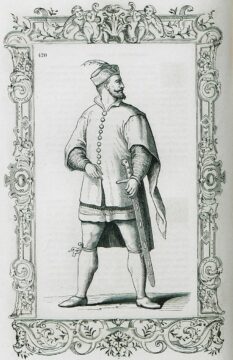
During the eight-hour ride, we went through villages that were at one time under the Venetian Empire. Only geography ensured they were not back then occupied by the competing Ottoman or Austro-Hungarian empires who were not many kilometers away in the interior.
Some regions are so determined by the realities of the land that it decides the trajectory of their whole history. This is one of those regions. The impenetrable mountains hugging the coast meant that there were only a set number of gateways allowing people to go inland. These were like portals between one imperial world to another, once heavily guarded as places of commerce and even as a way to escape. The settlement of Senj was one such guardian—the home of the ruthless guerrilla soldiers, the “Uskoks” or “the ones who ambush”—and we passed through their city on our route.
Eventually we arrived at Rijeka, and after enjoying myself for two days, took a bus through the lush rolling hills of the Slovenian region of Inner Carniola. We arrived at Trieste, Italy, which spawned like a grey, concrete apparition against the backdrop of greenery. Trieste was an in-between port city pulled by various states and empires all the same. It was the home of writer Italo Svevo who, too, was caught in his own in-betweenness and wrote the memoir Zeno’s Conscience (1923) about a fictionalized character’s neurosis (which I wrote about in a previous post). Joyce also wrote much of Ulysses in Trieste, furthering his fragmented stream-of-consciousness style during his time here, and was Svevo’s close friend.
The next stop by train was Venice, which I had never visited before and recalled some ideas that had been circling in my head ever since I read urban planner Christopher Alexander’s work, especially A City Is Not a Tree (1965). Rijeka, Trieste, and Venice all share a wholeness in their urban planning made possible by the slow accumulation over centuries. Alexander specifically points out that the main Piazza San Marco in Venice is one example of a structure that strengthened itself over a millennium. This is because the piazza had not cut its roots but added atop them.
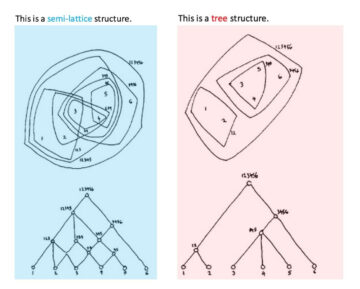 In Alexander’s mind, Venice is an organic city in contrast to planned cities where each part is defined by function (working, senior homes, shopping, and so on). Organic cities possess overlap among their many different parts and are hence conducive to life. Alexander likens a planned city to a “tree-like” structure with branches going off into largely separate worlds; and an organic city is a semilattice in shape, coming together in a complex web that allows for random emergence in all spheres of life, as the illustration to the right shows.
The issue is, our brains have a difficult time imagining a semilattice structure, so to build one from top-down planning is near-impossible. Whenever it needs to, the mind naturally understands the world as a tree and assigns meaning to each part. But that’s not how life is actually lived. Scientific studies have only recently started to validate Alexander’s idea that organic cities that resemble a semilattice have a higher quality of life.
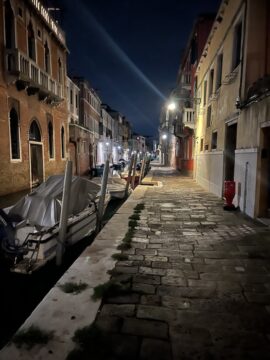
Luckily, the brief time I spent in Venice was when peak tourism was petering out. The connecting web of side streets and bridges in Venice resembled something of a living mind, and walking through them felt like an antidote to life online that so often resembles walking in circles in closed rooms not of your choosing.
Let’s say strolling in Venice is relaxing for the brain because it’s structured something like a healthy brain. And I can only think of the people who lived here before its native peoples declined due to tourism (the population of real Venetians has unfortunately fallen)—how remembering every hidden street and address must have animated your mental acuity. Then you had to also venture out with ships on the open seas, only to return and recall it all over again, like a lifelong test of your faculties. Such experiences are best remembered while walking around Venice at night when the quiet is twilight and still.