
Andrew Robinson in Nature:
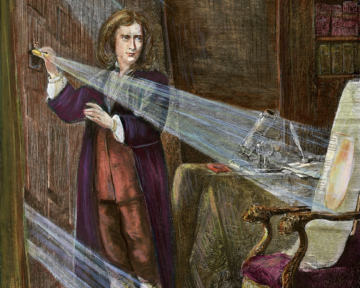 In 1665–66, during the Great Plague, Newton made three breakthroughs while working mostly alone at his birthplace and home, Woolsthorpe Manor near Grantham, UK. The house is north of Cambridge, where he was then a student at the university.
In mathematics, he laid the foundations for differential and integral calculus to solve complex problems in motion and geometry. In physics, after observing an apple fall from a tree, he deduced that the same invisible force that pulls objects to Earth governs the orbit of the Moon: an idea that he later used to formulate his gravitational law. And in optics, he performed experiments with a glass prism in a darkened room, and showed that white light consists of the colours of the rainbow.
But this remarkable year occurred well before he had accumulated ten years of study in maths or physics. The authors found no reliable evidence that Newton, who was born in 1642, studied maths or science at school. When he was sent to Trinity College at the University of Cambridge, UK, as an undergraduate in 1661, his guardians intended for him to become a minister in the Church of England, and he enrolled in humanities subjects.
After examining Newton’s curriculum at Cambridge and his surviving papers, Buchwald and Feingold suggest that it was in only his final undergraduate term that he started to engage seriously with science — that is, in 1664–65, one year before the plague forced him to seek solitude.
More here.
Enjoying the content on 3QD? Help keep us going by donating now.