
by David Hoyt
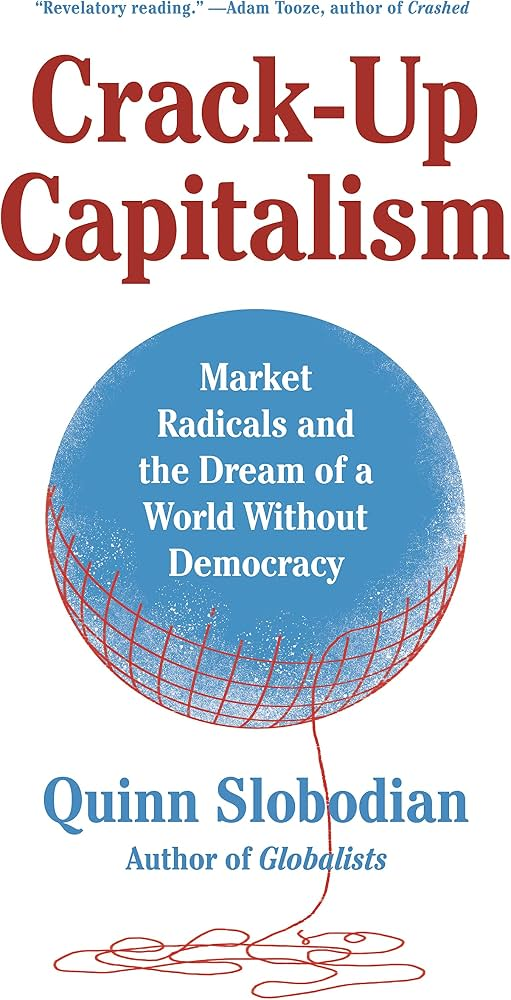 In his recent book, Crack-Up Capitalism: Market Radicals and Dreams of A World Without Democracy, historian Quinn Slobodian offers what might be the closest thing we have to an epigraph for our present moment.
Silicon Valley often forgets its Hegel at its own risk. The German philosopher taught that the master is always dependent on the slave. Neither island nor cloud can exist without its underclass. Beyond the masses of app-mediated gig workers, even the vaunted artificial intelligence programs work only because of the often repetitive routines… of labor both skilled and unskilled…The cloud floats because the underclass holds it up. Time will tell if they drop their arms one day and make something new.
Slobodian is one of a few thinkers taking the risk of writing contemporary history, one of the most difficult but important of genres, especially in a disoriented and shifting age. Shipwrecked attempts litter the shoals of our rising seas, many once registered under the flags of oracular business consultants or breathless Great Man hagiographies. Does anyone now think the world was ever flat? The present, to invert a mid-century novel’s famous opening line, is a foreign country. The pernicious side-effect of someone else’s bright idea suddenly dominates everything. What was a trend for decades became a tipping point last week. What seemed important or forgivable no longer is. Causal chains are clouded by changing weather, and the diviners at Farmer’s Almanac have thrown in the towel. “Is there anything Jack Ma can’t do?” a dazzled writer asks of the founder of China’s e-commerce giant, Alibaba, in 2012. Yes, it turns out, there is: Say no to Xi Jinping.
Distortions of attention are the hazards of thinking contemporary history. Already, free-range attention spans are further shortened when captured by the digital economy, and successions of world historical events are occluded by the price of gas or ground beef or manufactured online hysterias. Lotus-eaters all, we are desperately in need of reliable sea charts, healthier sustenance, and a repaired memory of where we were once trying to go.
In the pre-pandemic decade of the 2010’s, two narratives arose in relative independence of one another and now appear, in retrospect, to be much more closely intertwined: the phenomenon and critique of global inequality (most closely associated with the French economist Thomas Piketty), and the explosive growth of a new form of capitalism known as the platform economy or surveillance capitalism (closely associated with behavioral psychologist Shoshana Zuboff). Both developments were late expressions of the period of globalization that would conclude with the partial unraveling of the economic entente cordiale between the United States and China, beginning in the First Trump Administration.
What a handful of recent studies suggest is that the explosive growth and wealth of the second development – platform capitalism – has structurally contributed to the historical spike of the latter – global income and wealth inequality — since the Great Financial Crisis of 2008. Such an outcome has led some observers to further suggest that we have departed from capitalism altogether – or at least from that economic model that was premised on the wide distribution of the profit-seeking motive; and this not in exchange for socialism or unfettered markets or even monopoly capitalism, but for something else entirely.
So-called “techno-feudalism” is marked by a preoccupation among the world’s largest firms less with productive investment or manufacturing than with the extraction of data through deployment of relatively low-cost and diversionary gadgets, which then guarantee a stream of much more valuable information for use in the shaping of consumer behavior. Increasingly, such firms buttress their market share through lucrative arrangements with state power. The avatars here are Google, Amazon, Uber, Tencent, Didi and Alibaba, among others. The corporate embrace of machine learning represents a deepening of commitment to this economic model.
The rise to hegemony of digital platforms in the 2010’s, which occurred more or less simultaneously in the United States and the People’s Republic of China, can be thought of as a consequence of the failure of capitalism to generate investment, or the problem of ‘secular stagnation’. This was a widely noted problem at the time, with Paul Krugman penning a series of columns on the issue for the New York Times beginning in the middle of the decade. The enormous post-2008 stimulus programs initiated at the time (and in the case of China, truly unprecedented in magnitude), and further elaborated in response to the pandemic in both the US and China, were the essential preconditions for platform companies to grow in capitalization, revenue and market share while the real economy was stuck in the doldrums of prolonged austerity.
Low borrowing costs in the post-crisis decade did little to boost traditional manufacturing (though they triggered a housing bubble in China) but they did allow for firms like Google, Facebook, Amazon and Microsoft to acquire dozens of smaller companies on the cheap, thereby building out their increasingly sophisticated “closed garden” emporia of digital services capable of ever-greater data collection capabilities.
This explosive and lopsided growth of one economic sector at a time of stubborn overall economic growth and stagnating wages has profoundly transformed the world, but not in terms of enhanced corporate investment, worker productivity, or increased wages. Rather, it has restructured the organization of the most profitable firms and the mechanisms by which wealth is distributed throughout the global economy, primarily by moving it up the socioeconomic ladder. As economic historian Adam Tooze notes in his history of the 2008 crisis, “two thirds of nonfinancial firms that had managed to achieve a return on invested capital of 45% or more between 2000 and 2014 “were in either the health care or the technology sectors.””
As political scientist Herman Schwartz documents, in 2015, Apple reported cash reserves of $178 billion accumulated in less than a decade, with most of it held offshore. In comparison, Toyota’s cash reserves, accumulated over a span of some forty years, were by 2015 between $40 and $45 billion, and the firm was (and is) headquartered in Tokyo. Thomas Piketty’s Capital in the Twenty-First Century was first published, fittingly, in 2013, though in it he had almost nothing to say about the digital economy then taking shape, nor its effect on the long-term growth of economic inequality since the 1970’s.
This story is central for those seeking to understand how the current build-out of artificial intelligence infrastructure is financed. The ferociously expensive data center build-out is being paid for in part by the cash hoard accumulated by firms such as Microsoft and Facebook during the post-crisis decade. They literally have little else to do with it, apart from spending on occasional boondoggles such as virtual reality goggles or peeping-tom eyewear. The post-2008 stimulus with its low interest rates was disproportionately favorable to the technology sector, which had little fixed capital, low worker head-count and, with its assets primarily in intellectual property (IP) that it was able to easily domicile offshore, was able to avoid national corporate taxation.
As a US Senate report on corporate offshoring found in 2013, a unit of Apple domiciled in Ireland paid no taxes to any national government for the four years from 2009 to 2012. A French government report in 2013 found that “all big American Internet companies” were doing the same thing in Europe. Although this is a strategy pursued by other industrial firms as well (such as General Electric), it is not as easy to do when assets consist of rolling stock, jet engines, or steel mills.
But the story here isn’t just about badly behaved tech companies, as relevant as that continues to be. Political scientist Herman Schwartz (2016) argues that outsized tech growth in the decade of secular stagnation was the result of tax laws encouraging offshoring of IP, the reduced need for labor in tech, and the outsourcing of tech’s supply chains, all of which combined to reduce the need for investment in a way that would circulate money to the rest of society. Schwartz writes:
To understand what changed, we have to look at how IPR (intellectual property rights) firms generate profit and how the predominant form of industrial organization has evolved over the past four decades … The nature of IPRs as monopolies allows profits that these monopolies generate to accrue in firms with a lower propensity to invest, allows those firms to shrink their labor footprint to the smallest possible size (which concentrates wage income), and allows those firms to shift profits to low tax venues with greater ease than the industrial behemoths of the 1960’s could.
Industrial behemoths, as in the case of Toyota mentioned above, could hardly claim to be domiciled in Ireland, often employed tens if not hundreds of thousands of employees, and were thus compelled to distribute a portion of revenue to labor and to the nation state (to “cross-subsidize”) in the form of corporate tax. For every iPhone 6 designed in California and sold in 2016, according to Schwartz, Apple collected a net $319 in revenue, while China’s Foxconn pocketed $15 for putting the device together. This is why, by the mid-2010’s, firms with heavy IP assets held the bulk of cash reserves, and why the rate of corporate profit jumped in the few years between 2011 and 2014 an equivalent of 3.3% of US GDP.
Thus a paradox emerges. For all the thoughtful Marxist commentary on capitalism’s fundamental incompatibility with democracy, it may well be the case that the phase of industrial capitalism which obtained for roughly a century between 1870 and 1970 was in fact uniquely amenable to democracy. The need for large populations of laborers in the extraction of commodities and the manufacture of durable objects required a form of business organization that, of necessity, though obviously not without conflict, distributed some gains from productivity throughout the organization and thereby into broad reaches of society as well. The basis for a participatory community of informed citizens was laid on the grounds of employment in large organizations and living in a shared community.
The political scientist Timothy Mitchell has been keen to link the rise of nineteenth-century European democracy with the rise of an energy regime based on coal and the labor required to mine it. He then distinguishes this from the more colonial and less labor-oriented characteristic of capitalism once the switch was made from coal to oil, a less labor intensive enterprise. The argument Schwartz is making is that with the platform companies this switch has now gone even further, from the material assets of the industrial age to the intangible assets of the digital age, and to a system in which accrued wealth is restricted to an exceptionally small number of workers with little direct obligation to workers far away, rather than being distributed among many within a shared community.
The consequences for democracy are plain, and find ready echoes in the libertarian rhetoric from Silicon Valley, which in its more extreme and racist forms disdains both labor and democracy. Why should it be otherwise, if an investment in nations, communities, and workers has become exiguous to its very business model? It is worth noting that Steve Bannon, an early theorist of Trump’s MAGA movement, sniffed out this elitist inclination early on, an indicator of often latent popular resistance to Silicon Valley dirigisme among the working class.
As Slobodian recounts in Crack-Up Capitalism, there has been no shortage of technocratic designs for tech cities, tech zones, or tech protectorates in which Singapore or Hong Kong-like authoritarian mini-states, each seeking “exit” from the constraints of liberal democracy, social contract entitlements, or the messy encumbrances of history, are able to foster endless innovation unimpeded by the rules of politics or the disgruntlement of simple-minded masses as they are tracked and mined for data. The current opposition to data centers and license plate readers, so surprising to the coastal intelligentsia of The New York Times and Heatmap, did not come out of nowhere. It is rooted in a growing and deeply structured class antagonism.
In the proliferation of data centers, the American public has gotten a taste of techno-development with Chinese characteristics, if on a greatly reduced scale. We can only be grateful that the top-down onslaught of AI development does not generate the millions of displaced, the ecological destruction, or the formal, legalized regimes of discrimination deployed against the low-skilled, rural, and uneducated that has accompanied China’s program of techno-development. But the germ of affinity and the will are both clearly there, as one can see in reports from Indiana to Michigan to Pennsylvania. Data center opponents are characterized as poor and backward, living in “shitty houses” which, if occupants are unhappy with the roar of the diesel and gas turbine generators installed across the street, they should simply sell to their cryptomining or hyperscaling neighbors, and move away.
As one Midwestern activist group notes:
In 2026 alone, we’ve seen multiple enormous “hyperscale” data centers approved in Illinois. The projected resource consumption is alarming: over 4,500MW of electricity (that’s more than Chicago’s energy demand) and an undisclosed amount of water. In many cases, project approval was ushered through with little public input and transparency, making it difficult for the public to fully understand the long term impacts on energy, water resources, and the community.
How much easier things would be in China, where little can impede the wrecking balls.
The case of China’s turn to techno-development is important because it parallels in chronology and to some extent in ideological evolution that of the platform companies in the United States over the same period. It also illustrates foreclosed possibilities for alternatives both in China and the US. As Ya-Wen Lei shows in her fascinating study The Gilded Cage: Technology, Development, and State Capitalism in China, the Great Financial Crisis marked a watershed, as it had in the West. One half of the twin-engine plane of the global economy had been crippled in September of 2008. Export demand for Chinese manufactured goods cratered almost immediately.
Within months, the administration of Premier Wen Jiabao put together a 4 trillion yuan stimulus program, three times larger than the US Troubled Asset Relief Program in proportion to Chinese GDP. The crisis led many in China to reconsider its existing export-driven trade relation with the US and Europe, and to advocate for bringing China up the value chain from manufacturing to technology and services. Among the earliest advocates of such a transition was Xi Jinping.
Such a transition had begun before the crisis among the coastal provinces, long at the forefront of China’s economic evolution. In Jiangsu, Zhejiang, Guangdong, and Shandong, the effects of a decade or more of land-intensive industrial development and in-migration by rural workers was making itself felt; there was little land left to build out according to the existing model.
It was in these provinces in the middle 2000’s that the idea of “upgrading” the local economy to a less land-intensive, less labor-intensive, less polluting model was initiated. And it was during this period that China’s future leader, Xi Jinping served as party secretary of Zhejiang, China’s fourth largest provincial economy by GDP. There, Xi demonstrated an enthusiasm for tech driven modernization.
While serving in a previous position, Lei shows, Xi wrote an introductory essay on a late Qing intellectual, Yan Fu, who had been an important advocate of modernization along Western lines. In a hint of Xi’s overall orientation, Yan Fu was known for translating the works of Thomas Huxley and Herbert Spencer into Chinese. Yan is credited in particular with having translated the terms “survival of the fittest” and “social Darwinism” into his native language.
As Lei writes, “Xi expressed his great admiration for Yan. After stating that “technology is the foremost productive force,” Xi narrated how China lagged behind the West after the Industrial Revolution.” As Lei reads this and other early writings, Xi held a widespread faith in the power of science and technology alone to elevate China to greatness. Although he touches on rural poverty and general inequality in these works, “such considerations were ultimately subordinate to the pursuit of S&T [science and technology] development.”
After 2008, the program of economic upgrading was taken up by Beijing and made the basis of rewards and incentives to municipal and provincial governments. These, in turn, developed extensive metrics for assessing the value or “obsoleteness” of entire industries and classes of workers. With the rise of Chinese tech firms and the systems of data collection and analysis that they enabled, municipalities began to sort what they considered to be desirable and undesirable industries and workers, allotting to some – the more educated and accomplished – coveted hukou residential licenses and their associated access to quality public education and services, while denying them to migrant laborers with less education or connections.
This was the beginning of China’s comprehensive social credit system and its institutionalized discrimination against the rural and working poor – a digital validation of Yan Fu’s social Darwinism.
Most of China’s big tech firms were founded in the 1990’s and early 2000’s. It was in the early 2010’s that things really got going, as they took advantage of China’s enormous domestic market. This was partly in response to government encouragement of high tech as a successor paradigm to export industrialism, and also to a tolerant regulatory environment under Xi’s predecessor, Hu Jintao.
A fledgling public space also took shape on China’s early internet, and it was in the five years leading up to Xi’s ascension as General Secretary in 2012 that a semi-public debate took place. The subject was the proper course of China’s future development, and the ideal balance between technology-driven investment and social spending.
In these heady years before Xi, Premier Wen Jiaobao could advocate for freedom of speech; Guangdong Communist Party Secretary Wang Yang could meet with labor unions and accede to certain demands; and Chongqing Communist Party Secretary Bo Xilai could propose massive public housing and reform of the discriminatory hukou registration system in favor of the rural poor.
Given the relative autonomy of Chinese provincial governments to craft their own economic and social policies, certain among them came to stand as possible models for the future of China writ large. Wang Yang’s in Guangdong came to stand for the maintenance of the coastal worldview of openness to global commerce and technological upgrading. Bo Xilai’s inland city-state of Chongqing came to stand for a model that prioritized the venerable values of economic equality and redistribution, drawing heavily upon nostalgia for the Maoist era.
In the event, neither model won out. With Xi’s rise to power, coastal Guangdong’s openness to foreign firms and technology was traded for a policy of self-strengthening. In Bo Xilai’s left-populist agenda a number of senior Politburo members saw an unwelcome reversion to the instability of the Cultural Revolution and a challenge to Xi for the position of General Secretary. Following a truly Shakespearean episode of local intrigue, Bo Xilai was toppled and imprisoned, as was his wife, eliminating him as a potential competitor with Xi, together with the Chongqing model as a potential roadmap for China’s future. Rural-urban inequality and economic redistribution have both permanently receded as a major focus of concern.
In 2015, there followed the “Made in China” industrial policy that, a year before Donald Trump entered the White House, began to undo the US-China entente cordiale by aiming for self-sufficiency and an explicit bid for world leadership in technology. In 2020, Xi personally suspended the IPO of Jack Ma’s Ant Group less than two days before its offering on the Shanghai and Hong Kong exchanges, launching a multi-year crackdown on China’s most successful platform enterprises.
Although Chinese platform firms had been closely partnering with municipalities on governance, urban planning and surveillance projects for some time, Xi’s clampdown made it clear that the vast power accumulated by the platforms over the Chinese domestic workforce (in terms of such basic issues as piece rates, contract terms, and data privacy) would be checked and subordinated by the even vaster power of the Chinese state.
Such resistance has only recently been encountered by the American tech firms. Observing the spectacle of an autocrat acting to check the abuses of digital robber barons, Yannis Varoufakis has wryly remarked in his book, Techno-Feudalism, “it remains endlessly intriguing that the only glimmer of hope for any demos round the world shines in the midst of a society under totalitarianism.”
If democracy is a practice like anything else, and practices atrophy when they fall out of use, then it is not surprising that the concentration of wealth and power that have arisen in American tech have distanced its leaders from an affinity with the democratic ethos. This is certainly the tendency inherent in the very practices of data extraction and surveillance, which are in the unsolicited process of reworking fundamental assumptions of the Western political tradition regarding liberty, privacy, and individual freedom. The notion that knowledge is power, in its original Foucauldian formulation, may never have been truer than it is now.
Yet the Panopticon was only a prefiguration of surveillance capitalism, when the most basic social activity, or even the need to simply subsist, leave digital traces with third parties which thereby come to possess some slight ownership and control over you. Even so, contemporary history shows, as in Chinese debate in the years leading up to 2012, and the wave of American resistance to Big Tech’s forced deployment of artificial intelligence, that the shape of technology and its development are never predestined, nor fated, nor inevitable.