
Steven Poole in The Guardian:
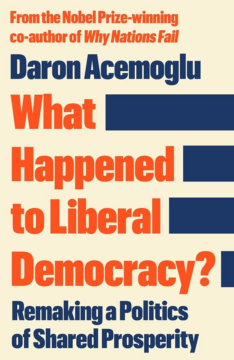 In 2009, the tech billionaire Peter Thiel published an essay with the portentous title The Education of a Libertarian, in which he announced: “I no longer believe that freedom and democracy are compatible.” Since the 1920s, he wrote, “the vast increase in welfare beneficiaries and the extension of the franchise to women” had rendered the notion of “capitalist democracy” an oxymoron. To be fair, Thiel still seems happy to exercise his freedom to extract money from democracies, via his co-founding of Palantir, which was lately given lots of money by the NHS.
Thiel calls himself, as many such do, a “classical liberal”, but Daron Acemoglu argues that his ilk still has much in common with left-liberals. All of them, he writes, agree on “the desirability of basic individual rights and freedoms (including the right not to be coerced and the freedoms of expression, religion, association, and choice); constraints on power, especially political power; and broad protections for equality before the law”. On his telling, by the mid-20th century democracy with liberal characteristics had amply proved its worth: blue-collar labour was generously rewarded, and there was a sense of “shared prosperity”.
But now, he argues, liberal democracy is in a crisis, largely owing to the abandonment of the working class by liberalism’s “progressive” wing. In post-industrial Europe and the US, the left ceased to speak of economic class and spoke instead of identity.
More here.
Enjoying the content on 3QD? Help keep us going by donating now.