
by Charles Siegel
Sixty years ago this month, Reprise Records released a Frank Sinatra single, “The Summer Wind.” If there is such a thing as perfection in music, this comes close.
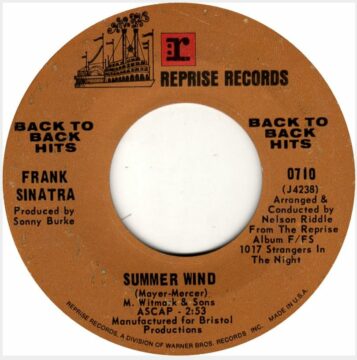
Sinatra’s version was not the first recording of the song. In fact, the song he recorded wasn’t even the first version of the piece at all. “The Summer Wind” started life a year earlier as “Der Sommerwind,” written by a German composer and a German lyricist. Sometime in 1965, the American songwriter Johnny Mercer happened to hear the song being sung by the Danish singer Grethe Ingmann, who two years previously had won the Eurovision title. She submitted “Sommerwind,” with Danish lyrics, for the 1965 contest and didn’t win. But Mercer heard her singing it, and the rest is history. (Twenty-five years later, Ingmann died at 52, becoming the first Eurovision winner to die.)
Mercer rewrote the lyrics “into pure poetry,” as James Kaplan, one of Sinatra’s biographers, put it. He thus became the first of two geniuses, aside from Sinatra, who combined to produce this gem. Mercer, of course, was perhaps the greatest lyricist of all time. It would take another column just to list his songs, and a dozen more columns to even attempt to convey the beauty of the words, but a few well-known examples would include “On the Atchison, Topeka and the Santa Fe,” “I Remember You” (with the sublime opening line “I remember you/You’re the one that made my dreams come true / Just a few kisses ago”), “Days of Wine and Roses,” and “Moon River.”
According to Sinatra’s daughter Nancy, Johnny Mercer was her father’s favorite lyricist. Mercer wrote, among others, another of Sinatra’s greatest hits, “One for My Baby (and One More for the Road).” “The Summer Wind” wasn’t even Mercer’s first great rewrite of a song originally written in another language. Fifteen years earlier he had taken a French tune, “Les Feuilles Mortes,” changed the feel of the lyrics, and turned it into one of the all-time jazz standards, “Autumn Leaves.”
Later in 1965, Wayne Newton recorded “Summer Wind” as the title track of an album. For good reason, it went nowhere on the charts. Perry Como recorded it that year too. Neither of these versions sounds remotely like what was to come from Sinatra the next year.
Genius number two now came into the picture. The song was recorded for the album “Strangers in the Night.” The title track itself went on to become one of Sinatra’s best-known songs, and earned him two Grammys. The conductor/arranger for all of the songs on the album was Nelson Riddle.
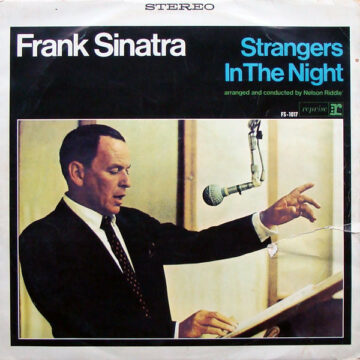
Riddle is a fascinating study in his own right. Suffice it to say here that he is among the most influential figures in American popular music of the last hundred years — despite never having been a performing musician, or producer, or record company executive or promoter. Instead, he was one of the greatest arrangers and orchestrators of all time.
In his reflective essay on Sinatra, “Why Sinatra Matters,” Pete Hamill quotes Miles Davis as saying that “a lot of musicians and writers don’t get the full value out of a tune. Art Tatum does and Frank Sinatra does. Listen to the way Nelson Riddle writes for Sinatra, the way he gives him enough room and doesn’t clutter it up… His backgrounds are so right that sometimes you can’t tell if they’re conducted.” And quoting Quincy Jones: “I loved how Nelson used Ravel’s approach to polytonality. Nelson was smart because he put the electricity up above Frank. He put it way upstairs and gave Frank the room downstairs for his voice to shine, rather than building big, lush parts that were in the same register as his voice.”
And finally, Hamill quotes Sinatra himself on Riddle: “Nothing ever ruffles him. There’s a great depth somehow to the music he creates. And he’s got a sort of stenographer’s brain. If I say to him at a planning meeting, ‘Make the eighth bar sound like Brahms,’ he’ll make a cryptic little note on the side of some crappy music sheet and, sure enough, when we come to the session the eighth bar will be Brahms. If I say, ‘Make it like Puccini,’ Nelson will make exactly the same little note and that eighth bar will be Puccini all right, and the roof will lift off.”
In all, Sinatra and Riddle made 318 recordings together, over roughly 25 years. “Strangers in the Night” was the last full album they worked on together. In addition to the title track, there are other classics as well, such as “All or Nothing at All” and “My Baby Just Cares for Me.” But “The Summer Wind” is two minutes and fifty-four seconds of musical, vocal, and lyrical lightning in a cool, cool bottle.
The opening bars are loud and a bit jarring, and start with an organ, possibly a Farfisa, tracing an exotic-sounding figure meant to evoke the sirocco, the desert wind that blows from North Africa to southern Europe toward the end of summer. Then things settle down and we’re into the first verse. The music is quiet, almost contemplative, with distant tinkling piano notes, as the narrator tells how the wind “came rolling in from across the sea,” and touched the hair of his new flame. He wistfully recalls how “all summer long, we sang a song, and then we strolled that golden sand / two sweethearts and the summer wind.” Riddle’s orchestra is still quiet, but the song is gathering momentum.
Now we’re into the second verse. The key moves up a step, from Db to Eb , in tune with the emotional quickening of the story. Mercer gives us what are, to my mind, two of the greatest lines ever: “Like painted kites, those days and nights went flying by / The world was new, beneath a blue umbrella sky.” Sinatra begins to loosen up a bit, as he sings the phrase as “those days and nights, they went flyin’ by.” We’re now at the exact middle of the story. And then the unexpected blissful summer fling ends, just as inexplicably as it began, as the summer wind carries the singer’s lover away: “Then softer than a piper man, one day it called to you / I lost you, I lost you to the summer wind.”
And then the last verse. Riddle’s orchestration is at full strut. The key moves up another step. We hear the drummer keeping a more distinct, insistent rim click beat. The volume and energy of the music make a strange contrast, however, with the sad end of the story: “The autumn winds, and the winter winds, they have come and gone / And still the days, those lonely days, they go on and on / And guess who sighs his lullabies, through nights that never end / My fickle friend, the summer wind.” That penultimate line, about lonely nights that never end, is sad and reflective, but here the arrangement is at peak swagger. That juxtaposition is so strangely affecting. Only after the very last line does the music abruptly wind down.
That’s it. Less than three minutes of music, and only twelve lines of lyrics. Somehow, though, in those twelve lines Mercer captured a universal experience. Who hasn’t had a romantic connection unexpectedly appear, and then just as inexplicably end?
There are, of course, lots of other versions of this song out there. Wayne Newton’s and Perry Como’s recordings are worth listening to, if at all, only for historical reasons. Michael Bublé has a snazzy, up-tempo cover that is polished but utterly devoid of feeling. Madeleine Peyroux’s effort sounds downright insipid, but is redeemed by a nice sax solo.
Don’t even bother, really, with any other version of this song. They’re not the same song. What Sinatra, Mercer and Riddle achieved was, and always will be, unique. Bruce Springsteen, who knows something about writing and performing memorable songs, appeared on Stephen Colbert’s show one night, Bruce Springsteen Takes The Colbert Questionert and was asked to pick one song to listen to, if he could only listen to that one song for the rest of his life. “Whoa,” he said. “One?” After thinking about it for a few seconds, he answered, “The Summer Wind, Frank Sinatra.” Perhaps this was just a gracious nod to a fellow New Jerseyan. But I can see why that would be his, or anyone’s, answer.