
Christof Koch at the MIT Press Reader:
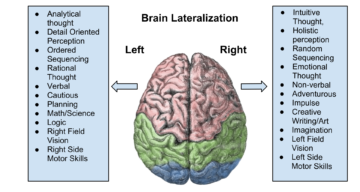 Closer inspection of split-brain patients by the biologist Roger Sperry at Caltech, however, revealed a persistent and profound disconnection syndrome. If specific data are given to one hemisphere, that information is not shared with its twin on the other side. Furthermore, only one hemisphere, typically the left one, speaks. That is, if the right hemisphere is lost or silenced by anesthesia, the patient can still talk, which is why the left hemisphere is called the dominant hemisphere. The right hemisphere by itself has only limited language comprehension and is mute, though it can grunt and sing. So, when engaged in conversation with a split-brain patient, it is the person’s left hemisphere that is doing all the talking. The patient can’t name an object presented in the left visual field because that image is processed by his mute right visual cortex. But they can pick out an object from a group on a tray using their left hand, which is controlled by the right motor cortex.
more here.
Enjoying the content on 3QD? Help keep us going by donating now.