
by Christopher Hall
How far does Trump’s bad taste go towards explaining his presidency? A long way, thinks Paul Krugman: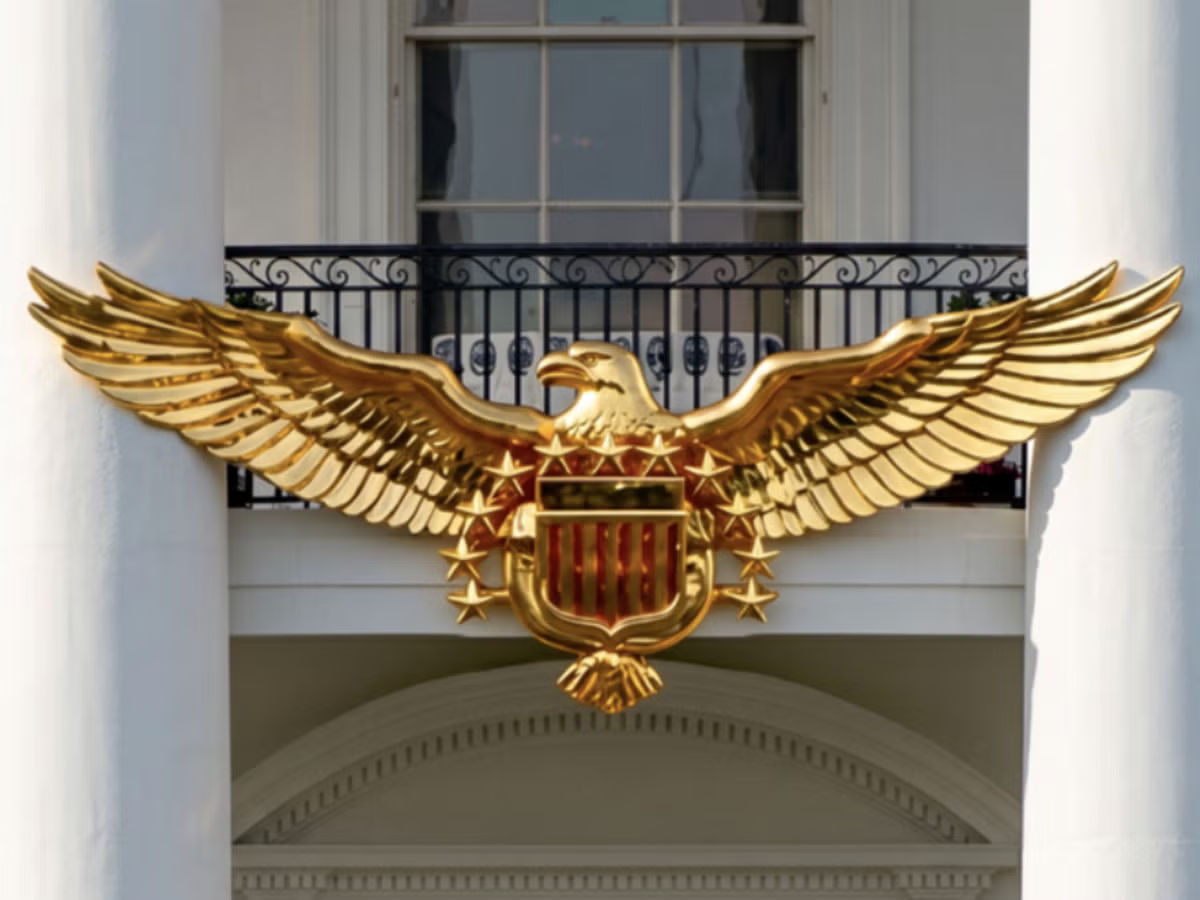
…is it any surprise that Trump is turning the White House into Mar-a-Lago North?
This is all deeply alien to American tradition. Washington DC is a city full of grand monuments and impressive public buildings. Yet the style of these monuments and public buildings is generally one of restrained neoclassicism meant to evoke the Roman Republic – an ideal of a republic of equals reflected in law and norms as well as architecture. Anything approximating the Louis XIV style of Trump would have been considered monarchical and autocratic by the Founding Fathers.
So the ballroom is a sign, not just of Trump’s personal vulgarity, but of the collapse of small-r republican norms. Trump is turning the people’s house into a palace fit for a despot partly because that’s his taste, but also to show everyone that he can. L’etat, c’est moi.
Are we still convinced that “restrained neoclassicism” and “American tradition” are closely aligned? The neoclassicism of the 18th century which informed the design of Washington DC most certainly advocated for refinement and restraint – or, more commonly, noted their absence. The “Timon’s Villa” episode of Pope’s Epistle of Burlington is a dissection of taste gone wrong, even as it is deployed by an aristocrat:
At Timon’s villa let us pass a day,
Where all cry out, “What sums are thrown away!”
So proud, so grand of that stupendous air,
Soft and agreeable come never there.
Greatness, with Timon, dwells in such a draught
As brings all Brobdingnag before your thought.
To compass this, his building is a town,
His pond an ocean, his parterre a down:
Who but must laugh, the master when he sees,
A puny insect, shiv’ring at a breeze!
Lo, what huge heaps of littleness around!
The whole, a labour’d quarry above ground.
Bigness, of course, is at the centre of the Trump aesthetic, but such measurements are a matter of perspective. Big and small, high and low; whatever categories are manipulated or inverted were never firm in the first place. Fintan O’Toole has recently written about this matter of perspective in Trump’s America, using Gulliver’s Travels by Pope’s friend Swift as a jumping-off point:
…we return to a neurotic form of politics in which, like Gulliver, citizens are made to hover between the poles of massive aggrandizement and utter mortification. These opposites come as a package; they must be experienced together. The great leader costs the people imaginatively down into the pit of abjection so that he (and only he) can lift them up into hyperinflated greatness. He does so because he has nothing to offer in between: no betterment, no dignity, no equality.
Trump elevates the degraded and degrades elevation; the point is not to bring the values of “the people” into the regions of decorous authority, but to dismantle the very idea of authority itself. (Or, least, an authority which is rule-bound, and not simply the projection of the leader’s stochastic, inevitably ugly desires.) Trumpian kitsch trespasses against whatever is “soft and agreeable” in good taste; he stamps his name on the Kennedy Center to simultaneously show his alignment with the forms of art most enjoyed (theoretically, at least) by the ruling classes, and to encourage their rage by bringing it all down to his level. It is revolution-by-proxy; only Trump, wealthy but loutish, could take the masses (symbolically of course) to such places.
Trump has succeeded because, despite appearances, there’s something to this that makes sense in the American context. Whatever value neoclassicism had for the 18th-century men who framed the Constitution and designed Washington DC, surely much of the core of American tradition is not to be found within restraint – and even if we find that “restraint” is a value to be praised within republican government, is it really a democratic virtue? The values of, say, the monster truck rally – the noise, the spectacle, the grand, violent impact of American technology, and, above all, the ingenuity of “regular” people – cannot be banned from American democracy as it exists without a noticeable loss. The person who hangs plastic testicles on the trailer hitch of their truck is, at the very least, making a declaration that they won’t let decorum override their exuberance. But this fundamentally democratic impulse can just as easily ferment into authoritarianism when excess and its violences are seen as virtues in themselves. At what point do we see the difference?
Krugman notes the conflation between what Trump genuinely seems to like and the will-to-power his taste expresses. Of course, taste, good or bad, is inevitably an expression of one’s relationship to power, whether it’s the power one has or the power one wishes to have. Trump holds an MMA match on the grounds of White House because he can, yes, but also at least partly because he knows doing so will piss off precisely the right people – people like Paul Krugman. If high culture sends a message about who has the right to control who, then Trump’s inversion is at least partially successful; he is certainly controlling people to the extent of getting a reaction. This may be the “control” of the bully or the troll, but its effect is unquestionable. The center of the contradiction of the ballroom is that it is, like Trump himself, born and bred within the high tradition but everywhere, with its absurd size and gold filigree, “coded” low. This pays political dividends for Trump, even if it may be just the kind of thing he likes.
That Trump proceeds almost entirely by instinct is itself an important signifier. Trump’s golden eagle may look more appropriate as the design on a belt-buckle struggling to emerge under the gut of a midwestern trucker, and the fascist overtones are unmistakable – but the point may be in fact the utter absurdity of it, the chaos which bad judgment introduces everywhere. Even the fact that the image was generated with AI seems calculated to induce a reaction in those of us (I’m certainly one) who doggedly stick to staid, possibly patrician values about human creativity.
Restraint and decorum are values which the upper class uses to make a clear stratification between themselves and the excess and vulgarity of the lower classes. These values exist at least partly out of caution: are democracies born out of politeness, or sustained there? If we bemoan the current rancidity of American discourse, that must come in the recognition that, if the excess has been excessive, the calls for restraint do likewise miss the mark somewhat. As Republicans are reveling in their charivari, Democrats continue to wallow in a pool of missed opportunities, half-actions and pointless hedges which has its own kind of putrescence. Their restraint, neo-classical or not, is increasingly, and justly, responded to with contempt and lost primaries for mainstream candidates.
Let’s assume that the question about taste is not really about what’s high and what’s low, but rather the quality of the interaction between the two – since interaction is inevitable. The opposites, as O’Toole very sagaciously notes, come as a package. So, the real question becomes: does the current dialectic between exuberance and restraint seem healthily democratic – or even small-r republican? The answer must be No, but that doesn’t imply that a deep overcorrection from one side to the other is in order. Trump’s vision that aggressive impulse must be the guide for everything cannot be replaced, after all this is over, with the takeover of our social betters who can make sure that their brand of order is restored. Nothing which truly descends into chaos can ever be exactly restored – and that’s maybe for the best.
Taste is a language, and full fluency is a difficult matter. The democratic undoing of the traditional orders of being which began in the 18th century is an unfinished project which we continue to sort out in arenas that lie deeper than the cores of politics – or even culture itself.
Enjoying the content on 3QD? Help keep us going by donating now.