
by David Winner
If anything useful comes out of the Jeffrey Epstein saga, it is that it gives us an example of pure evil with which to compare our lesser ill deeds. I’ve done some shitty things in my life, some secret, some observed, but only once was I subject to something like trial and punishment. Nearly half a century later, the incident serves as a kind of personal bellwether. This was me. This actually happened. I’m using some initials rather than names because I don’t want the players involved in the incident to google themselves and remember this eerie incident
Early in the 1990s, M, a kid I’d gone to high school with, smashed his car into a tree and died. Only a decade earlier, his life had also been in danger on a fateful tenth grade school trip up from Charlottesville, Virginia to New York City, and I and one other boy had been held responsible.
In the 1970s, my parents adopted the French/Italian tradition of allowing the child a small glass of wine at dinner, and actually several one evening when Ismail Merchant came over to dinner at my grandmother’s apartment and (ignoring my father’s side-eyed cautions) kept refilling my glass until I got drunk for the first time.
Drugs were a different matter. I only knew them through cautionary references on TV shows, and, after I started attending a progressive high school just outside of Charlottesville, by their whispered reputation. When Rory invited me to my first actual high school party in ninth grade, my mother (or maybe a cab) dropped me off in front. When Rory opened the door, I jokingly asked him where the “din of iniquity” was located. “The basement,” had been his matter of fact reply, and down a flight of suburban carpeted stairs, kids were drinking from a keg and puffing on peculiar cigarettes that smelled nothing like my father’s Marlboros.
That was the beginning of a beginning and the beginning of an end. An end of weekday and weekend evenings spent contentedly with my parents: dinners, a bit of homework perhaps, then detective shows on television: Murder She Wrote, Hart to Hart, and reruns of my father’s and my favorite, The Rockford Files. I spent a couple of hours most nights in the company of criminals, their victims, and the detectives who always caught them.
By the spring of 1981, my tenth-grade year, I was going frequently to high school parties: six packs and Jack Daniels; from barely inhaled puffs of weed to multiple bong hits. Things got more dissolute when our high school got computers. A friend purchased a laminating machine, went to the photo store downtown for passport-size photos, and created fake university IDs which were accepted at most ABC stores in town.
By the spring of our New York trip, my high school boy gang had developed considerable tolerance: Mr. Boston Vodka, Seagram’s Gin, Bacardi 151.
And when a friend’s brother started selling black beauties, basically antihistamines with speedy properties, we brought them along.
We bad boy boys arrived in New York after the seven-hour van trip up from Charlottesville to the YMCA on East 42nd Street well equipped to party.
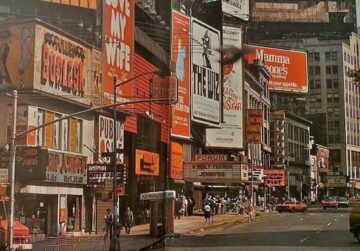
While we did some stuff together as a class – The Elephant Man on Broadway, the Statue of Liberty – the two adults chaperoning us disappeared into the woodwork, and we trolled around the neighborhood of the Y drawn like sirens towards Times Square, utterly unreconstructed a decade or so before Giuliani.
In New York, the drinking age was eighteen, and you practically had to pay a liquor store owner to card you. Each boy bought a fifth. For some reason or other, I picked J&B Scotch. I guess it seemed adult.
At a midnight showing of Excalibur, I fell asleep on the shoulder of the nice girl next to me. We hadn’t been crushing on each other, but she hadn’t been able to stop me. And I was relieved when I ran into her as an adult many decades later; she didn’t appear to remember something troubling having happened between us.
But generally the boys and girls did their separate things. Were the girls also getting fucked up? Probably not as much, but I doubt they were innocent.
It was only us boys when we were walking near Times Square, and a man approached E to offer up hookers: “white girls, Black girls, Spanish girls. We got all kinds of girls.”
With the alcohol and the black beauties, night blended into day, and my memory, forty-five years after the fact, is an oddly specific blur. In the middle of the second or third night, I woke up in the room, but my friends were gone. I walked up and down the halls and into the bathroom, then outside the building, maybe heading towards Times Square before returning to the Y, an eerie, hallucinatory circuit. Did my tenth-grade friends even exist? My house back home, my parents?
Eventually, I went back to the room and fell asleep. When I next woke up, my friends were asleep in their beds.
M had not been a part of our social circle. While we drank copious booze on weekends and wandered dazedly around Charlottesville, he went home after school to his parent’s sumptuous country house. In New York, he also purchased a bottle of booze though he lacked the gradual dissolute preparation, the building up of tolerance.
On the evening of our third (and penultimate) day in New York, P, M and I took off by ourselves at some latish hour drifting inevitably towards Times Square.
Were our bottles of alcohol in tow, fifteen-year-old boys promenading about with them in public? I don’t remember, but the early eighties were really the seventies in NYC, no one bothering with minor white boy malfeasance.
After a block or so, P and I realized that M was having trouble walking, and our already-dysfunctional story began to go south.
Earlier that year in the town council that began each school day in the blue room in the large eighteenth century house that housed the school, Todd Shelton raised his hand to mysterious denounce the presence of a “narc.” Who that person may have been and whether or not he or she was guilty of the accusation was unknowable, but it was emblematic of an absolute code. Informing adults about misbehavior, particularly misbehavior involving drugs and alcohol, was a high crime and a dastardly betrayal. We were not about to reach out to the adults who’d come with us from Charlottesville.
And it was not until years later, after college at some point, that I first heard the term alcohol poisoning though I’d probably poisoned myself on alcohol on a number of occasions. I had not realized that drinking too much too fast could kill you.
When M landed on the sidewalk with a thud, we tried several times to heave him to his feet. But he was heavy, we were weak, and we just couldn’t manage it.
So what did we do? We could not handle the situation on our own. We could not call the adults. Our boy clique was sexist, surely we were, but we also realized somewhere in our bones that when the going got tough but adults could not be engaged, the second best thing, the closest to competent authority figures, were the girls.
We could go back to the Y, summon every kid who was available to help, including the girls, but what would we do with M, lying nearly comatose on the sidewalk? Hence our biggest mistake, our logical and ethical failure. Surely, we’d both seen movies and TV shows in which one person stayed with the injured party while the others went to get help. But suddenly, thoughtlessly, P and I were running like the wind through the dark streets back towards the Y, abandoning M.
It was indeed the girls who came to the rescue, particularly one girl, Susie Stahl who’d grown up on a commune and was resolutely kind and competent.
We charged back to the street corner where M was still lying, dragged him to his feet and carried him back to the room at the Y.
Where he lay sleeping, mumbling, occasionally vomiting. We sprayed enormous quantities of air freshener. We checked up on him periodically to see If he was okay except he wasn’t.
Our two adult chaperones, noting his absence, checked up on him too. Unless they were idiots, they had to have known that this was alcohol related, but they did not grasp or chose not to grasp the gravity of the situation.
Gradually over the next day or so, he got a little better, better enough to take the van with us back home, but he had been seriously sick from alcohol, quite possibly endangered.
Nothing much happened of note that I remembered in the week or so after our return. But about another week later, I learned that M had told his parents, and that M’s parents had called the headmaster, the founder of our school. John Howard, about fifty at the time, was an old school southern liberal and a passionate proponent of John Dewey.
To avoid serious consequences, I confessed to my father that I had drunk some alcohol in New York, a few sips of booze, a major diminishment of the truth. My father (who had been giving me wine for years) was untroubled. All was well.
But suddenly, out of nowhere it seemed, about three weeks later on a weekend afternoon, John Howard was coming over to the house to talk to my parents.
As I sat with my mother, my father and Howard in the “music room” with the elaborate stereo system and the thousands of records, I was not actually all that upset. I had confessed my drinking, and it seemed unlikely that Howard had specific enough knowledge to know that I had actually downed a whole fifth of scotch. Twenty odd kids went to New York and almost all of us, even the girls, had had at least a little alcohol. Was Howard really going to all of our houses to talk to all of our parents?
Even when Howard calmly described what M had been cognizant enough (surprisingly) to remember, his being abandoned by P and me, I remained fairly calm. Our terrible illogic still seemed logical. We had gone to get help. We were only absent for ten or fifteen minutes.
What my father heard, of course, was different, the son who had only failed him by being messy and forgetful had abandoned a passed-out classmate in the gutter near Times Square. I might be some sort of sociopath, unaware or in disregard of basic ethics.
Later that day, as I passed my father in the hallway, he stopped me. Sighing dramatically and taking a deep breath, he announced that I lacked “moral courage,” words that ring ominously in my mind forty-five years later. I kept quiet as he walked back up the stairs, but why (I would wonder again and again over the ensuing years) had I not tried to explain what happened. We had not abandoned him. We had gone to get help. We had enlisted the girls, Susie Stahl. We had brought him back to the Y. We had checked up on him to make sure he was okay.
But somehow, despite my father’s devastating verdict, it was the quantity of alcohol upon which I fixated, the possibility that he might learn that I imbibed more than a couple of sips. How would he find that out? None of my friends would narc?
But what about K? K was the boy among our friend group who did not like me. I did not know why, but he didn’t. K, half Japanese and the only non-white person among us, would sit cross-legged in the backyard of our school, pretending to commit seppuku with a stick.
When my parents were out of the house, I found K’s number in the phonebook and called his house. His mother picked up and passed K onto the phone. Shakily, I asked if he would mind not telling anyone that I had more than a few sips of booze. A bit confused but amenable (he didn’t like me but didn’t hate me) he acquiesced.
Every June, the faculty of our school voted whether or not to expel the most problematic kids. This year P and I were on the list. P had gotten into other trouble and was expelled while I was allowed to return in the fall.
My moral failure was more than just the abandoning of M but the lying to my parents, the call to K, the unawareness until years later that M had been at serious risk.
For decades as a college writing teacher, I’ve read essays concluding (“In conclusion, I conclude”) with bromides.
I lack one here. While I’ve done as many unethical problematic things as the next person, the problematic action that got me in trouble, that made my father doubt my moral courage, never felt as bad as it should have.
No matter how drunk you are (Graham Platner) you can’t rape someone without premeditation. And it’s the crimes that you’ve had time to think about that are the most duplicitous.
Which tells us something about guilt and innocence and the judging of others.
One kid in school once told another (who eventually told me) that he had sex with a developmentally disabled girl. I think it was more of a boast than a confession, landing him first prize in the race to have sex. It was a forgotten crime so grave as to implicate not only that boy but myself and all my friends because it never occurred to any of us to tell anyone about it.
That was a far darker occurrence than anything that happened in New York. But shadows fall around all of our lives. The guilty kid married, had children, and died young, and his victim never gained anything like a #MeToo moment.
I grow confused about things as I grow older, and, of course, I misremember. At least, I can hope to myself that such a thing never happened. We never quite know what did or did not unless we were there, which I was, with M and P on East 42nd street in 1981.
Enjoying the content on 3QD? Help keep us going by donating now.