
by Mary Hrovat
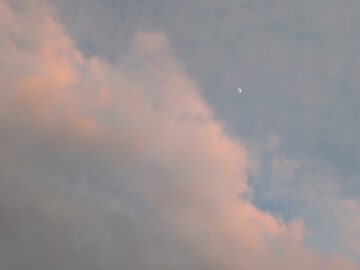
When I began to photograph the sky every day, the first thing I noticed is how quickly the sky changes. If I want to photograph a particular configuration of clouds, I need to go outside immediately, or stop walking to wherever I was going, and take the picture. Those clouds are probably on their way somewhere else, or busy forming or dissolving. The sky, so constantly present, is also the essence of the ephemeral.
I love being so enchanted with what I see out the window that I leap up and run out to take a picture. (And then I turn around and face the other direction and, as often as not, say “Oh!” and take another picture.) However, in general I tried to avoid chasing things. I do a lot of my sky-watching as I walk to the grocery store or the library or to see friends or family. Although I’m sometimes frustrated by human clutter that blocks an otherwise lovely view of the sky, I generally don’t like to search for a better place to see or photograph a particular sky—for example, to chase after a better view of a sunset. I don’t want to turn my love of the sky into a matter of obligation, of time pressure, of ought and should.
Sometimes I feel present and engaged when I’m photographing the sky, but at other times, taking pictures gets in the way of the actual experience. So I’ve formed the habit of sometimes just looking, of engaging only with my eyes and mind, not with my camera. Even if I want to, I can’t possibly photograph every cloud, every shade of blue, every change in the light, because the sky is so changeable.
There are brief elated periods where I try to capture as much as I can—when I’m out walking during the golden hour, for example—but ultimately I wouldn’t want to catch every nuance. Even if it were possible, when would I find the time to look at all of those images again? They belong to the moment, and the moment passes. In order to appreciate and enjoy what’s in front of me, sometimes I simply stand and look.
When I post my photos on social media, I usually caption each day’s photograph as, for example, “Monday’s sky.” Shortly after I began using that description, I recognized its absurdity. It’s generally impossible to characterize a day’s sky with a single image. I thought of the selection practice as a discipline, choosing one image out of the photographs I’d taken, which represented a tiny subset of all the possible images the day had offered. It took me a long time to realize that I was learning about my relationship to impermanence and to the limitations of circumstance.
∞

Around sunset, the sky and the light change so rapidly that it seems almost as if I can feel Earth turning. The last daylight moves up to the tops of the trees and then vanishes. Night approaches as Earth’s shadow rises in the east. So much is going on, and sometimes it can be tempting to try to photograph everything I see. And yet somehow this period can also feel timeless. Even if I’m taking photos, I can become so absorbed in watching the shift from day to night that my sense of anxiety and any time pressure I’m feeling (dinner to cook, chores to complete) can briefly fade—not always, but often enough.
I’ve observed or absorbed a great many sunsets or parts of sunsets since I began photographing the sky. I thought briefly of writing this essay as a humorous exposition on various types of sunset: the classic, the diffuse, the quiet, the glowy. The stealth sunset, the 360° sunset. Sunsets after storms, sunsets with moons, sunsets that look fake. Sunsets observed from the top of a parking garage. My categories began to slide toward the Borgesian, and I remembered that I don’t like to categorize things anyway. So instead I’ll just write a bit about some of the many factors that affect how a sunset looks, and show you some pictures.
∞
Low-angle sunlight provides the colors of sunset, and clouds are often the canvas to which these colors are applied. One of my favorite things about sunset color is the way the color changes with time. Sometimes the first warm golden tinge in the clouds deepens to vivid oranges and reds, which slowly fade to salmon pink and dusty pink. Other times, the colors shift from one group of clouds to another.
Some sunsets sing. Stormy weather in particular can produce dramatic sunsets. Cumulus clouds billow so high that they can catch the very last of the red-gold sunlight; the chaotic clouds after a storm can show countless shades of orange or red. Large diffuse clouds can take on a brief rosy radiance at sunset so that even people who don’t normally pay much attention to the sky are stopped in their tracks.
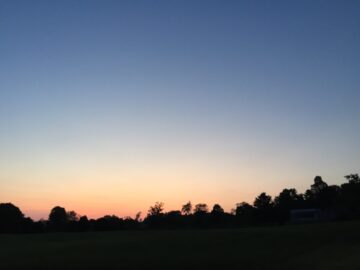
Other sunsets are tranquil. If there are no clouds to catch the brighter colors, there’s usually some sort of haze in the air—often water vapor, in the humid region where I live. This haze shows a quiet, subtle gradation of sunset color at the horizon. I love to let my eye follow the colors up, from the pink or orange near the horizon, up through a band of gold or yellow that’s so pale it’s almost colorless, and then through a million shades of blue into the darkening twilight.
In the city, it can be impossible to completely avoid including human ephemera such as street lights and power poles in my photos. But I there are also plenty of places with trees and grassy fields that enhance the view. There’s a stained glass effect when a sunset is visible through the bare trees of a wooded area in winter, for example. There are certain trees that I visit again and again around sunset, old friends whose branching silhouettes add to the quiet and peace of the closing of the day. It’s always a visual treat when the moon appears near sunset-tinted clouds.

But perhaps the most intriguing thing about sunsets is that you can never be sure what you’ll see. Sometimes the visually interesting clouds I’ve been watching will melt away as sunset approaches, and the sunset will be simply a peaceful glow. Other times it may look as if the overcast is so heavy that no sunset color will be visible, and then the edge of the clouds lifts at just the right moment.
It’s always worth watching, if you can, even for a few minutes. In The Once and Future King, by T. H. White, Merlin tells the young Arthur that the best thing for being sad is to learn something. I agree that learning is one of the best things, but watching the sky, especially at sunrise or sunset, is another. What Merlin said of learning, I would say of skywatching: “That is the only thing which the mind can never exhaust, never alienate, never be tortured by, never fear or distrust, and never dream of regretting.”
∞
You can see more of my work at MaryHrovat.com, or follow me on Bluesky, where I post my photos.
I am indebted for my title to Emily Dickinson, who wrote a poem that begins “I’ll tell you how the sun rose.”
Enjoying the content on 3QD? Help keep us going by donating now.