
Kathryn Hughes at The Guardian:
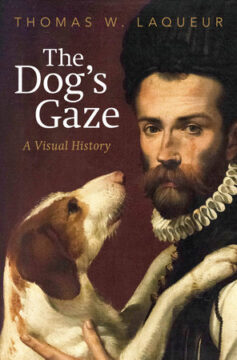 Thirty-five thousand years ago, in the Ardèche region of France, Paleolithic artists drew a spectacular bestiary on the walls of the Chauvet cave. Their focus was apex predators, so there were lots of lions, as well as mammoths and woolly rhinoceroses. Dogs were nowhere to be seen, and yet in the soft sediment on the limestone floor of the cave, there are traces of canid pawprints next to human footprints. Two fellow creatures, most likely a boy and a dog, stood together, about 10,000 years after the art was made, looking up at the walls in wonder. Here was a moment of shared contemplation, followed perhaps by a glance to see the other’s reaction.
In this luminous book, the American cultural historian Thomas Laqueur explores what he calls “the dog’s gaze”. The dog was the first animal to live companionably with humans, and Laqueur argues that this marks the boundary between nature and culture. It is this threshold status that has, in turn, qualified the dog to play a rich, symbolic part in western art. Just having dogs in a picture – snuffling for picnic crumbs in Seurat’s La Grande Jatte or trooping home in Bruegel the Elder’s Hunters in the Snow – becomes a way for an artist to pack an image with extra resonance and second-order meaning.
more here.
Enjoying the content on 3QD? Help keep us going by donating now.