
by Jim Hanas
I remember the rush the first time I entered Manhattan via cab from one of the airports—I don’t remember which one—and felt the density and the pressure. I recognized the blue scaffolding of the city’s endless refurbishments, as seen on Law & Order, and felt that I was home. (I moved here a few months later.) I was staying with a friend on West 17th Street and within minutes I saw my first celebrity. It was Wallace Shawn. I remember him toddling north on Seventh Avenue, paunchy and—can this be true?—wearing clogs. At the time, only Woody Allen would have been a better sighting, and now—well—I’m glad it was Wallace Shawn. The year was 2000 and I was thirty. He would have been fifty-six, the age I am now.
I had seen My Dinner with André (1981) for the first time less than ten years before, with a college friend, shortly after (or before?) we graduated. It was one of those movies I had avoided—though it was around—because what it was wasn’t legible to me. It seemed like old people stuff, with a sad, late-’70s taint to it. I still can’t watch The Bob Newhart Show—the first one, funny though it may be—without feeling depressed. With its wan colors and necrotic leisure suits, it feels like TV from another, possibly socialist country. (Only M*A*S*H survives that era for me. Military fashions never go out of style.)
But the movie finally caught up with me, circuitously, via Jonathan Demme. From Stop Making Sense (1984) to Spalding Gray’s Swimming to Cambodia (1987), I found myself accidentally stumbling around “downtown”—with no sense of what that was as a scene or a neighborhood from my childhood home in suburban Cincinnati—which led to My Dinner with André. Prior to that, Shawn appeared as a waiter in Atlantic City (1980)—his first of four Louis Malle films, André being the second—and in Manhattan (1979), as Jeremiah, Diane Keaton’s previous ultra-virile lover whom Woody Allen is shocked to find out is, well, Wallace Shawn.
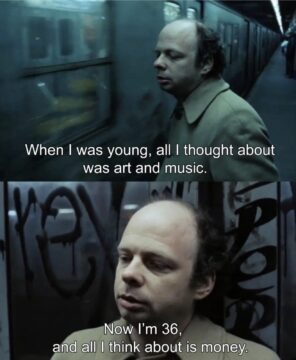
My Dinner with André is best suited to a certain stage of life, and better suited to some eras than others. I was pleased to see it make it as a mid-life meme for millennials (above), though not surprised. André is an autofiction on the theme of how a person should be, to paraphrase the title of Sheila Heti’s genre-defying turned genre-defining 2013 novel.
Shawn and his long-time collaborator, theater director André Gregory, play themselves, delivering a compressed and heightened version of actual events and their relationship. Wally trudges through the Bernhard Goetz-era Manhattan landscape to the titular meeting he has been avoiding. Word is André has been away and has been somehow transformed. Wally resolves to simply ask questions to survive the encounter, which allows André’s journey of self-discovery to unfold. Through a series of ritualistic adventures informed by his mentor, Polish director Jerzy Grotowski, André has sought to wake up from the robotic slumber characteristic of modern life. (Grotowski’s indebtedness to the avant-garde mysticism of G.I. Gurdjieff is often noted, and debated.) These tales are interesting in their own right and pre-figure the florid digressions of late-century recherché post-modernists like David Foster Wallace and Zadie Smith. Shawn, with his beady but bright blue eyes and Cheshire cat grin seems by turns bored, bemused, and offended by André’s self-indulgence. (At times it offends Gregory, too.) Shawn mounts an attack on the egotism of synchronicity and a defense of the quotidian, but still he emerges changed. He treats himself to a taxi and he notices things he hadn’t before. The world is reenchanted, at least temporarily.
The pair would go on to further collaborations. Shawn played Uncle Vanya—the role he was born to play—in Louis Malle’s final film, Vanya on 42nd Street (1994), based on an experimental staging of the play directed by Gregory. Then they appeared together in A Master Builder (2013), Jonathan Demme’s adaptation of the Ibsen play, based on previous staging by Gregory with a screenplay by Shawn. All three, like snapshots in time, share the same perennial concerns. The gap between ideals and reality. The impossibility (or is it merely an impracticality?) of being or becoming “good,” and the pain and disappointment that entails.
This work is newly relevant since a revival is afoot to return to Ibsen and Chekhov, to excavate the painful necessity of the life-lie and the essential tragedy of bourgeois life, which may be the only life we can imagine. Uncle Vanya has been staged three times in New York since the pandemic. The trend extends from the current downtown scene of Dimes Square—Matthew Gasda, who has written a play of that name, has also staged Vanya and written a book titled, a la André, The Sleepers—to Mike White’s The White Lotus. The latter is particularly Chekhovian in that every character is allowed a defense of his or her life-lie and—through the course of a season—each is put into dialogue with the others. But there is no resolution. Life cannot be solved.
It is amid this return to the roots of the modern theater that Shawn and Gregory have come together for what is likely their final collaboration. (Shawn is now 82. Gregory is 91.) What We Did Before Our Moth Days—written by Shawn and directed by Gregory—is currently playing at The Greenwich House Theater, not too far from my Shawn sighting all those years ago. The title is as illegible as My Dinner with André once was to me, but it basically means “what we did before we died.” It is a four-part braided monologue featuring a man (Josh Hamilton), his wife (Maria Dizzia), their son (John Early), and the man’s mistress (Hope Davis). It gets off to a roaring start as Tim—the millennial son—delivers a disorienting tale of sexual debauchery, demonstrating that Shawn could run with the alt-lit crowd, should he care to. As the story, and characters, unravel there are strong, intimate moments, but even as those on stage question their own choices and ethics, it seems like rarified air. Dick, the writer and husband, is a comfortable Manhattanite novelist of a kind I’ve failed to meet in more than twenty-five years in New York, and which arguably no longer exists. The precarious Aggie Wiggs—Claire Danes’ character in The Beast in Me—seems more up to date.
So despite copious self-reflection, the play invites the complaint one hears from half one’s friends about White Lotus. Aren’t there better things to be thinking about than rich people? Perhaps, but Shawn—who, as the son of the benighted New Yorker editor William Shawn, would today be pilloried as the rankest of nepo babies—is determined to gaze into his blindspot. This is better demonstrated by his revival of his 1990 monologue The Fever, which is playing in rep with Moth Days. If André staged a contest of worldviews between two friends, The Fever reenacts the conflict within Shawn himself.
At my second ever sighting of Shawn—New York is a big place—he mixed with the crowd before he took the stage, hugging a masked Cynthia Nixon, who sat two rows behind me. He really is a tiny man, though he was not paunchy and did not wear clogs. Shawn warmed up the audience with a few anecdotes, holding it easily in the palm of his hand. His trademark lisp and high-pitched voice belie how clear and self-possessed his speech is, the contrast that made him the perfect Vanya. The Fever is a monologue about a man like Shawn who finds himself sick, in a poor country, confronting his own complicity in global suffering, which makes it sound more didactic than it feels. Shawn cleverly explains fetishism of commodities, for example, after a stranger leaves a copy of Capital on his doorstep. In modern parlance, it dramatizes someone of Shawn’s level of privilege becoming a red-pilled socialist—as he readily identifies—while facing the fact that he doesn’t have the strength to do anything about it. “When we were young, all we thought about was art and music,” as the Andre meme on adulting goes, “Now all we think about is money.” Life, at least this life, is not solvable. One feels, as in André, that he will treat himself to a cab home. I myself took an Uber. So much has changed since our first meeting.
***
Enjoying the content on 3QD? Help keep us going by donating now.