
by Mike Bendzela
Around the year 2005 I stumbled upon a rather disturbing website called DieOff.org, which is no longer extant. (Don’t try to go there: The url now leads to porn.) Run by the late Jay Hanson, it provided a wide-lens view of humanity’s future based on such physical realities as ecology, mining and minerals depletion and, most importantly, declining energy resources, in particular the fossil fuels. It seemed our species’ prospects were rather stark and dim (hence the site’s name). There I discovered an important article by geologists Colin J. Campbell and Jean H. Laherrere called “The End of Cheap Oil,” first published in Scientific American in 1998.
I immediately recognized that I was re-encountering some of the lessons I learned in an influential college course I took in 1980 called Geology and Human Affairs, taught by professor Mark J. Camp at the University of Toledo in Ohio, co-author of Ohio Oil and Gas. I had just dropped my geology major, simply because I couldn’t hack the math and chemistry, but even as a humanities major I wanted to keep taking science courses. Camp’s course was listed as being for non-majors, so I enrolled, thinking I would be learning about historic earthquakes and volcanic eruptions, and perhaps about the uses of precious gems and minerals and such. Happily, I turned out to be very mistaken. It was a course I would never forget.
Camp’s course was a tour (and tour de force) through modern humanity’s dependence on the fossil fuels and other planetary energy resources. We learned all about coal, petroleum, natural gas, and then on to fission nuclear and breeder reactors; then to possible future “alternatives” such as wind and solar, and finally what CO2 emissions might mean for the future. It was one of those courses that changed one’s perspective. I was no longer “energy blind,” as analyst Nate Hagens puts it. I left with the feeling that by the year 2000 humanity would be seeing an immense flock of chickens coming home to roost. But that was still a long way off!
In their SciAm article, Campbell and Laherrere reiterated a similar message. Their claim:
Using several different techniques to estimate the current reserves of conventional oil and the amount still left to be discovered, we conclude that the decline [in production] will begin before 2010.
This has turned out to be wildly wrong, of course. But while reading this in 2005, I thought it made perfect sense, given what I had learned in Professor Camp’s course. Because of their genesis — from the buried forests that seeded the coal seams to the vast ocean algal sediments that prefigured the formation of oil and natural gas — the fossil fuels are finite, period, which means the oil extraction rate must taper off at some point. Their article is long and contains no hocus-pocus, just figures, estimates, and calculations of reserves, production rates, and future decline rates. Their work is based on the pioneering views of M. King Hubbert, a Shell petroleum geologist who spent a lot of time studying how oil wells gradually declined in production. As go individual wells, he observed, so go entire fields; as go entire fields, so provinces. And, eventually, he surmised, the whole world. Campbell and Laherrere’s article was an attempt to quantify and predict the inevitable decline in world oil production that Hubbert foresaw.
A particular passage in their article galvanized me:
Perhaps surprisingly, that prediction does not shift much even if our estimates are a few hundred billion barrels high or low. Craig Bond Hatfield of the University of Toledo, for example, has conducted his own analysis based on a 1991 estimate by the U.S. Geological Survey of [1.55 trillion barrels] remaining—55 percent higher than our figure. Yet he similarly concludes that the world will hit maximum oil production within the next 15 years.
Amazingly, Craig Hatfield was yet another professor who influenced me while I was a geology major at UT. I understand that the line between trusting an expert and the Appeal to Authority Fallacy is tricky: But whom else is one to trust if one knows little about a subject? I was particularly impressed that Hatfield had published these findings in Nature magazine, meaning he was no slouch in the subject of oil depletion. I knew Hatfield as a rigorous, methodical professor who taught the course Historical Geology, wherein I learned how the Western Interior Seaway came and went on the North American continent over geological time and what this meant for the American landscape and its resources. It was a tough course; I got a B. Then I drifted into drawing and painting, and finally American literature, but I never forgot him.
Now hooked on the subject, I managed to dig up some of Hatfield’s other work. The title of an article he published in the M. King Hubbert Center Newsletter is perhaps the most direct, succinct and accurate statement of the problem I have seen: “How Long Can Oil Supply Grow?” Yes, that is the right question. Not “When Will Oil Run Out?” nor “How Much Oil Is Left In The Ground?” nor “When Will The World End?” The issue concerns timing (“How Long”), flows (“Supply”), and, most, critically, growth, or, rather, when growth ends, not when oil ends. But I would soon discover that casual observers of the problem simply could not tell the difference between the end of growth and a full-on, running-out-of-oil apocalypse.
Twenty-seven years after taking his class, while away from Maine visiting family in Toledo, I would look up Hatfield and go to his house to interview him and learn more about this phenomenon of a worldwide oil “roll-over” in oil production. It now had a name, “peak oil” (a term coined by Colin Campbell, I believe, although Hubbert was the father of the concept). After a nice chat in his living room, wherein he inquired what I had been doing with my life, I turned to the topic of his past articles and wondered if he had written anything since his retirement from the University of Toledo. Surely now that “peak oil” had become something of a meme, he was contributing to the literature.
No, he told me, it’s too late. Oil decline is just over the horizon, probably 2015 at the latest, and building out the infrastructure for alternative sources takes too much lead time and investment, which just isn’t happening.
“Our nation’s current attitude toward this dilemma is serene apathy,” Hatfield has written. “We have no long-term energy plan. We don’t even seem to recognize the existence of a long-term problem. Rather, we simply vacillate from panic to complacency in response to short-term shortages and surpluses.”
I was so impressed with Hatfield’s knowledge of the subject, and with the way he chose to stay completely out of the public eye about it even as the idea gained traction, that I wrote up an interview with him and published it at the now-defunct blog, The Oil Drum. Reading it nearly twenty years later, I’m still struck by Hatfield’s matter-of-fact candor.
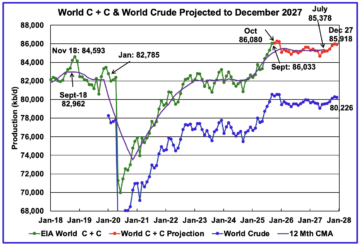
I recently learned that Professor Hatfield died last spring, at home, a month after his 90th birthday. A few months later, world oil production reached a new record high of over 86 million barrels of oil per day. This beat the previous record of 84.5 million barrels set back in November of 2018. At that time, production tapered off for over a year, was slammed by the Covid shutdown in 2020, then clawed its way back up. I often wondered what Professor Hatfield thought of this development, but I never got to ask him.
It is interesting to take stock now of an issue that appears to have undergone a thorough self-refutation. When I was 45, I was about 99% certain I would be alive to witness a great turning point in human history, a sea-change in the deployment of fossil energy throughout civilization. Now that I’m 66, I’m about 50% certain that I’ll be dead before it even matters. I now weigh probabilities much more conservatively to remain utterly agnostic on the issue.
“Peak oil” for some observers was as much a vision of a transformed future as it was the trigger of world die-off, as in Jay Hanson’s calculations. Suburbia will have to be bulldozed, some of us thought, and in its place will be thousands of small, relocalized farmsteads. That bane of the American landscape, the personal automobile, will have to go! Imagine the construction of hundreds of thousands of miles of high-speed electric rail across the United States. No more traffic congestion or pollution. And CO2 emissions will be forced to decline, as less oil means less burning, forestalling the horrors of future climate change. We will have no choice but to downsize and relocalize. Peak oil could usher in a Renaissance of planetary care and sobriety.
Fat chance.
My main takeaway from studying this phenomenon is that science is hard. Prediction is the sine qua non of the scientific method, but sadly, in this case anyway, the problems around making an accurate prediction are intractable.
Why the failure? I don’t think it’s because Hubbert, Campbell, Hatfield, et al. were incompetent. Perhaps resource estimates are inaccurate and impossible to attain; or perhaps “above-ground” issues are too confounding to make an accurate prediction possible. Maybe peak oil cannot be predicted so it’s pointless to try, like a patient with a disease that is 100% fatal asking his doctor to state exactly when his health will start to decline.
At this point, predictions have failed so frequently it’s unlikely any future predictions will be listened to anyhow. People become habituated to failed alarums, like the villagers in Aesop’s fable of the shepherd boy who cried “Wolf” (n.b.: the wolf shows up at the end). They have “alert fatigue.” Like logging on to a secure website, you’re only permitted so many attempts before you’re shut out.
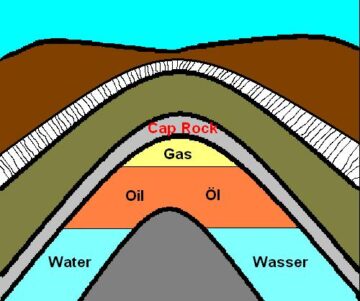
Petroleum is still a finite resource, and the horrific truth is that humanity is burning through this stock as if utterly blind to this fact. We have at our disposal hundreds of millions of years of fossilized solar energy “trickle charged” into the earth’s crust, and we’re pissing it away. I can’t recall the source of the following quotation but its blunt obviousness has really stuck with me. I paraphrase it this way: In order for the molecules in a barrel of oil to be useful they have to be destroyed. Once the oil is destroyed, the energy is dissipated and the shattered molecules left behind, CO2 primarily, build up in the atmosphere as greenhouse gas. The original long-chain molecules don’t regenerate themselves, and their lost energy is unrecoverable: entropy rules.
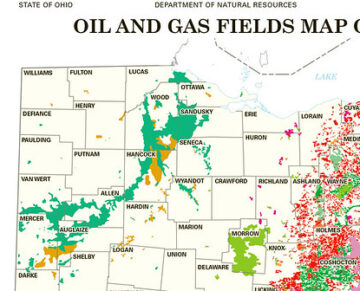
Anyone who thinks the finite nature of petroleum is not an issue should take a ride through the suburbs and farmlands south of Toledo, Ohio. Lucas and Wood counties were once within the boundaries of the largest oil field to have ever been discovered in the 19th century. This was the Lima oil field, part of the Trenton Limestone formation, extending all the way into Indiana. Original oil in place is estimated to have been something like one billion barrels of sour, sulfurous oil. The traveler will find nothing left of the oil extraction industry near Toledo, not a single nodding donkey, nothing.
US Census reports from the early twentieth century list two of my great-great grandfathers, one in Wood County, the other in Sandusky County, as “oil pumper” and “oil field worker.” This floored me when I learned about it: All traces of the oil boom in Northwest Ohio have completely evaporated. My mother, who was raised in the thirties and forties, has only the vaguest memory of seeing a pump jack in the countryside around her grandmother Blanche‘s house. Tell anyone in Toledo that they live on top of an extinct oil field and they will look at you like you have a hole in your head. And anyone in Texas who doesn’t think their mighty oil fields, too, will go extinct really does have a hole in their head.
The discovery of new petroleum deposits has long lagged behind yearly extraction totals. In fact, such discoveries peaked in the 1960s, and 2025 was the worst year in decades for new discoveries, with only about one barrel being discovered for every six consumed per year.
While the overall extraction rate continues to grow, the rates in most countries keep declining. Lately new growth has largely come from light tight oil in the United States. This so-called shale oil is being hydraulically fractured out of source rocks in an ever-diminishing number of places, the Permian Basin in Texas and New Mexico now being the most prominent.
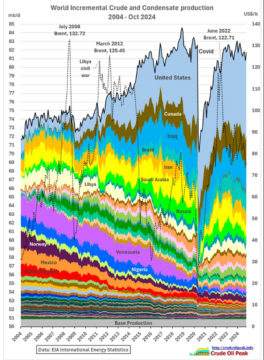
The chart I reproduce here by Matt Mushalik is a brilliant piece of work. I think of it as an angiography of world oil supply: In an angiogram, a contrasting dye is injected into a patient, and then the patient is subjected to an X-ray, which lights up all the blood vessels for inspection. This chart gives us such a view of what is happening below the surface. We’re used to seeing just that top line in oil production charts (like the one at the top of this article) which shows the total barrels of oil pumped per day. While this chart is two years out of date (that top line now extends beyond 86 million barrels per day) it shows in literally vivid colors what has been happening to oil growth for over 20 years now. The predominance of “growers” is shrinking.
That jagged-but-flat rate from 2004 to about 2010 reveals a stagnation that led to the spike in oil prices in July of 2008. This was followed by the subprime mortgage crisis and financial crash and a subsequent free-fall in oil price. (Analysts argue to this day over how much that temporary oil spike had to do with the crash.) “Peak oil” was in its heyday: The predictions seemed to be coming true. But then something remarkable happened in the United States: A technology that was developed in the 1940s, hydraulic fracturing, was being dusted off and improved upon. Combined with horizontal drilling, fracking allowed previously-inaccessible source rocks to be freed of their “tight oil.” Simultaneously, projects were being developed in post-war Iraq, and Canada began doubling down on its production of bitumen, which is basically a heavy oil that is mined along with sand and separated from it through the use of natural gas. Thus, oil supply was stimulated to grow again beyond the peak in the early 21st century.
But take a look at what happens below that big wedge of US fracked oil at the top of the chart: Canada and Iraq barely keep supply flat, and below them all other oil producers added together keep declining.
Now you can appreciate why I continue to wonder: “How Long Can Oil Supply Grow?”
Enjoying the content on 3QD? Help keep us going by donating now.