
Emily Watlington at Art in America:
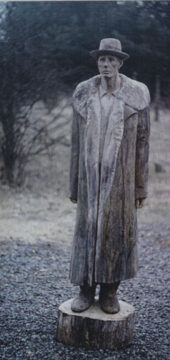 ALL THE DOUBLING MAKES Beuys a tricky figure. And it’s not clear how intentional it all was: Was his healer persona a clever conceptual act, or proof of his repression and self‑delusion? Probably both; and Spaulding does not—and presumably cannot—parse this out. Instead, he focuses on what the doubling does. Taken in good faith, Beuys’s evasive equivocating risked obstructing rather than enabling an honest reckoning with the past, Germany’s or his own. But it did something else too. Spaulding’s book centers around Beuys’s “economimeses,” a term borrowed from Derrida to describe how his work mimicked capital in order to critique it. Capital, after all, is an abstraction that mediates all social relations; Beuys wagered that art could also do this, and do it better. He made work attempting to prove this point.
Where his contemporaries, like Andy Warhol, turned to commodities and readymades as capitalism’s metonyms, Beuys focused on capitalism as a system and on money as a mediator, signing bank notes and writing “Kunst = Kapital” (“Art = Capital”) on them.
more here.
Enjoying the content on 3QD? Help keep us going by donating now.