
by Anton Cebalo
Bibiheybat is a settlement on the outskirts of Baku, Azerbaijan. Located along the Caspian Sea, the region became the crown jewel of Imperial Russia for its resources. Modern oil production as we know it today began in this tiny town. In 1846, the Russians began drilling here. It was the first time an oil well was drilled mechanically instead of dug by hand.
By the late 1800s, large oil fields were discovered offshore. Baku by then was producing over half of the world’s demand. But the labor became incredibly dangerous, and oil gushes were common. High-pressure blowouts would spew oil, mud, and gas into the air, and sometimes even ignite. Azerbaijan was known as the “Land of Fire” as these infernos billowed black plumes into the sky.
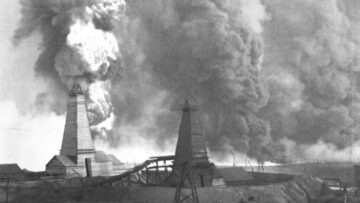
Russian cinematographer Alexander Michon was in Baku at the time and witnessed one such fiery blowout. Using a fixed hand-cranked Lumière Cinématographe, he captured the scene in a 30-second silent film in 1898. Titled The Oil Gush Fire in Bibiheybat, it is considered the first film shot in Azerbaijan.
Michon was operating in the genre of actuality films. These were proto-documentary B-rolls that captured daily life, much like still photography would. Given that film was still a new medium, actualities dominated these infancy years as cinematographers sought to depict life “as it really was.”
And Michon did so for Azerbaijan, even in all its ugliness, and in doing so he also created the first eco-horror film. In a time of intense imperial extraction, the viewer is met with a spectacle of terror as uncontrollable environmental forces are unleashed. Practically the entire frame is filled with hellish smoke, periodically lit by fire. Workers had to improvise to contain it by throwing mud and water on it, to basically no effect. It’s said that the disaster was visible some 10 kilometers away.
Horror is defined by a few key themes. Firstly, it contains the unknown and the often terrifying. Secondly, it unnerves us through transgression and the breaking of regularity. Thirdly, horror assaults the senses to overwhelm them. And lastly, horror contains a grotesque quality: something unnervingly unnatural.
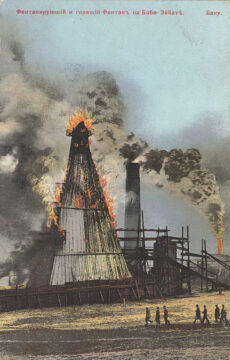
All four of these themes are not present in every horror film. Yet, Michon arguably succeeds on all counts by simply placing a still camera. Eco-horror is part of the tragic story of empire, as if the Earth is violently rejecting our demands, and Michon captured it on film at the birth of cinema.
Michon would document yet another oil gush that year near Baku, in the settlement of Balakhany. This footage would be more muted, with a single rig spewing plumes into the sky. Other actuality footage was also collected that year by Michon: people walking in the park, trains entering stations, and folk dances.
“The Oil Gush Fire in Bibiheybat” shows the world on the cusp of modernity. Railways, telephone lines, schools, and other civil infrastructure came to Baku to support this industry. The population boomed to 200,00 by 1913 from just 15,000 in 1860. But while these changes brought promise, they just as easily brought peril. Modernity is defined by this inextricable tension, and Michon’s film forces us to confront the ecological unknown and its consequences.
Enjoying the content on 3QD? Help keep us going by donating now.