
by Michael Liss
For several centuries, as we moved from farm to city, the human ear has engaged in a ceaseless battle against the noise caused by human ingenuity.
The ears are losing. It is loud out there, even in my bucolic and serene New York City. Just getting around can be sonically disruptive. Trucks, especially the multi-axel ones that go through 10 forward gears while they bang-bang-bang over winter-roughed asphalt. Buses, whether newer ones with their air brakes, pneumatic doors, and kneels, or the older version tricked out with diesel engines that sound like an aging warthog with catarrh. Cars—the ones driven by those whose keen sense of anticipation allows them to lean on their horns before the light turns green or who have retrofitted their sound or exhaust system to resemble either a mobile disco or a shooting gallery (and sometimes both).
Want to see New Yorkers come together? Place on the ballot a referendum mandating three days in the stocks for the worst of the worst. Second offenders must limit themselves to Smart Cars with dealer-installed elevator music.
What about our glorious Central Park? Surely, it’s largely carless (except for the odd official vehicle or ambulance)? Yes, it is a place where my running buddies and I can thock-thock, scrape-scrape, wheeze-wheeze to our ears’ delight, but that doesn’t make it intrusion free. Not only does it harbor lurking delivery guys in spacesuits and oven mitts, but it’s also home to high-speed pelotons shouting out the occasional “ON YOUR RIGHT!!!” Those guys flashing the upscale gear and first-class lungpower don’t have a lot of patience for the hapless pedestrian or runner in or out of his designated lane.
OK, that’s way too much complaining about a place that gives me so much satisfaction. The fact is we need quiet, and we need sound. Most of all, we need to communicate. It’s a human thing to do. It also may be a Neanderthalic thing to do. According to the all-knowing AI, musical instruments like the flute have been around for at least 40,000 to 50,000 years.
What’s the perfect “pH” for sound and silence? Surely, it’s based on the idiosyncratic needs of both the person and the community.
The play (and movie) Children of a Lesser God gets at this. The completely deaf (and voiceless) Sarah is alienated and alienating. When she wants to communicate, she signs furiously. James, a teacher of the deaf, struggles with the sheer intensity of the effort. From time to time, he escapes into Bach. There’s a painful, but hopeful scene where he listens to the Double Concerto in D Minor, and she wants to be shown what it’s like to experience the music.
…. Music starts with pitches. … Sounds! High and low. A whole, huge range of sounds. And each one has its own emotional life. And then when you combine them and play them together—these two and these two—it has a whole new life. And then you can play them on different instruments—trombones, violins, flutes, and drums—The combinations are infinite! And then when you put it all together…. It transcends mere sound and speaks directly to your heart—because you hear it!
Of course, that’s fiction. In the real world, how do we hear it, our music, and that of others? How do we sort out meaningful communication from noise? This is, of course, a particularly difficult question when so much in our world is alienating, but it’s not exclusively a political one. If anything, our failures are as much passive, a result of pre-existing choices fed into an algorithm, as they are active, seeking out things to disagree on. Look at your email this morning, put aside the never-to-be-repeated sales, and check that pH balance. How much of what was left was sound, and how much noise? Did it speak directly to your heart? Did you hear it?
I got lucky when, on January 9th, in the early evening, I did. I was doing the obligatory every hour on the hour checking of the email and found there was something going on at Symphony Space for March 12th: “Tony Trischka In Residence: NY Banjo Night.”
Banjos! What’s not to like about banjos? I field-tested the word on my wife, who rewarded me with some comment or other that I loosely translated to “Husband, you are wonderful, what a terrific idea!” Banjos—cool. I promptly reached out to two friends who live near the theatre, sadly, he couldn’t make it, but she could. Three it would be, and, as the seating charts were filling rapidly, my wife grabbed tickets. Good she did: Apparently, others also liked the idea of music played on a gourd with metal and skin, and the remaining seats in the 715-person-capacity theatre were promptly snapped up.
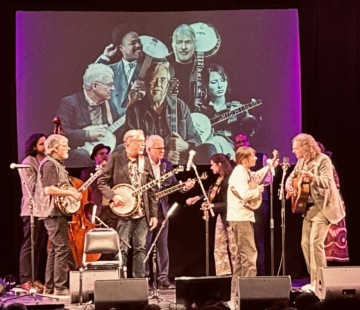
That’s what New Yorkers rush the box office for: Banjos, and banjo players, along with a few other blue-grassy types. What to expect? Trischka’s band included Michael Daves (guitar), Brittany Haas (fiddle), and Jared Engel (bass). There was Nora Brown, banjo and vocals, pairing with her friend Stephanie Colman (fiddle). Jerron Paxton on banjo, briefly joined with guitar by the multi-instrumentalist Dennis Lichtman.
That is a ton of talent, but there was still more to come. Béla Fleck, perhaps the best banjo player in the world (at 67, he’s still adding to a list of 17 Grammys and 39 nominations) would be performing, as would the veteran true-crime podcaster Steve Martin.
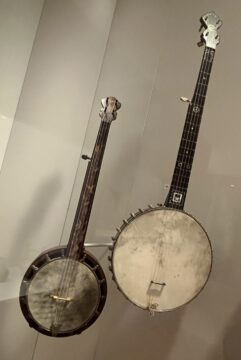
I was just looking for a good distraction. Instead, I found potential riches—and a test that needed prepping for. A trip to the Metropolitan Museum offered some particularly interesting-looking banjos and some interesting-reading descriptions. The banjo is not exactly a violin de gamba, played in some princeling’s court for the be-wigged. Rather its roots go back to 17th-century Africa, where gourds were used for the body of the instrument and scraps for much of the rest. Soon-to-be slaves brought them (or the knowledge of them) to American Colonies, where plantation life included banjos for entertainment, special occasions, and in religious ceremonies. They were seen, quite literally, as instruments for the enslaved. Whites did not adopt them in numbers until the development of minstrel shows in the first half of the 1800s.
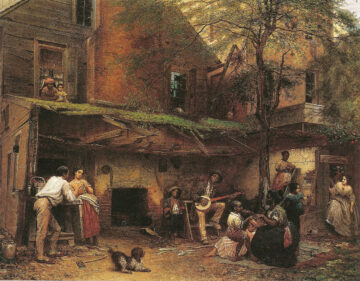
That painting to your right is by Eastman Johnson, who was a founder of the Met, and executed “Negro Life at the South” (also known as “Old Kentucky Home”) in 1859. Three things jump out. A mixed-race group of slaves, the dilapidated state of their home, and a banjo. Banjos were not toys of the affluent.
Over a period of several decades, there was a significant switch. Some influential blacks, Frederick Douglass amongst them, saw minstrel shows, with their grotesque stereotypes, as profoundly insulting. Blacks began to distance themselves from the instrument. The minstrel era eventually died out, but, while Blacks were estranged, the banjo was adopted by more rural southern and Appalachian whites, and was used in folk, country, and bluegrass music.
I wanted to know more, and I wanted to hear more. Most of my banjo listening had come in small packages, from fictional characters like the Darlings on Andy Griffith, the Beverly Hillbillies, and on variety shows when we hung out with grandparents. The rest came from folksingers like Burl Ives, and particularly Pete Seeger. The banjo went well with songs that also blended in a sense of purpose. Here’s Seeger performing solo on “Darling Corey” and with the Weavers at Carnegie Hall. You can see how the piercing twang of the banjo conveys a sense of urgency.
I dug in a bit further. YouTube turned out to be a real source, especially on the Bluegrass side. Let me share just a few.
Here’s “Three Bluegrass Banjo Styles Explained with Noam Pikelny | Reverb Interview”
And Béla Fleck & Abigail Washburn: Clawhammer vs. Three-Finger Banjo Style | Reverb Interview
Earl Scruggs “Foggy Mountain Breakdown” with JD Crowe Bill Emerson Sonny Osborne and More
Or you could just hunker down with Bluegrass Preservation
None of these made me a banjo player, any more than reading the libretto of an opera before the curtain came up would have made me a good Tristan, but I had a good time.
B-Day came and with the aid of the subway (no laughing, this is still a New York story, and yes, we emerged to the sounds of honking), we made our way to Symphony Space.
Crowded—a lot of people for that space, most middle-aged or older. Casually dressed, but respectfully—a lot more khaki than jeans. Everybody smiling. In they filed, finding their appointed seats, with a minimum of ego breakdown. I held out hopes that we would all have an unobstructed view. There was a pleasant buzz going on, not so unlike an audience for opera or a classical concert, but with different expectations–a little more relaxed and ready to have some fun, a bit less wondering if this would be a night for inspiration and awe. We might get a mournful tune or two, but not Tosca jumping off the parapet.
With about five minutes to go, a bit of misfortune. The seat in front of my wife was filled by someone with hair that looked like the Flying Nun. And, curses, the seat in front of me was now occupied by a woman who had to be a basketball player. I’m not the tallest guy, but unfair genetics were going to mess with the plan. The point guard stayed put, and I began to stretch my neck into a variety of positions. The music began, and off we went.
It was great, pointguard or not. How generous they all were, both with their time and their fellow artists. The first part was 90 minutes long, not a note out of place, nothing hurried. They just enjoyed themselves and we (all 715 of us) enjoyed them. Recording was forbidden, so to give you an idea of how they sounded, here’s a YouTube taste of same performers, other performances:
Tony Trischka, Michael Daves, and Brittany Haas – Fox Chase I have to say that live, or online, Brittany Haas can play the violin.
Here’s Nora Brown and Stephanie Coleman (NPR Tiny Desk Concert)
The partners, on their way to Europe to perform, did something to me I didn’t expect. The first few minutes of their set, I wasn’t that engaged. Maybe it was tempo and a lack of bounce. Then, something clicked, a sense of place, far away, maybe even out of reach, but unerasable. I’m sold.
Next up, Jerron Paxton and Dennis Lichtman, and a ragtime piece from Lichtman’s own channel. Lichtman is an amazingly good accompanist. He effortlessly blends. Paxton combines two qualities—great technical chops, and the knowledge that he’s an outlier among banjo players—he’s black, and he quite consciously brings that to the table.
First up after the Intermission, the insanely talented Béla Fleck. Fleck does things that others don’t, both in his choice of rep and his sheer technical brilliance. He performed several pieces, but two come to mind specifically–the first being his extraordinary mastery of Bach, and then having his banjo carry the entire ensemble in Gershwin’s “Rhapsody in Blue.”
Let’s do something different with him and Bach.
Here’s Fleck performing Prelude from Partita No. 3 for Solo Violin (BWV 1006) (Instrumental)
Now this. The (run-out-of-superlatives) Jasha Heifetz’s performance of the same Bach piece, recorded more than half a century earlier.
Maybe it’s me, but they’re eerily alike, aren’t they? Different instruments, different eras, different sound equipment, but when I heard Fleck play it was almost a ghost-like experience. As he finished, I felt more than a touch of awe—and a memory that some critics had called Heifetz “cold.”
Finally, Steve Martin. It wasn’t a joke performance—the man can definitely play. But I can’t make up my mind about him in this role—and maybe he can’t make up his mind either. He seems a good ensemble member, blending into the larger group. It’s when he’s center stage that he seems less trusting in his talent and reverts to joking. He ended his set with “Caroline,” it’s funny, he’s talented, and you can judge for yourself.
The show ended, reluctantly, with happy artists performing together and then milling about on stage, and a cheerful audience smiling, standing, applauding, and otherwise showing the people around them they were glad to have shared the space. For almost two and a half hours, we’d been entertained, occasionally challenged, and basically just made happy. All those banjos had a bit of magic in them. My wife and I walked our friend back to her building and then took a cab home. It was late on what we used to call a “school night.”
The late, great jazz pianist Thelonious Monk was quoted as saying, “The loudest noise in the world is silence.” If you consider that was almost self-referential (Monk’s idiosyncratic, impossible-to-duplicate style used silence prolifically), you can almost agree.
But for now, I wish you all a night at whatever Symphony Space is near you. Listening to some pickin’.