
by Barbara Fischkin
Round about St. Patrick’s Day, in the Spring of 1984, my Jewish mother, Ida Fischkin, learned that within months I would marry Jim Mulvaney.
She offered enthusiastic congratulations, as did my father. They loved Jim. We had been living together for a few years.
“Please tell me the honeymoon is in Aruba,” my mother said, sounding hopeless. She had already guessed where we were headed: Ireland, setting up shop in Dublin then establishing an outpost in Belfast to cover the raging civil war.
Jim and I exchanged vows on June 17, underneath a proper Jewish chuppah on the outdoor deck of an Irish style pub-cum-restaurant on the shores of New York’s Jamaica Bay. In less than two weeks we would move across the Atlantic. Jim and I were both newspaper reporters and this ancient Celtic-versus-Anglo story had raged again in recent years, although it bored most American editors. Jim pitched our bosses at Newsday with a suggestion of a Ireland bureau to appeal to the large number of potential readers who claim Irish ancestry – 6 percent of residents of New York City, double that on Long Island.
During the weeks leading up to our wedding, I realized how fortunate I was to have a mother who, like me, appreciated the value of risk and adventure, particularly if these included happy endings. As a six-year-old, in the midst of an Eastern European pogrom, my mother had saved her own life, astonishing my grandparents, who thought she was dead. A different sort of mother could have made those days of frantic preparations hellish instead of compelling.
There was, though, one small problem. Something else was going on in the complicated brain my mother had developed despite minimal schooling. I could hear her inner voice, clear as a bell:
“Your father and I absolutely cannot wait to spend Rosh Hashanah in Dublin.”
For my mother all things Jewish took precedence. And, Rosh Hashanah, the Jewish New Year, was extremely high on her list of all things Jewish. There was no way she was spending her favorite holiday in Brooklyn while her daughter was in Ireland. I wondered if, for her, this also meant Yom Kippur in Belfast.
Finally, I summoned the courage to ask her. “Will I see you in September?” I said. She nodded, emphatically.
For a few days—until I came to my senses and assessed my priorities—finding a wedding dress at lightning speed did not seem anywhere nearly as pressing as how I would pull off Rosh Hashanah in the decidedly Catholic Irish Republic. Could I find a shul in Dublin? Rosh Hashanah without a shul service was akin to Christmas without a tree. Or worse, without Jesus.
The truth: I knew a lot about Jim Mulvaney when I agreed to marry him. But agreeing to marry him—and almost immediately moving to Ireland—was a different story. What I didn’t know about Ireland as it existed in the 1980s could fill the Book of Kells and more. Mostly, it sounded like fun. My modus operandi—then as now: Jump then look. I figured I could learn more about Ireland when I got there. And I did. I dug in. With books, theater, pubs and everyday people, including the women at crowded beaches who unabashedly wore Maidenform brassieres in lieu of bikini tops. It was an unusually warm Dublin summer.
I also had a lot to write. Often I would send Jim off to Belfast and work on the stories I wanted to make mine. Stories I never knew existed as an American journalist. Stories that affected Irish women more severely in the supposedly liberated Republic. (For instance there was a ban on divorce that tied many to abusive husbands for life). The Dail, the Irish Parliament, was also preparing to consider what was jocularly called, “The Condom Bill.” It would permit unmarried people to use contraceptives and hopefully prevent many unwanted pregnancies. For me, this was confusing since women in Dublin could get most types of birth control they needed at the Well Women Center, conveniently located in a tony central neighborhood. A country woman who had a bit of money for bus or train fare to the capital, and enough nerve to defy the teachings of her local priests and nuns, could get the same, no questions asked. It seemed that the only people asking questions about the legality of birth control were male members of the Dail.
There was also a great story in County Wexford. An unmarried school teacher named Eileen Flynn, had lost her job because she had a baby with her lover. Soon after I read about this in the Dublin newspapers, I rushed off to Wexford before Ms. Flynn changed her mind about giving me an interview.
Too soon, the weather changed. The atmosphere in Dublin became more Irish, infused as it was with nearly constant soft rains. A damp letter arrived from my mother, reminding me how thrilled she would be to “usher in the Jewish New Year in Dublin.” I tried to remember if since our arrival, I had learned anything about Jewish life here. Anything beyond reading portions of Ulysses and finding out that the fictional Jewish everyman of Dublin, Leopold Bloom, was, strictly speaking, a goy. His father was Jewish. His mother was not.
By then I knew that Dublin once had a Jewish Lord Mayor named Robert Briscoe. But hadn’t he also been a leader of the rebellion that created the Irish Republic? Would he even have had time to daven? His son Ben was a member of the Dail. I had interviewed him. But it was about condoms, not Jews. A golden opportunity missed. I seemed to remember there might have been a Goldberg, who held the Lord Mayor position more recently in Cork. But that was another city altogether. Maybe Cork had more Jews than Dublin. I had no idea.
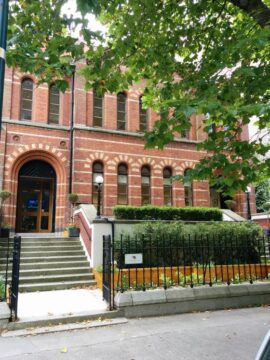
Then, as luck—mazel in Hebrew—would have it, I inadvertently stumbled upon a shul, which was actually a large synagogue. I wondered how I had missed this, since this decidedly Jewish house of worship was a few minutes walk from our flat in a mews house behind Dublin’s elegant Fitzwilliam Square. The Dublin Hebrew Congregation sat in the midst of Adelaide Road, a street I had yet to explore on my walks around the city. Its hearty Romanesque Revival brick and stone building built in 1892, seemed to mock my reportorial failure to find it. Years later, the congregation would merge with another Dublin area temple—yes, there was more than one. But in September of 1984, it was going strong. Rosh Hashanah was fast approaching and within days my parents would be arriving. I needed four High Holy Day tickets and I needed them fast. In New York, those tickets were sold (for fundraising) weeks or months in advance. Would there be any left?
I marched into the hallowed halls of the Dublin Hebrew Congregation. Then, I softened my step, praying for a miracle, perhaps from a saint, this being Dublin. Miracle delivered: A secretary in the synagogue office presented me with four tickets. Two for my father and husband, downstairs. And two for my mother and myself which she told me would be “upstairs in the women’s balcony.” Holy Moses, I thought. This place is even more orthodox than the allegedly orthodox B’nai Israel of Midwood back home, where my father was a perpetual president and where the men and women sat on the same floor.
Tickets in hand, I was asked my husband’s last name.
Somehow, even though this was Ireland, Mulvaney did not sound right. Not for a shul. Even a glorified one. And certainly not for one so religious women were relegated to the balcony.
“Fischkin,” I said, anticipating marital strife in the land of no divorce.
“Lovely,” replied the shul secretary. “And your father’s last name.”
Uh-oh, I thought.
“Fischkin,” I said.
“Ay, your husband and your father have the same last name?”
“It’s a common one in Brooklyn,” I replied.
She gave me a look which, since my arrival in Ireland, I had learned to translate as: “Another crazy Yank.”
I went home and found my husband back from the wars in the North.
“Good news,” I told him. “We have four tickets for Rosh Hashanah.
He was not moved.
“There’s a Dublin Hebrew Congregation,” I reported. “Just a few minutes away.”
Silence.
In Mulvaney-speak that meant I had better tell the whole story.
“There’s just one thing,” I said. He nodded and flipped through the pages of a reporter’s notebook that smelled a bit like a petrol bomb.
“One thing?” he said, still flipping the pages.
I coughed, “Yes, when you go to shul your name will be Jim Fischkin.”
“And that is because…”
“It’s an old Irish custom,” I replied.
Nothing, in Dublin at least, blew up after this. And despite the characters involved the subsequent Rosh Hashanah shul day went well. My mother, in her balcony seat, did briefly turn into a rabid Jewish feminist, bragging Bella-Abzug style that in her orthodox shul the women sat close enough to the men that couples in center aisle seats could hold hands. (I had never seen this happen). Fortunately a woman who sat on the other side of my mother padded her hand a few times and, evoking a Hebrew name for God, said: “Luv. Hashem can hear us better from up here.”
This seemed to calm my mother. She liked to be heard.
My husband later reported that downstairs, farther away from God—and seemingly from religion as well—he’d had a grand old time listening as my father schmoozed with the Irish Jews. Away from my mother, my father had a chance to brag about how many times he had run unopposed to be the president of B’nai Israel. Later, my husband swore to me that in the men’s section of the Hebrew Congregation of Dublin he had noticed the same stream of Jewish faces he’d seen when he had accompanied my father to services in Brooklyn. But when he closed his eyes, all he heard were thick Dublin accents.
“I was in two worlds at once,” he said.
“Was anyone praying in either of those worlds?” I asked.
“A few,” he said. “Mostly they were talking about golf,”
At B’nai Israel it was pinochle.
Rest assured, this experience did whet my curiosity about my people in Dublin. To learn more, I pitched and was assigned an article on “A Jewish Traveler in Dublin,” for Hadassah Magazine. My mother, who may have made me a lifetime member of Hadassah the day I was born, was never more proud. Of course, I mentioned the Dublin Hebrew Congregation. I also checked out the house on Eccles Street, the fictional home of Leopold and Molly Bloom. I learned about the shtieblach, the small makeshift shuls around the city, some above the River Liffey so that Jewish construction workers could pray during their tea breaks.
As for my parents, after Rosh Hashanah in Dublin, they took a short trip to Belfast and then up the beautiful Antrim Coast, before flying home for Yom Kippur, insisting they were needed at their own shul. Northern Ireland at its best fascinated them. At its worst it angered them, particularly my mother who, of course, sided with what was then the oppressed Catholic minority. And, yes, there will be a chapter forthcoming on this.
By the way, for those who would like to see where I married Jim Mulvaney, I can report that this Rockaway, New York restaurant is still owned by members of the same family, although these youngsters have engineered a transformation. The venue was beautiful in 1984. It is now stunning and has a new name: The Bungalow Bar.
A less joyous postscript: I never experienced anti-Semitism during the almost two years I lived in Dublin and Belfast. In Northern Ireland I was asked more than once if I was a “Catholic Jew,” or a “Protestant Jew.” This was what today we would call a “meme,” one that had nothing to do with my being Jewish and more to do with whether, as a “Catholic Jew,” I favored a united Ireland—or as a “Protestant Jew,” I wanted the North to remain under British rule. Keep in mind that back then anti-Semitism in Ireland was not measured, perhaps because it was believed it did not exist. That is not the case today. This month the the Jewish Representative Council of Ireland published findings that “Jews in Ireland reported over 100 antisemitic incidents through a communal reporting system within six months after it launched.”