
by David Winner
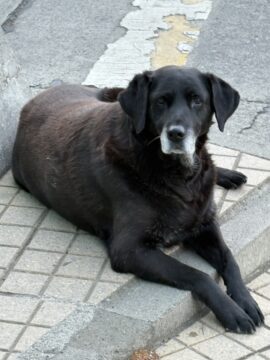
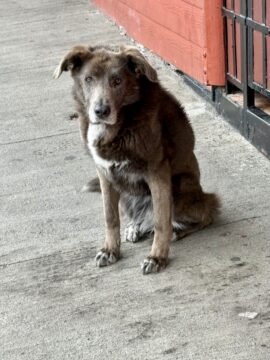
A neighbor I ran into out walking his dog in our Brooklyn neighborhood asked me about my recent trip to Chile and relayed his own experience there. He loved the skiing, the landscapes, the wine, but he could not abide the stray dogs.

But stray dogs, more than anything, had brought me to summertime-Chile this January towards the end of the first year of Trump’s second term. Hazel, my wife Angela’s and my large yellow mutt, had died a terrible death a few months before, and, in my mourning, I was besotted by dogs. And similar to shorter humans who are only attracted to much taller humans, I am a smaller man with a taste for larger beasts. The dogs of neighbors and friends, the dogs on the Internet, were just not enough. In Chile, I knew dogs would be everywhere, big ones.
I visted three places: Puerto Montt, a rugged medium sized city in the south, looking out on the Reloncavi Sound, which connects to the Pacific, Castro, a smaller city on Chiloe, the large island off the southern coast, then San Pedro de Atacama, a tourist town in the desert far in the north.
Dogs in Chile straddle a line between housed and unhoused. I don’t know their real stories, and I romanticize what I observe. They appear healthy, friendly, cared for on some level, but free to do as they please, providing glimpses of true dog nature that we don’t get with fully domesticated canines. Fifteen years ago, I watched a pack of them chase madly after passing vehicles on a desolate boulevard in Punta Arenas in Patagonia. Dogs strolled and slept just about everywhere around Villarica in the Lake District when I visited just before the pandemic.
Famously, Foucault’s (via Borges’s) ancient Chinese emperor divided animals into an unfamiliar taxonomy to express inexpressible differences in cultural communication: those belonging to the emperor, embalmed ones, trained ones, suckling pigs, mermaids (or Sirens), fabled ones, stray dogs…
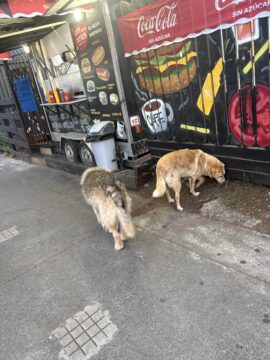
And I will put Chilean dogs in my own odd categories: packs of large stray dogs, pairs of large stray dogs, loner large stray dogs, owned but off-leash large semi-street dogs, small lap dogs on the leash or being carried around, large guard dogs barking from behind enclosures.

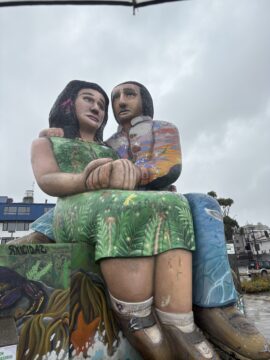
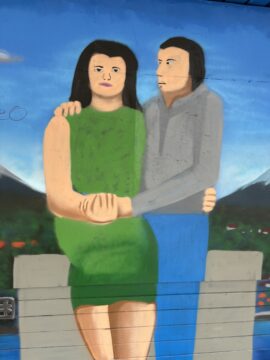
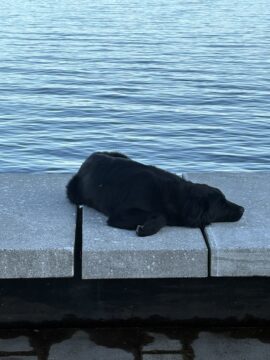
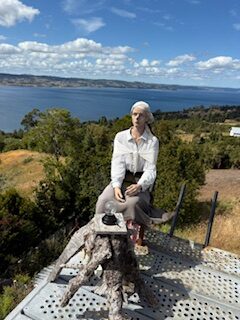
The heart of Puerto Montt is its malecon, a long concrete footpath along the coast that eventually dead ends into a lovely green valley right outside of town. Its most notable feature, other than its dogs, is a peculiar statue, echoed by a mural on the side of a building a few blocks away.
Five or six times life-size (about ten meters high) the two figures, built to honor the 150th anniversary of the city, were inspired by a classic 60s song by Los Iracundos, a band from Urugay, called “Sentados Frente al Mar,” “seated in front of the sea,” which they are.
About half a mile from the statue towards the end of the malecon, there was once a hotel, an Ibis, but only its sign remains. In its stead, there is a ramshackle shopping mall attached to Puerto Montt’s long distance bus station.
Something I observed just outside it inspired another pseudo-Borgesian category. Dogs who sneak inside. Unfortunately, I wasn’t fast enough
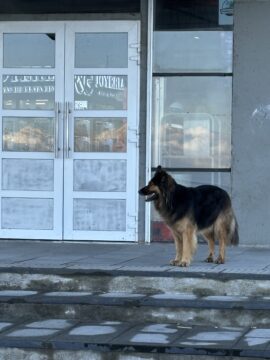

to catch the exact moment in which the dog slipped into the mall.
The next morning I took a bus from the station at the mall to Chiloe. On the island of Lemuy off its coast, I visited the Muelle de los Brujos, the witches harbor.
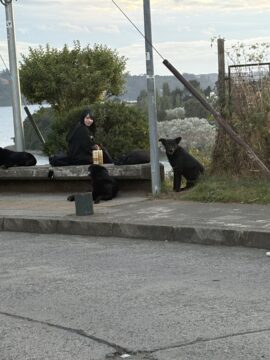
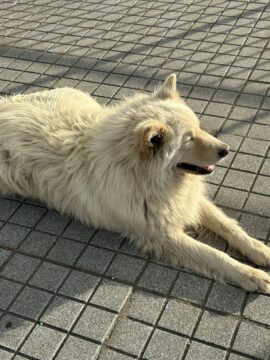
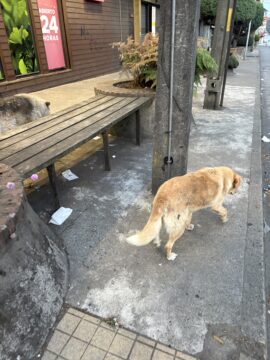
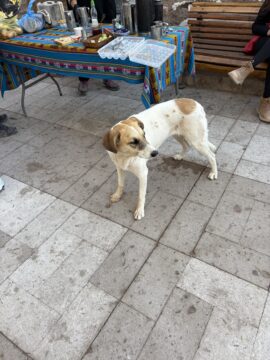
But mostly I wandered around taking portraits of dogs.
Imaginary Animals
Before Angela and I found actual animals to fill our lives, we developed fictional ones. Two extremely stout rabbits (both each other’s cousin and each other’s wife) became – when subject to my dark imagination – masturbatory, homicidal pop stars. I subjected our real animals to the same treatment. Hazel, the blond shepherd/lab mix, sometimes known as “the dog.”
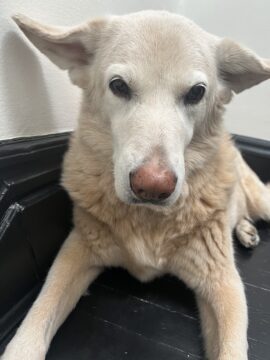
constantly complained in a sort of symbolic southern accent, befitting her western Mississippi heritage, that she had never been fed, looked voraciously upon young children as potential “amuses bouches” and searched for nuclear powered batteries to blast into the ear of her slumbering fictional boyfriend. I, “Master David” and Angela, “Miss Angela,” were incompetent fools forever exasperating her. After the Hazel’s voice fell silent on the afternoon of Hazel’s death, Angela asked me to reinstate it at least temporarily, so while the real dog is no longer on this earth, her terrible poltergeist continues to insult us and wreak havoc on our lives. And while exercising on the treadmill, showering, or walking around Chile, her fictive voice resounds through my mind. When I was nine or ten, growing up in Charlottesville, I would visit an elderly lady a couple of blocks away for tea and brownies. “It’s a good life if you don’t weaken,” Mrs. Dick would say when feeling poorly. “It’s a dog’s life, Miss Angela,” Hazel often complains in my mind, expressing the same sort of existential malaise.
Dogs before the Dog
Briefly, we had a dog when I was a boy, a sad story that I don’t wish to revisit, but mostly I remember the dogs of aunts, uncles and cousins. And when I started to travel as an adult, I began to meet street dogs.
On different occasions in the Ecuadorian countryside, I encountered savage ones, growling, barking, intimidating. And my companions and I followed what we had been told was the protocol. We hurled rocks not at them, but near them to keep them at bay.
In Morro de Sao Paolo, an island off the coast of Bahia in Brazil, a medium-sized white dog with black spots abandoned her puppies to follow Angela and me for hours, digging deep in the sand while we sat on the beach, accompanying us into town when we went off to eat, then suddenly and unceremoniously abandoning us. What is that street dog instinct, not begging, not threatening, just accompanying? Another canine category: dogs that follow.
Saint Petersburg 1997, not long after the Soviet fall. A medium-sized poodlish dog approached us and allowed us to pet him. We bought him smoked meats at a deli, but when we needed to leave the neighborhood and he was still following us, we naively approached a friendly bellhop at a nearby hotel and asked about available services for strays. He did what he assumed we wanted, which was to aggressively shoo the poor dog away.
A small village outside of Sibiu, Transylvania. A large, regal golden retriever approached my friend Robert and I. She followed us for well over an hour, skirmishing with a group of other dogs along the way to protect us, only to be shooed away by an unsentimental woman in stereotypical peasant attire as we waited for the bus that would take us back into Sibiu.
When we encountered a huge, magnificent street dog in Athens in the early 2000s, I approached and moved to pet her. She barked. She growled. Almost instantaneously her pack materialized. Six or seven ferocious growling beasts surrounded us, getting closer and closer. We had no rocks to keep them away, but mysteriously, deus ex machina, they suddenly lost interest and ambled away.
Hazel: The death of the Dog
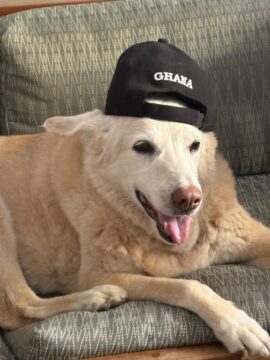
She was large, difficult, beautiful, and misleadingly friendly-looking. After six months as a Mississippi stray and fourteen years with us, her penultimate emergency vet visit left her imprisoned in our living room where she was supposed to lie around, shitting, pissing, drinking and eating in the same tiny space until maybe, just maybe, her arthritic and neurologically damaged limbs gained strength. Dog-aging speeds towards the middle of their lives and just gets faster. From a slight limp, to a major one, to barely being able to rise, to being unable to stand at all.
A little too house-trained, she refused the grim wee-wee pads in the living room. When I lifted her up by the double harness that the hospital had provided in order to take her outside, she yelped in pain, reaching with her snout to bite me except I (aging a bit more slowly) would be too quick for her, carrying her sixty pounds (twenty less than when she had been well) down our front steps so she could shit and pee.
She seemed to be improving. I still had to pull her to her feet, but, once I did, she could walk. Once she broke through the chairs intended to imprison her into the dining room where her water and food bowls had once rested. She just wanted things to be the same, a human instinct maybe even more pronounced in a dog. She was even able (just once) to defecate without my needing to hold onto to her stop her from falling and landing in her feces.
But quickly the accelerated aging took hold again. She could no longer walk unassisted. She could no longer stand.
The idea of a kinder, more dignified death, a vet coming into the house to euthanize her, proved impossible as she needed immediate meds to numb her pain and a catheter because a terrible UTI was preventing her from emptying her bladder.
We stroked her whiskers and whisker holes one more time in the “comfort” room of the emergency animal hospital but left before the vet gave her the final death shot.