
by Mindy Clegg
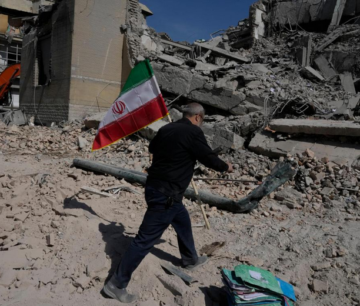
The American and Israeli invasion of Iran has become the next major crisis to emerge out of the ongoing polycrisis we are all living through. The thing causing the most consternation about the war seems to be the lack of clarity on reasons and the end game. The President and the Secretary of Defense Pete Hegseth claim this will be easy, a one-and-done conflict that won’t bog America down. They throw out the usual rhetoric about Iran as an especially pernicious force in the world, as a state-sponsor of terrorism. They claim that their actions will allow the suffering people of Iran to rise up and “take back their country,” an argument for regime change.
It has been a chaotic roll-out to a war that threatens to further destabilize an already unstable world. But perhaps all this chaos is the point. Maybe the old idea that American postwar empire encouraged stability for its markets has been replaced by a new logic of rule by chaos. Amie Ceasar’s notion of imperial boomerang during the era of Forever Wars points to an intensification rather than a rupture. Rather than stability built for markets, American empire has increasingly come to demand is the exact opposite of that: chaos, deployed to make market extraction easier. The haphazard nature of the attack on Iran is just one example of the chaos of the neo-liberal economy.
A couple of overlapping phenomenon can help us to understand the world in which we find ourselves. We are living in the age of the full expression of disaster capitalism, as described by Naomi Klein. Capitalism as a tool of empire was always violent and extractive. The wealth built by western European and American empires in the nineteenth century depended on lots of imperial violence to ensure that raw material returned to the imperial core. That included physical goods and labor in the form of enslaved and indentured people. The Cold War era continued that extraction via violence. The Congo provides a prime example from the global south. The violent murder of the first post-colonial leader Patrice Lumumba put the Congo on the path to its current reality of instability today. That instability makes the mining and sale of its vast mineral wealth without any pesky oversight from a strong national government possible. The chaos of conflict in the Congo (and other places) is rather the point then. The ability to maneuver around regulations or ignore them altogether have been a key feature of the postwar forms of colonialism, which has intensified since the end of the Cold War. A stable Congolese state with a strong democracy might make the decision to stop mining its resources or at the very least charge a higher price for them and ensure safety for its people doing the labor. Hence, instability became a key feature of the modern neo-liberal economy and has entrenched inequality between the global north and south ever deeper. The end of the Cold War saw that boomerang on back to the global north, such as with the collapse of the Soviet Union which became a fire sale of state goods for various oligarchs and foreign investors.
A key difference between the Cold War era and now is that you can see the dynamic of inequality more clearly within western society, not just in in the periphery as theorized in the World-systems model. In fact, internal income inequality has hit many in the west rather hard in recent years, especially after the 2008 market crash. Inequality within the US (or within other western states) always existed. However, the gains made during the Cold War were real and tangible. More people had a job with a living wage and were able to buy a home and build generational wealth. The baby boomers went to college in record numbers, too. This is even as the home and suburbs became a useful mechanism of social containment during the Cold War. The mid-60s Civil Rights victories seemed to be a major victory against the various forms of social inequality that had plagued American society since its founding. Thus, when the Cold War ended, figures like Francis Fukuyama waved a big victory flag in favor of the American way of life. Sure, things weren’t perfect yet, he argued, but we can certainly work to end all social ills via liberal democracy with a capitalist economic system. No further economic exploitation of anyone would be necessary in the future. But Fukuyama ignored the destabilizing nature of the Cold War itself where imperialist extraction continued under a different guise: bringing economic stability and democracy to the former colonized world.
Another idea we should incorporate here is the clash of civilizations. The post-Cold War conflicts from the 1970s to the 1990s in places like Yugoslavia, Rwanda, Afghanistan, Northern Ireland, and Sudan should have prepared us for this current world we’re living through. Most at the time viewed these as the last gasps of the old world dying. It is becoming clearer now in hindsight that these vicious conflicts were an expression of the ideology of figures like Samuel P. Huntington, who articulated the idea of civilizational conflict as the post-Cold War norm in global affairs. Social and cultural identities often framed the reasoning for those conflicts. He turned out to be correct, not because those kinds of conflicts are inevitable. Rather, it’s because people listened to Huntington’s views on the matter and sought to make that world a reality. There is a direct line between his thesis and the rise of the forever wars since September 11, 2001. Organizations such as the Project for a New American Century championed the idea of American hegemonic domination and the inevitability of civilizational conflict. The Iranian conflict is taking on deeply apocalyptic tones based on the clash of civilization narrative. During the Bush era, the apocalyptic framing of such conflicts were more obscured. But the same figures who drove the forever wars favor a direct armed conflict with Iran, even as they frame in terms of American national interest. They claim its due to the hostile nature to the Iranian regime, who are irrationally hostile to American empire—ignoring the very real reasons why the Iranians might be hostile to US empire. It’s as if history started in 1979. But a major reason for the absolutely hostility towards the United States rests in the actions of our country during the Cold War. Subjugating Iran to the whims of the US and Israel seems to emerge out of both the logic of resource extraction and civilizational conflict (whether apocalyptic or not). Breaking the country will also allow for disaster capitalism to do its thing in Iran. Disaster capitalism and clash of civilizations thesis work together, in other words.
Stability is built on enough people buying into any particular political or social system. It works best when people believe in that system. Anytime the majority of people living in a system aren’t being served, it exists on borrowed time. Alexei Yurchak’s concept of hypernormalization illustrates how a failed system can continue on for a time despite those failures. In Yurchak’s book Everything Was Forever, Until It was No More, he examined how Soviet citizens experienced the collapse of their empire. Soviet citizens learned to function within the confines of the state, accommodating when possible, engaging in private forms of cultural resistance. But always going along to get along. But when Mikhail Gorbachev came to power, he opened up space for those citizens to criticize the government and the system which was failing them. That led to the ultimate downfall of the Soviet state. The outcome of that collapse Naomi Klein described in Shock Doctrine was not pretty. We seem to be living in a very similar situation, according to some. We can see that in the link to Philsopheasy essay above and in a recent article in the Guardian by Adrienne Matei. If the Cold War era systems rested on a simulacra of stability and democracy, the current neo-liberal economy functions more obviously on chaos and force. Although the second Trump term seems a break from norms, the reality is that the wars that began after September 11th have been predicated on similar logic, just more hidden. Our democratic institutions failed during that time to keep us out of imperialist wars (unless, like Stephen Miller, you believe in wars of imperialism). The only difference between now and then is that now the fig leaf of asking for permission from Congress to invade another country has been completely discarded. It is clear that many of the Democratic officials would have given that permission anyhow, but the Trump administration did not even bother to ask. If that’s not broken systems, I’m not sure what would qualify. We do know that the weaknesses of our neo-liberal institutions have opened a space for authoritarians, both secular and religious, to emerge once again. It is not too late for more measured change, but with the actions of the US and Israeli governments this week, time is shorter than ever for that kind of change. The upcoming congressional election will be an important inflection point that could lead to real change that doesn’t lead to further destruction. The present moment demands that we have a clear eye on what the past means and that we can build a better world in the future, which is not yet written. But we must accept that what exists now doesn’t work for most of the world and demand something better for all of us, not just a few of us with the rest fighting over crumbs.