
by Eric Feigenbaum
“This hospital makes mine look filthy,” the nurse manager from Sacramento said to me as we walked the halls of Tan Tock Seng Hospital.
This wasn’t a surprising first reaction to a Singaporean hospital. What Nancy said later surprised me more.
“I’m not sure about whether these nurses can handle working in an American ICU – their setup is so much better than ours,” Nancy told me. “These nurses are each taking care of one patient. And each patient is in a room with a complete set of state-of-the-art equipment. You would never find this in an American hospital, I’m sorry to say. I wish we had care quality like this. But I don’t know how nurses used to focusing entirely on one critical patient will do when they have to take care of two – and in some hospitals, even three patients using shared equipment coming down the hall on crash carts.”
At that time – 2004 to 2006 – I worked recruiting foreign nurses for US hospitals. Often, nurse managers would conduct video interviews, but on those occasions when we could talk hospitals into sending their interviewers to Singapore, the results were always better. Of course, the prelude to live interviews was helping the nurse managers understand the nurses’ work environments – which in turn gave them key information about things like skills, practice and language ability.
For several hours, we had toured the Johns Hopkins facility in Singapore – at that time located within National University Hospital – NUH itself and then Tan Tock Seng. At every step, Nancy and her colleague Gloria were amazed by facilities. Not only was the quality of care undeniable, but the nurses they spoke with were erudite and intelligent.
It was amazing how rarely nurse managers and hospital administrators even knew where Singapore was, let alone that it is a developed, English-speaking country. Many imagined something like the Vietnam they saw on television screens in the 1960’s with jungles, rice paddies and people wearing conical hats. Singaporean healthcare was far more advanced than our visitors typically expected – believing America set the standard for hospital care.
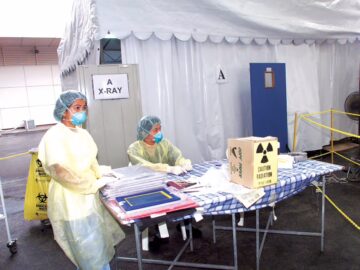
But what took Nancy and Gloria aback wasn’t the technology, cleanliness or even care protocols, but a shockingly simple, but profound innovation at the Tan Tock Seng Emergency Department: two treatment areas – one for communicable disease patients and the other for injuries and other ailments. Or, as the Tan Tock Seng staff labeled it – Fever Patients and Medical Patients.
The idea was incredibly simple and born of the SARS epidemic of 2003. Why mix patients with a highly communicable respiratory disease with patients who were not ill at all? The five-year-old with a broken arm shouldn’t be exposed to someone with a life-threatening critical disease.
At the peak of SARS, the setup was almost superfluous in that Singaporean government and healthcare facilities had coordinated to route SARS patients exclusively to Tan Tock Seng and other emergencies to any other hospital.
This simple decision at first glance seems almost obvious. Yet it’s shockingly rare. In 2003, I was living and working in Taiwan in which all emergency rooms were treating SARS patients – although they did transfer critical cases to National Taiwan University Hospital which had an extraordinary rate of success.
This kind of care coordination is practically unheard of in the United States. During COVID, major cities and even metropolitan regions didn’t coordinate to send COVID cases exclusively to one or a set of facilities while routing injuries or labor and delivery cases to another.
At the same time, Singapore didn’t keep Medical Patients out of Tan Tock Seng for the entire time that SARS was an issue. Obviously, the Fever Patients area – which was originally an outdoor, open-sided tent, eventually replaced by a more durable structure lined with ceiling fans – existed side-by-side with the indoor Emergency Room that had once housed everyone.
When SARS subsided, Tan Tock Seng decided not to change anything. Didn’t keeping infectious patients away from the others make sense? Everyday? Even without an epidemic?
That’s without acknowledging that medical staff too is safer treating infectious patients in an outdoor ventilated tent.
Nancy and Gloria who had been nurses in excellent hospitals for more than 35 years each were amazed that neither they or anyone they ever knew had ever considered such a simple and effective approach to emergency care. Separating the Fever Patients was astounding in its sheer obviousness compounded by its ease to implement. It’s hard to see the Tan Tock Seng Emergency Department and wonder why their protocol isn’t standard throughout the world.
It doesn’t take a high school English teacher giving a lesson on Foreshadowing to see how the Tan Tock Seng approach benefitted Singapore later. When COVID turned the world upside down, places like Singapore, Hong Kong and Taiwan were better equipped than average to handle a respiratory-virus-driven pandemic thanks to their experience with SARS.
Singapore’s hospitalization and death rates were consistently below those of almost every other developed country worldwide.
For example, as of April 2022 when the Singapore Ministry of Health stopped publishing daily COVID data, Singapore had cumulatively lost 1,263 people to COVID. That’s 0.02 percent of its population. On January 12, 2022 – four months earlier than Singapore’s reported loss – the CDC reported the United States had cumulatively lost 842,000 people to COVID – or 0.254 percent of its population. That’s proportionately 12 times more than Singapore’s loss.
Similarly, as of June 2022, The United States had seen 1.47 percent of its population hospitalized with COVID while Singapore has seen 0.85 percent. Naturally, the hospitalization rates can be attributed to many factors including the countries’ different public health responses. However, the recovery rates are equally noticeable with 98 percent of hospitalized COVID patients in Singapore recovering while only 85 percent of those hospitalized in the United States recovered. That means a hospitalized COVID patient was 4.5 times more likely to live in Singapore than in the United States.
Of course, Singapore’s success can’t be chalked up to a tent outside Tan Tock Seng Hospital. Staffing, protocols (like a one-to-one nurse to patient ratio in the ICU) and the ability to sequester COVID patients within one facility played their parts. Most of Singapore’s hospitals are many times larger than even a large tertiary hospital in America. Tan Tock Seng has almost 1500 acute beds – meaning it could easily take all of Singapore’s COVID hospitalizations in one facility. In fact, Tan Tock Seng Hospital is currently building a 330 bedded infections disease specialty facility on its campus. As a benchmark, UCLA Ronald Reagan Medical Center – one of Los Angeles’ largest and best hospitals – operates almost 300 acute care beds among all its disciplines when its Children’s Hospital is factored out.
All of this begs the question as to why the United States can’t – or hasn’t – done like Singapore and coordinate its response to infectious diseases among local or regional hospitals? Why wouldn’t a city like New York or Chicago want to direct its H1N1 cases to one or two facilities to reduce the spread of infection and exposure of its healthcare workers?
To some degree, it may be the same as the shock Nancy and Gloria experienced when seeing the Tan Tock Seng Fever Tent – it’s so obvious, but no one has really talked about it. More likely, it’s money. Singapore has a scattering of private hospitals – but most of its facilities are owned by one of two major healthcare companies, both spun-off from the Singaporean government in 2000. The Singapore Ministry of Health remains a significant shareholder of these public-private corporations. While the hospitals are run as private organizations and tasked with being at least nominally profitable – by design, they retain significant governmental oversight and are wedded to public interest. American hospitals are usually private and even when “nonprofit” – are market-driven beings. Patients – however ill and unless they are on Medicaid – are revenue. Few hospitals are likely to work out arrangements with one another to swap patients based on diagnosis.
This isn’t to say American healthcare is second rate and Singapore is a healthcare leader. America’s competitive system also spurs innovation and investment like nowhere else in the world. While there are many reasons to complain about healthcare in the United States, the vast majority of healthcare innovation still comes from America. And capitalistic reward is a big part of what spurs advancement.
The flip side is we also pay for it with some of the highest medical and prescription costs in the world. Singapore, on the other hand, negotiates with pharmaceutical manufacturers and distributors as a nation. It bargains for access to its market with top-tier, name brand prescription drugs often costing about a third of their US market prices – something US leaders have discussed, but never comprehensively done.
Singapore reminds us not to sit on our laurels. There’s room to refine, improve and take things to the next level – such as staffing for exceptional care. Perhaps more importantly, sometimes we just need to take a step back to realize not every great innovation takes vast resources. Sometimes, it’s just placing a tent outside that can save thousands of lives.
Enjoying the content on 3QD? Help keep us going by donating now.