
by Richard Farr
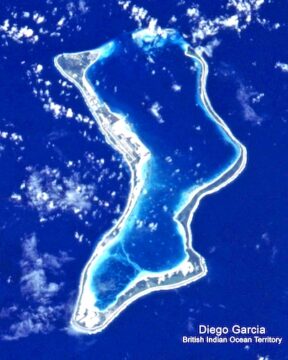
If you’re not from the US or the UK, you probably think that the recent dispute over the Chagos Islands is a below-the-fold story of no interested to you; perhaps, with less excuse, you think that even if you are from the US or the UK. In either case you’d be wrong. Never mind whether you can find the Chagos Islands on a map. They are very very interesting indeed — partly because what’s most interesting about them is not what the world’s press can be bothered to write about.
A string of pearls in the central Indian Ocean, the archipelago lies almost exactly halfway between Tanzania and Sumatra. It has been under British control since the defeat of Napoleon; since 1971, it includes the strategically vital joint US/UK military base on the largest island, Diego Garcia. Because of its shape and role, Diego Garcia is referred to by the US Navy, in an eruption of patriotic sentiment, as “the footprint of freedom.”
The story currently being reported about Chagos is as follows. After an embarrassing string of national and international court defeats, the government of the UK — in close consultation with the first Trump Administration — agreed that it was best to cede control of the archipelago to the government of Mauritius, while retaining a multi-generational lease on Diego Garcia itself. But in the new context of Trump’s Greenland fantasies, this voluntary relinquishment of sovereign territory “FOR NO REASON WHATSOEVER” suddenly has a bad look. In language clearly showing that he literally had no idea of his previous administration’s consent to the deal, Trump has announced that it is (applying two of his favorite unintended ironies) “weak” and “stupid.”
Kemi Badenoch and Nigel Farage, after being vouchsafed royal audiences with Speaker of the House Mike Johnson and US Treasury Secretary Scott Bessant respectively, have swallowed the bait with enthusiasm. As I write, Keir Starmer is doing what he does best: backing down, then not backing down, then furiously flailing and dithering, the splintery top edge of the world’s fence wedged firmly between his buttocks.
The question before us is therefore supposed to be this: are Trumpeters on both sides of the pond right that Starmer is weakly and stupidly “surrendering” British territory? Or were both governments previously correct that the new agreement was in their long-term strategic interest? Wisdom or weakness?
And then there are the facts.
*
In 1783, enslaved Africans are brought to the islands by the French to work coconut/copra plantations. They are later joined by mostly Indian and Malay indentured workers. These Chagossians and their descendants become the first permanent human inhabitants of one of the last spots on earth to gain a permanent population. (Per international law, this makes them the islands’ indigenous inhabitants.)
In 1814, the Treaty of Paris cedes French control of Mauritius and its dependencies, including Chagos, to the British. The plantations continue. Even after emancipation in the 1830s, the Chagossians do not own property on the islands and are only licensed to stay as “contractors” at the pleasure of the plantation owners.
Early in the 1960s the US Navy realizes that a base on Diego Garcia would be the strategic equivalent of a permanent orgasm. But a dock and a runway are not enough: the US wants exclusive control, and the removal of all inhabitants. The British Government takes the hint, as it always does — see under “Iraq” — and creates the British Indian Ocean Territory (BIOT). The BIOT acquires the declining plantations and closes them, leaving the Chagossians without work.
From 1965-1973 — pursuant to a secret deal between the US and UK governments that is hidden from both Congress and Parliament — the Chagossians are removed from the only home they have ever known by means not only of plantation closure but also physical threats, the deliberate limiting of food and medical supplies, the tactic of allowing Chagossians to visit Mauritius for medical reasons and then refusing to let them return, and systematically killing all the Chagossians’ pets. A new immigration ordinance makes it illegal to enter or remain in the BIOT without a permit; this legalises forcible removal.
In 1971 construction of the base begins. By 1973 the last Chagossians have left. Most end up in dire poverty in Mauritius and the Seychelles; some later go to the UK. The US and UK governments maintain that, because the Chagossians are only transient workers, the islands do not have, and have never had, a permanent population.
In 1982 hunger strikes by Chagossians force the UK government to agree to $4 million in compensation. This is about $6,000 per head. At the same time, the US is spending exactly a hundred times this amount, $400 million, just to expand the existing base.
In 2000, the Chagossians sue for the right to return. The UK High Court rules in their favor, adding that their expulsion was illegal in the first place, yet excludes Diego Garcia from the settlement. The UK government procrastinates for four years and then issues Orders in Council nullifying the Court’s decision.
In 2008 two more High Court victories for the Chagossians are overturned by a five-member panel of the House of Lords. The Lords do mention that they “regret” the original “resettlement.”
In 2010, the UK creates the 200,000 square mile Chagos Marine Protected Area, which encompasses the entire archipelago — excepting Diego Garcia. Since all fishing is banned within the CMPA, the Chagossians’ return is rendered effectively impossible. Julian Assange’s Wikileaks then uncovers internal Foreign Office communications showing that this was the entire point. (The FO does exhibit admirable restraint however in never once referring to their plan as “the final solution to the Chagossian problem.”)
In 2015, the UN Permanent Court of Arbitration rules that the UK government acted illegally in creating the CMPA, given its dishonest intentions. In 2019-21 the International Court of Justice rules, further, that British occupation of the Chagos Islands was illegal in the first place — which is to say: the UK had then, and has now, no sovereignty in Chagos. The ICJ condemns the continued occupation, and orders the UK government to hand control back to Mauritius.
In 2024, having taken great care to mollify and get permission from the country it still quaintly believes to be its most steadfast ally, the UK agrees at last to hand over control of the islands to Mauritius — minus, at the risk of sounding repetitive, Diego Garcia.
*
Granted, this case does not involve a vast number of what we used to call “natives,” and none of them has been cut to ribbons in a hail of lead, in the tradition of Amritsar and My Lai. But still, the big story here should be that this is one of the more shameful narratives of arrogance, racism, cruelty, dishonesty, cynicism, misrepresentation, persecution, and statist self-dealing in the all the sorry annals of colonialism. And here we are in 2026, bickering about whether Starmer is going to project “weakness.” Even The Guardian has an “explainer” that explains very little because it leaves out virtually all of what’s most nauseating in the history; the Sunday Times meanwhile is still referring in all seriousness to “an obscure archipelago belonging to Britain since 1814.” As A.E. Houseman might have said, “Three minutes’ thought would have sufficed to discover” that the islands are far from obscure to the people whose only home they were before we forcibly removed them — and that, per the international legal institutions we signed up to, they never “belonged” to us in the first place. “But thought is irksome, and three minutes is a long time.”
*
A simple but profound question arises from all this, one that reaches deep into the heart of the colonial worldview. Are we to defend the state because of the values the state defends – 0r, notwithstanding the stories in which we wrap ourselves, are we to defend the state regardless of its pitiless indifference to the values we claim to defend? To put it another way: Why exactly do two states like the US and the UK “need” Diego Garcia this desperately?
There’s a standard answer, given by a class of people who can only say what they say about foreign affairs because they are comforted out of their wits by calling themselves Realists. According to them, we need Diego Garcia (and a thousand places like it) because it projects our power; we should be concerned, not with what we did in the course of getting and holding onto it, but only with what might happen if the really nasty people get hold of it instead.
The patron saint of Realism, Henry Kissinger, famously said that the United States has neither allies nor enemies but only interests. Whether he owes this aperçu to Philip of Macedon, one of the Czars, or maybe Palmerston or Groucho Marx, is a fun debate for another time; in any case, a bracing and convenient undergraduate-Machiavellianism has precipitated out of it like poisoned snow. It’s not just that states are Hobbesian creatures with no morality beyond their own power; we citizens must accept and celebrate our incorporation into the warm glow of this amorality. Not ours to ask how the “national interest” or “national security” is related or unrelated to the interests and securities (and moralities) of the actual human beings who live and die under the state’s command. Nor ours to ask whether there might be a different world, in which the ordinary moral compass of citizens makes them reject their own states’ contemptuous domination of the most defenseless. The state’s interests are always paramount; “morality” is for the rubes. And a tricky question (under no circumstances to be aired in, say, the streets of Minneapolis right now) is this: when “justice is nothing but the advantage of the stronger” (Thrasymachus, Republic Book I), how is the doctrine of Realism to be teased apart from the doctrine of Fascism?
*
Although clothed from time to time in good intentions, colonialism has often been pretty straightforwardly a form of fascism. Its damage has needed a lot of undoing, but we have seen that some of the undoing can be done — in the modern world, some states do sometimes speak of their crimes and of restitution. Alas the story of what we did to the Chagossians, and the current burial of that story beneath a trivial story about bluster and spin, shows how far we have to go.
Think how much easier it would have been, if two centuries ago both the US and the UK had decided not to become the world’s richest and most arrogant “bastions of freedom” on the backs of other people’s poverty and humiliation and subjugation. What if, instead of trying to become safe at home by dominating abroad, they had committed to defending their own borders against aggression and helping others to do the same? What if, as a matter of course, anyone trying to do what was done to the Chagossians in the name of our freedom had been exposed, reviled, and banished forever from public life?
They say you judge someone’s character by the way they treat the weakest and most defenseless. In that context, let’s hold these truths to be self-evident: the Chagossians should never have been enslaved; having been enslaved, they should have been compensated lavishly for their enslavement; having been given at best derisory compensation at one point, during two centuries of abuse at the hands of Anglo-Saxon values, they should at an absolute bare minimum have been given both an abject apology and their home back.
Realism dismisses this as naive — no term in its vocabulary more contemptuous than idealism. Yet ethical language that Realism should find impermissible has a tell-tale way of slipping back in. Why, if everything is power, should we accept the state’s thuggery instead of using our wits to expose and denounce and oppose it? “Well,” the answer might go, “if we gave up Diego Garcia, it might be taken over in turn by people who are not champions of Freedom like us. It might be taken over by people who prove — oh, how shall we choose to express this? — even more cruel, pompous, self-righteous, dishonest, hypocritical, and morally disgusting than we are.”
***
Selected sources:
The Chagos Archive: https://edspace.american.edu/chagosarchive
Library of Congress Blogs: https://blogs.loc.gov/law/2025/06/the-status-of-the-chagos-archipelago-part-i-history-of-the-disputes-surrounding-its-status-and-the-creation-of-a-uk-us-military-base/
BIOT: https://www.biot.gov.io/about/history/
U.S. Navy:
https://installations.militaryonesource.mil/in-depth-overview/navy-support-facility-diego-garcia.
The Guardian: https://www.theguardian.com/world/2026/jan/20/what-are-chagos-islands-uk-mauritius-explainer
The Sunday Times: https://www.thetimes.com/uk/politics/article/starmer-chagos-islands-deal-w5kvdb7jp
BBC: https://www.bbc.com/news/articles/cp80p875pdko
***
Enjoying the content on 3QD? Help keep us going by donating now.