
Sanders Isaac Bernstein at Cabinet Magazine:
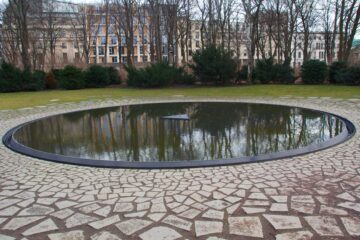
In the glade that is the Memorial to the Sinti and Roma of Europe Murdered under National Socialism, history seeks to enter memory. At the center of a grove of trees is a dark pool, reflecting the open sky as well as the looming face of the Reichstag. Surrounded by shattered stones inscribed with the names of sixty-nine sites where National Socialist Germany incarcerated and killed Sinti and Roma, the pool itself in turn surrounds a triangular island, the memorial’s center, on which rests a flower or two, unwilting.
Situated in the middle of Berlin, steps away from the Brandenburg Gate and across the street from the Reichstag, the memorial, sheltered by tall trees, feels a place apart. Its sounds and rhythms are distinct from the babbling frenzy of the city, seemingly distant. From the trees comes birdsong, and from invisible speakers a plaintive violin composition—“Mare Manuschenge” (Our people), composed for this site by Sinto violinist and politician Romeo Franz. Visitors who enter the memorial drift around its landscape.
more here.
Enjoying the content on 3QD? Help keep us going by donating now.