
Jeremy Denk at the NYRB:
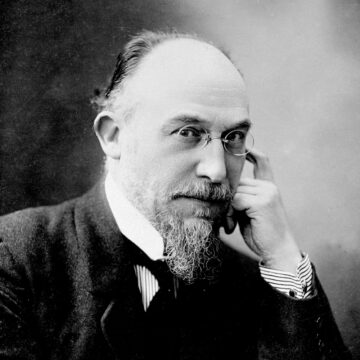 What is the point? is of course one of the main points of Satie. You don’t get the same sensation, for instance, listening to The Rite of Spring, Salome, Wozzeck, or Pierrot lunaire. As shocking or boundary-testing as those modernist masterpieces may be, they all have a point, and they work. They offer dramatic shapes, vectors, formal conceits; they expose sharp contrasts or conflicts. Mostly, Satie’s pieces don’t work in those ways, and they leave the question of a point open at best.
So how exactly does Satie take down the arrogance of late Romantic classical music? Consider the Sarabandes, Satie’s first suite of dances, from September of 1887. They begin with three lubricious seventh chords. The last, a chord that “should” lead forward, sits and lingers in the air. We hear five more chords, full of branching possibilities—but end up in the same place. This feels a bit neutralizing, if not yet frustrating. The third phrase travels more purposefully, and we soon arrive at an A major chord—a normal triad. But it’s notated on the page as arcane B-double-flat major, making it hard to read and even more irritating to write about. (A trivial distinction that also screws with your head is a perennial Satie combination.) This is the first of many arrivals sprinkled about the score, an abundance of goals that paradoxically don’t produce a sense of direction.
more here.
Enjoying the content on 3QD? Help keep us going by donating now.