
by Amir Zadnemat
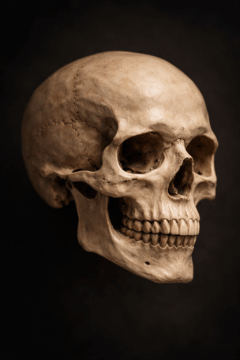 In almost every medical school in the world, there is a cupboard—or a quiet back room—full of bones. The skulls are numbered, the femurs stacked like firewood, the ribs threaded onto metal wire. Officially, they are “teaching aids”. Unofficially, they are the remains of actual lives, reduced to objects that can be ordered from a catalogue.
We are used to this sight in photographs and films. The skeleton in the anatomy lab is so familiar that it has become a cliché. But if you pause for a moment, a much more disturbing question emerges: how did those bones get there, and what does their journey say about the way we value—or fail to value—human bodies?
The answer is not only a matter of medical history. It is a window onto something larger: the politics of who is allowed dignity, who becomes “material” for science, and whose remains can be moved, displayed, or even sold without much public concern. To look closely at the skeleton is to see, beneath the neat language of progress, a long story of power.
From memento mori to medical specimen
For most of human history, bones were not neutral. They were sacred relics, moral warnings, or traces of the dead who still had a claim on the living. Medieval European churches were filled with skulls and femurs carefully arranged into chapels of bones. Their purpose was not scientific. They were there to remind the living of their own mortality—memento mori—and to keep the dead within the orbit of the community.
In many cultures, human bones were (and are) integrated into rituals of mourning, ancestor veneration, or collective identity. The skeleton, even when separated from the flesh, was still someone: a grandfather, a warrior, a victim. To move the bones without permission, to disturb their resting place, was an act of serious moral and sometimes spiritual violence.
The modern idea of the skeleton as a “specimen”—a piece of biological hardware—emerged gradually, as medicine claimed more authority over the body. Dissection theatres, anatomical museums, and medical schools needed material to work with. As the scientific gaze hardened, the skeleton shifted category: from symbol to resource, from presence to property.
But whose bodies were turned into property?
The supply problem and the hierarchy of bodies
By the eighteenth and nineteenth centuries, European medical schools faced what they openly called a “supply problem”: the demand for bodies to dissect exceeded the number of legally available corpses. Executed criminals were one official source, but not nearly enough. So medical students and their suppliers turned to a shadow economy of grave-robbing and body-snatching, disproportionately targeting the poor, the unclaimed, and the socially powerless.
The skeletons that now sit in glass cases did not appear there via some neutral process. They came from somewhere, and usually that “somewhere” was a place where people had little ability to resist. The dead of workhouses, asylums, prisons, and colonial territories furnished the modern atlas of anatomy.
The resulting hierarchy was brutal in its clarity. Some bodies were destined for funerals, ceremonies, and carved tombstones; other bodies were destined for dissection tables and teaching collections. The logic was circular: if you were poor, criminalised, colonised, or otherwise marginal, your body had less “right” to rest. The proof of your lower status was, in part, that your remains could be put to use.
This is not simply a story about the past. The bones that universities and museums still hold—often in the thousands—carry this history in their very presence. Many are unlabeled, unidentified, and stored in cardboard boxes. If we think of the dead as fully gone, already beyond harm, this might not disturb us. But if we believe, as many humanist thinkers do, that dignity extends beyond the moment of death—that how we treat the dead reflects how we value the living—then the question becomes more urgent: why are some skeletons still in institutional limbo?
The colonial skeleton
If the poor and criminalised supplied many of the bodies for metropolitan medical schools, colonised peoples supplied many of the skeletons for European and North American museums. In the era of empire, human remains were collected, shipped, classified, and displayed alongside animal specimens and archaeological finds. Skulls, in particular, were prized, feeding into pseudo-scientific projects such as phrenology and “racial science”.
These collections were not simply about curiosity. They were instruments in a political project: to arrange humanity into hierarchies that coincidentally put the collectors at the top. The skulls of colonised subjects were measured and compared, used as evidence that certain groups were naturally less intelligent, more “primitive”, or closer to animals. The skeleton became a diagram of power, drawn on the most intimate material available.
Today, many of those skulls and skeletons remain in storerooms. For decades, their presence was defended in the language of research and preservation. But in recent years, descendant communities and activists have demanded repatriation and reburial. They argue, quite forcefully, that the bones were taken without consent, that they embody histories of conquest and humiliation, and that keeping them in institutions is a continuation of that violence.
These demands have forced museums and universities to confront a question that cannot be answered by technical committees alone: can the pursuit of knowledge justify the indefinite detention of human remains, especially when those remains were acquired through coercion and theft?
Consent, education, and the modern laboratory
In response to such critiques, modern medical education has tried to reinvent its relationship with the dead. Today, in many countries, bodies used for anatomical teaching are supposed to come from people who explicitly donated them while alive. Ceremonies of thanks, memorial services, and plaques in medical schools acknowledge the “silent teachers” whose bodies make education possible.
This is an important moral shift. It recognises that the dead are not simply raw material; they are, in some sense, participants in a social contract. But even here, the realities are messy. Consent regimes vary widely between countries and institutions. Economic and social inequalities still shape who is more likely to donate—and whose bodies are more likely to end up in under-resourced teaching hospitals, while wealthy patients are more likely to be buried or cremated according to family wishes.
Moreover, beyond the context of formal donation, there are still troubling grey zones. The bodies of migrants who die at borders, of prisoners in overcrowded systems, of unidentified people found in cities—these remain vulnerable to being classified as “unclaimed” and thus available, in some jurisdictions, for institutional use. The old hierarchy lurks in new forms.
When we step back, a pattern emerges: whenever a society declares certain lives to be less valuable, less grievable, or less visible, it is easier to treat their remains as objects rather than as the leftovers of a person.
Skeletons on display: museums, hashtags, and public unease
If the medical lab is one place where we confront the politics of the skeleton, the museum is another. Walk into many natural history or anthropology galleries and you will still find human skulls and partial skeletons in glass displays. They are often arranged next to animal bones, tools, and reconstructed environments. Silent and well-lit, they appear to offer neutral information: this is what a human skeleton looks like; this is how bones grow; this is how people in a particular region buried their dead.
Yet in recent years, visitors have started to question these displays more openly. Social media campaigns and activist interventions have pointed out that the bones behind the glass are not generic “specimens” but specific individuals, often identified as “male, 25–30, possibly African” or “female, 18–25, from [X] culture”. If we would find it unsettling to see our own relative displayed like this, why do we accept it for others?
Museums typically respond that they are preserving and educating; that to hide the skeletons would be to erase history. But the counter-argument is that how we show them matters at least as much as whether we keep them. Are they displayed as curiosities, as scientific samples, or as members of communities whose descendants are still alive and watching?
One striking sign of change is the language that institutions now use. Terms like “specimen” and “object” are being replaced, in some catalogues, with “individual” or “person”. That may sound like a small semantic shift, but it marks an important acknowledgment: even without a name, the skeleton retains a human claim on us.
The humanist question: What do we owe the dead?
Humanist thinkers have typically focused on this life rather than the next. If there is no immortal soul, if consciousness ends at death, then the bones left behind are, in a strict sense, just matter. But “just matter” does not mean morally irrelevant. We routinely treat inanimate symbols—a flag, a family home, a memorial stone—as worthy of respect not because they feel, but because we feel. The same is true of human remains.
We cannot harm the dead in the way we harm the living, but we can harm the living through the dead. We can humiliate communities by displaying their ancestors in degrading ways. We can perpetuate injustice by keeping stolen remains as trophies of conquest. We can send a powerful message—intended or not—about who counts as fully human by deciding whose bones deserve rest and whose can be endlessly handled and exhibited.
From a humanist perspective, the question is not whether a skeleton has intrinsic rights. It is whether our treatment of skeletons reflects the values we claim to hold about equality, consent, and the worth of every person. If we insist that all human beings have equal moral status, then that commitment cannot end conveniently at the moment of death for those whose bodies we find useful.
Restless bones in a restless present
In recent years, campaigns for the repatriation of human remains have achieved some high-profile victories. Museums have returned skulls and skeletons to Indigenous communities. Universities have issued public apologies and created ethical review boards for their anatomical collections. Some medical schools have quietly buried long-held remains that could not be identified or ethically kept.
These gestures do not erase the past, but they signal a willingness to see the skeleton not only as a tool for knowledge but as a trace of relationships that demand repair. They invite us to imagine a different future in which the bones in cupboards are no longer anonymous, and where institutional convenience does not trump the demands of justice.
At the same time, new dilemmas are emerging. Digital technology allows us to scan bones, reconstruct faces, and create virtual models. If a community asks for the physical remains to be returned and buried, should the institution keep the digital copy? Does a 3D model of a skull count as a continuation of the same ethical problem, or a way out of it? We have not yet found stable answers.
The paradox of the skeleton is that it is, in one sense, the most universal human image. Strip away skin, features, colour, and the particularities of appearance, and we are all bones. Yet in practice, some skeletons have always been treated as more disposable than others. The promise of equality has stopped, again and again, at the surface of the body.
To take the skeleton seriously is to ask uncomfortable questions about how much we genuinely believe in a shared humanity. It is to look, not away from the bones in the cupboard, but directly at them—and to admit that they are not only relics of medical history, but witnesses to a moral one.
If those bones are restless, it is not because they harbour ghosts. It is because we have still not settled what we owe to the bodies that made our knowledge possible, nor to the people whose remains we turned into specimens without their consent. Until we do, every neat anatomical diagram will carry, in the white of its bones, a shadow we have yet to fully confront.
***
 Amir Zadnemat is an Iranian writer and essayist. He holds an MA in Persian Literature from the University of Gilan, Iran. His work focuses on philosophical and literary essays, often exploring the intersections of literature, cinema, and critical theory. His writing is primarily concerned with questions of interpretation, modernity, and the limits of narrative and meaning in contemporary culture.
***
Enjoying the content on 3QD? Help keep us going by donating now.