
by TJ Price
I came to Andrés Barba as I come to many authors—via recommendation. A very good friend was the first to mention Barba’s work—specifically, Such Small Hands—during the course of a fun back-and-forth of “Have You Read?” My friend proposed Such Small Hands at first assuming I was familiar, but when I admitted ignorance, she was surprised, and exhorted me most adamantly that I would love it; that it was one of her very favorites. It is hard to turn down a recommendation like this, especially when my friend’s taste in fiction is as varied as it is impeccable.
Such Small Hands, for quite awhile, however, was just a slim, neatly labeled spine tucked between others on the shelf—those of much more imposing measurement. The book was quite tidily printed—had a handsome cover and a very aesthetically pleasing presentation—and the title itself instantly evoked for me the closing line of one of the more famous E. E. Cummings poems: not even the rain / has such small hands.
Thankfully, my friend is not one of those people who will take offense to delay—a blessing in any relationship for which mutual taste in reading is foundational. Months passed. Maybe a year. But in a fit of pique one night, having endured a drought of uninspiring genre fare, I picked out the book and opened it. In a matter of an hour, I’d read the book, closed it, turned out the light, and went to sleep, as I so often do after reading.
I have not had such howling terrors populate my dreams as I did that evening. I woke into the dim predawn with my husband snoring fitfully beside me. Overnight, the temperature had plunged, and cold leached into the bedroom like a germ, pervaded the air with a faint miasma that I swore I could almost see, which made the walls seem a dingier gray than their typical eggshell. When I breathed, I swore I could see a plume of my breath, which felt incongruous inside, against the familiar, safe contours of our bedroom.
I didn’t, at first, chalk it up to the novella. But as the days went on, I found myself curiously stymied to read anything else. A few desultory flips through the pages of the other books from the shelf. A valiant attempt, one night, to begin the thousand-page journey of Larry McMurtry’s western Lonesome Dove. I couldn’t focus. I chalked it up to a draining amalgam of reasons: exhaustion from the holiday season at my retail day job, a lack of daylight hours, and general existential malaise. But my mind kept returning to Barba’s slim, unassuming book, and the violent, tumultuous story inside.
Marina’s story, in Such Small Hands, is a simple one. At seven years old, she is orphaned in a horrific car crash. Both of her parents die, and Marina is sent to an orphanage. As Barba (via his brilliant translator Lisa Dillman) specifies, this place is not by the sea, but by a sea. “Everything was a, a place that already existed. It wasn’t so much the fear of leaving … but the idea of that space, that intricate, bountiful, preconceived place, full of beforehands.” Right away, this attention to detail is important. It’s such a small thing, this determiner article. We would ordinarily let our eyes fly right over such a glyph on the page, but here it takes on manifold meaning. Barba’s emphasis on the indefinite article versus the definite article illustrates Marina’s subconscious terror at the impending unknown. Henceforth, she will not be guided by the familiar, but rather will be tossed into alien circumstances again and again without any context. Before the girl even arrives, she has already come to understand that the only way of gathering agency to herself is through possession of knowledge.
At the orphanage, of course, there are other orphans, but not on the day that Marina arrives. These missing girls are evidenced by name only, each written in colors on the drawers of a bureau in the communal dormitory. The girls themselves are out on a field trip, and won’t return until the next day. Marina arrives to the orphanage out of sync already, going to sleep in a room full of empty beds. Before she sleeps, though, Marina enacts a curious rite: she chooses not to acknowledge each individual girl by name and instead, in her head, runs all of their names together as one word, a paste of letters resulting in gobbledygook. (As we all know, to name a thing is to have power over that thing.) Marina creates of these girls a plural golem, each joined to the other, fashioned as a collective entity before she even comes in contact with them.
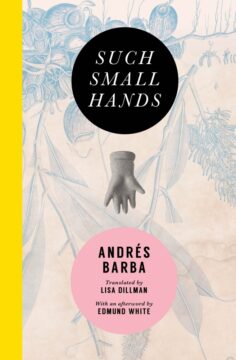
The genius of Such Small Hands, and what made it stick in my head so dramatically, is what the author does next. Instead of presenting individual characters to counter Marina’s solipsistic prejudgement, he leans into that viewpoint and begins Part Two of the story as told from a first-person plural perspective—that of the other girls. The effect could be likened to that of the Greek chorus, providing both strophe and antistrophe for the ensuing events, but the chorus of a Greek classically serves as commentary only, as cover for the drama’s load-bearing episodes and what happens ob skene.
That is not the case in Such Small Hands. The chorus is us, we are the chorus, and the character is Marina, who has been shoved onto the stage like an actor with amnesia. We poke and prod her at first, trying to assist with obvious prompts, attempting to maintain the pretense, but it isn’t long before we realize that this isn’t our story. In this way, both the chorus and the reader settle into a receptive role, brimming over with curiosity, and Marina takes the reins.
Insinuating that the reader is complicit via point-of-view is a somewhat jarring and confrontational choice—especially given that Barba’s story begins by introducing Marina, newly orphaned, adrift and grieving. Our sympathy as reader is fastened on her, and of course, the doll she is given by a psychologist after her convalescence as symbol of solace. This object, robbed of agency, becomes a stand-in for Marina—she is as much the doll as the doll is Marina. Confusing signifier with signified in this way is a common behavior of children, and it is a powerful choice on the author’s part to recognize it and then intentionally use it as distortion in this narrative for emotional impact.
And what an impact it is. The reader is tossed back and forth from day, then night, and point of view. When the sun is out, Marina is the victim of the girls’ hive-mind—we, like they, are fascinated and repelled. She is sad, alone, distinctly Other. There then follows shocking violence—the kind of hate fueled only by its opposite, like fire rushing into a vacuum. When the children speak, the dialogue is delivered in strange, dithyrambic refrains—choppy and abstract, almost as if by rote, or chanted (there is a ferality to the girls’ wide-eyed violences which brings to mind the divine ecstasy of the Maenads)—which further mutates the story into a realm of fascinating disorientation. But this is how children think, perform, act; and so while it feels intensely unfamiliar, it also stirs the memory of that primal state and creates a strange dissonance in the mind of the adult reader. In fact, it is so primal that it betokens the Fall of Man; we intuit that these orphans, before they meet Marina, inhabit a blissful, harmonious paradise. It is only when Marina arrives that everything changes—she is not, however, the serpent hissing in their ears, as one might think, but rather the fruit of which they eat, which mars their tabula rasa with a long, scarring stroke.
Marina is set apart from the others, then, because of curiosity. Their urge to know—the same overreaching committed by Eve & Adam in the Garden. But also, as Barba takes pains to describe, the true temptation is their infatuation with—and adoration of—Marina’s Otherness. In their nocturnal adorations, they objectify—and, concurrently, abjectify—the new girl. The struggle between this infatuation and revulsion causes them to eventually steal her doll one night as she sleeps. This single act, intended to bring Marina closer to their homogeneity, “down to their level,” so to speak, backfires. Instead, Marina discovers that, in difference—in Otherness—there is individuality. There is power, and at once, a weapon.
I don’t remember much of my nightmare anymore, and what I do recall is probably inextricably enmeshed with my mental images from Barba’s novella. I remember I was in a gray, clapboard attic with too many empty beds and cobwebs in the corners. Voices, or rustling sheets. Little laughers tripping over themselves, hushing and giggling just beyond my sight, like mischievous boggarts. Then, silence, and the burning, the pricking, the poking began. Ice and fire alternating. An eyelash plucked from my lid with swift, diabolically minute fingertips; seconds later, another, followed by tugging on my limbs—small, but insistent, then with increasing power, until I felt my joints beginning to separate—and myself powerless to stop any of it. I won’t spoil the rest of the novella—suffice to say that my nightmare only skims the surface of subsequent events.
This same undertow awaited me in Barba’s other books, though appearing in slightly different forms. August, October does not invoke such deliberate reference to the chorus, but still it presents a story of Otherness—in it, the protagonist is an adolescent, and their thought-process is detailed—intimately—by an omniscient narrator. In this one, the main character (Tomás) is attracted to a quartet of slightly older boys, rough-palmed and sneering, who introduce Tomás to their world through a rite of violence. This violence only amplifies, too, finally—in true Bildungsroman style—climaxes at a dark moment involving the assault of a girl of limited mental capacity. (Barba—via Dillman again—uses the word ‘retarded’ here, but the depiction of Marita is so much more nuanced and complex that I view the word as more cultural shorthand than as identifier.) Guilt and shame are the forces that oust Tomás from his relatively sheltered innocence, but it’s what he chooses to do in addressing those forces that provides the shape of the second half of the book. There, Barba approaches something a little like hope—a soft glitter of joy, rather than the dark whirlpool of madness that ecstasy brings, whether violent or otherwise.
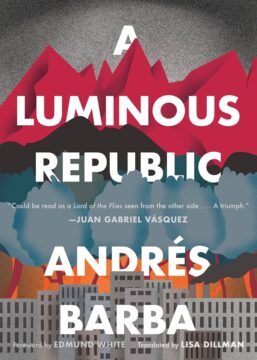 A Luminous Republic—again, translated by Dillman—is a bit more straight-forward than the others, but also involves children. Treated more with a framing of anthropological research or field notes, the narrator of this novel remains largely a cipher to the reader, a lens through which his observations can be interpreted. It, much like the other two, tells a story of a collective of children, but magnified in scope. Compared to the small cloister of girls in Such Small Hands’ orphanage by a sea, thirty-two kids abruptly begin to appear in the fictional city of San Cristóbal. They are ostensibly feral—perhaps educated in the ways of society, but stubbornly resistant to its boring seductions. They are a constant reminder that civilization is really at its core just a very elegant sandcastle—and they are the waves nibbling at its foundation. As their presence escalates, perhaps inevitably, to an act of terrible violence, conflict becomes unavoidable. Again, in Barba’s meticulous prose, we see echoes of the divine ecstatic, these throes of seeming innocence warped into violence by society’s rigid inability to accept any progressive deviation from the standard. “…[T]he children had no criminal intent before entering … the murders came about because of some glut of euphoria and ineptitude…”, states the narrator before lapsing into a brief summation of eyewitnesses, including “…one from a woman who swears that the kids had ’insect faces’ and another…who declares, ‘We all knew exactly what we had to do.’” Chilling phrases indeed, only hinting at the hive-mind rather than outright stating it. An unspoken, rhizomatic system of ecstasy seems to connect these children, and society as we know it cannot bear its presence. One multitude is threatened by another, which almost always leads to decimation—in this case, suffered by both sides, albeit in divergent ways.
Though Andrés Barba has written extensively in his native Spanish, and is a translator of English classics into Spanish, (among them Moby-Dick!) only a few of his books have been translated into English. There is a fourth, a collection of sorts, entitled The Right Intention, which I have only just finished. This volume comprises four stories, each of them a novella in their own right (except for perhaps the first, which I felt was more of a long short story). “Debilitation,” the second piece, possesses echoes heard in Barba’s other books— it is the narrative of an adolescent whose relationship with her own body begins to disintegrate into an obsessive hatred. Falling out of favor with one’s own flesh takes a toll on the young woman, and her revulsion slowly translates into self-harm. As her ordeal plunges to unimaginable depths, the protagonist is finally committed to a facility with other girls like herself. It’s then that our horror turns into sympathy—indeed, how can we continue to consume in a world increasingly and willfully ignorant to the slow rot all around us? In contrast to the spare telling of the narrative (sometimes the pages seemed nearly diaphanous, like the lines of prose were in fact the shadows of bones poking through) the ending of “Debilitation” seems to accumulate by a magnitude, accreting breathlessly across three pages in one long run-on sentence. (This seems fitting, as the third story, “Marathon,” involves the obsessive fixation of a husband on running.) “Debilitation,” at its conclusion, seems to go so fast that it blurs into nothingness—in a literary way, granting its own protagonist’s wish, but the kind of nothingness that sticks around and eats you alive, from the inside out.
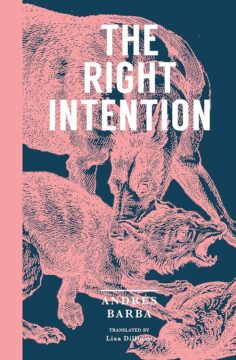 The other stories in The Right Intention are just as haunting, though “Nocturne,” the first, is in my opinion stronger than “Descent,” the fourth and last entry. “Nocturne” focuses in relentlessly on a middle-aged man’s obsession with the age difference between himself and his young lover. Barba peels away the artifice of infatuation here with agonizing slowness, baiting the reader into agreeing with the protagonist—yes, the boy is too young; yes, attempts to bridge generation gaps will always end in collapse—but by story’s end, a reversal occurs that sneaks up out of nowhere and causes the reader to doubt everything they assumed was true to that point. We are, Barba seems to be saying, particularly susceptible to our own fictions, even (and especially) the ones that hurt the most. “Descent,” by comparison, feels like it doesn’t quite fit in with the other three as much. On the last days of a tyrant mother’s life, her children—all of them corrupt or contemptible in some way—are summoned to her bedside for a last excoriation and much wailing. Though I found all the characters believable, of the four, this story felt the least connected to the others. The focus on obsession seems absent, unless one takes into account the moribund matriarch’s obsession with emotional manipulation. Still, there’s a sense of humanity to be found in this, much like the shards of hope glittering through August, October—the protagonist’s husband, Manuel, is a rock and a river for her to rely upon during difficulty. This woman is introduced to us only via pronouns—“she” and “her”—and in dialogue by her mother as “daughter.” There is never a time when the protagonist is given a name, not even at the penultimate moment. In fact, dear Mamá confuses her with her sister, instead, in another transposition of faces, names, beings—a joining and blurring, much like those witnessed in “Debilitation” and Such Small Hands. This time, however, the hands are small because of great age.
In all four of these books, there’s a kind of equanimity found to the prose, a simplicity that calls to mind a still pond, even when the temperature of the scene has either reached a boil or plunged into freeze. It puts me in mind of Shirley Jackson’s limpid writing—clear and straightforward, like a beam of light in an otherwise darkened room. Somehow, that beam draws attention to the shadows moreso than it does banish them, seeming to theorize that light may not always be the best antidote for darkness.
Despite all of the torment and dark philosophy, there is still beauty to be found here. The author’s virtuosity with language and imagery results in astonishingly lyrical moments. More than once I found myself having to halt in the middle of a narrative, rereading the prior sentence as if tasting it again. In the Translator’s Note provided in the end-pages of Such Small Hands, Lisa Dillman makes the astute observation that Such Small Hands “is, in many ways, about translation … In his finely wrought prose, Barba allows us to see through them, to apprehend the reasons for their behavior. He translates the girls into language we feel on a gut level.”
This gut level, then; the language of the primal parts of us that do not wear the vestments of logic or reason. Barba’s fiction lives in this space and is a stunning paradox of terror and hope, inspiring a giddy vertigo just this side of ilinx. Whirling around and around in ever-tighter circles, abruptly the reader discovers that they’ve been tracking inward on a spiral, surrounded by a constant murmur of voices from Others: a reminder that we are them and that they are us; that, in the end, all we are is all alone, together.
***
Enjoying the content on 3QD? Help keep us going by donating now.