
by J. M. Tyree
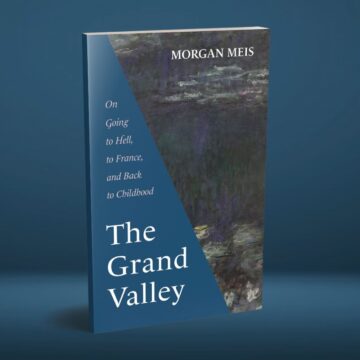 Morgan Meis and I have been talking about art for years. We’re friends and interlocutors, so I’ll refer to him by first name here for the sake of transparency. Morgan writes about painting; I write about movies. We spent the pandemic exchanging letters with each other about films by Terrence Malick, Lars von Trier, and Krzysztof Kieślowski. These letters were later collected in a mad book called Wonder, Horror, Mystery, in which we spent 366 pages arguing like two flannel-wearing Gen X oldsters sipping lemonade on a porch.
I like reading arts criticism that is personal, not too heavy, and accessible to non-specialists, written in a style that is a little bit more intellectual than most American journalism and magazine writing, but a little less jargony and a little more fun to read than academic monographs. Maybe it is possible to dream of creating a form of arts criticism that is itself art. Hardly novel in itself – on the contrary, this idea returns criticism to certain old ways of writing about the arts, and makes a mess of the contemporary academic divisions between criticism, scholarship, and belletristic writing. This book does all of these things.
What Morgan has to say about art makes the world a more interesting place when one reads books like The Grand Valley, the last volume in his trilogy about paintings. The trilogy started with Rubens (The Drunken Silenus), continued with Franz Marc (The Fate of the Animals), and has now culminated with this new book about Joan Mitchell. Apart from Mitchell I strongly dislike the painters Morgan has selected for his triptych. Actually, Rubens is much more interesting than I previously thought, I realized, after reading Morgan’s book, and going to look at Rubens’s terrifying paintings in Munich (which are truly creepy and hellish). I still hate Rubens. Marc does nothing for me, to be honest. Among Mitchell’s paintings Morgan has selected the series of canvases entitled La Grande Vallée. Finally, things were looking up for me as a reader!
Joking aside, the preceding volumes in the trilogy are very compelling reads worth exploring and mulling over, but the trilogy is designed so that each book can be read separately and the reader won’t lose the thread. More generally, I love the idea of a trilogy of arts criticism books – in this economy? – for its simultaneously high-minded and intentionally ridiculous impression of self-mocking and self-serious moves. Refreshing.
If the world isn’t terribly interested in arts criticism, then one answer to this problem is to throw caution to the wind and write what you want. For example, write three noncommercial books about three painters, totaling some hundreds of pages, laboring over this project for many years and then calling the results a trilogy. I (re)commend this approach to a life in the arts, which involves doing your thing, consistently, paying dues, for years, regardless of whether anybody notices or not, and just plowing forward and plugging away with what you really believe in your heart of hearts, and not trying to ride waves, follow trends, or accommodate yourself to internalized pressures around market demands. It’s just not worth it to write any other way, you’ve got to keep part of yourself sacrosanct, if possible, even if that’s just for an hour a day or one day a week.
So Morgan’s trilogy of books now ends with this two hundred plus page essay about a constellation of paintings by Joan Mitchell. None of the paintings gets printed in the book or on the cover. This awkward situation doesn’t wreck the book, but it makes it a different read for audiences who may not know these paintings. Mitchell’s paintings are abstract but have titles, often of places, like Chicago (1966) or City Landscape (1955), that connect back to non-abstract, real or imagined places, or to memories or feelings about them. The Grande Vallée paintings were created in a place outside Paris, an area where Claude Monet also painted after his wife’s death. But, according to many critics, they seem to hover in a space between pure abstraction, memory, and perhaps the dream or imagination of an alternative space of some kind. The paintings of La Grande Vallée, created in the 1980s, were said to evoke a story Mitchell heard, late in life, about a valley where children played.
Morgan’s writing about Mitchell works by weaving in his personal reflections and following many detours into art and literature, as well as biography and autobiography, creating a first-person journey into a subjective encounter with complex works of art. This habit of turning everything into a form of mirrored autobiography is also a hallmark of writing by the Romantics (Coleridge, the Wordsworths, De Quincey, and co.). And Morgan clearly self-defines as a Romantic critic. This style makes the book compelling and enjoyable, but also strange, in a positive sense, because it includes the writer in the process of discovery as they think, remember, and sketch out their own reflections about their encounters with art. Something has left them deeply moved and permanently affected by what they’ve experienced, as with a pilgrimage. Why not tell the truth about this from one’s own perspective?
The French philosopher Michel de Certeau once wrote that “all stories are travel stories.” This story is about how artists, writers, readers, and people descend into hell in the hopes of retrieving something to bring back from their journey, which is not in search of the Golden Fleece but something less tangible and more elusive. Joan Mitchell, in Morgan’s rendering, is a figure who did this, through her painting, her tumultuous relationships, her fiery temper, and her battles with booze and cancer. She was a “combustible person,” in Morgan’s phrase. In relaying these aspects of Mitchell’s personality as an artist, Morgan says he is revealing something of himself, whether directly or indirectly, as well as illuminating other works of art (by Rubens, Monet, Clyfford Still, Ad Reinhardt, and Barnett Newman) and literature (by Homer, Virgil, Hugo von Hofmannstahl, and Gertrude Stein).
As a result, the chapters wander lovingly from, say, Mitchell’s interest in von Hofmannstahl’s Lord Chandos Letter, to the meaning of that 1906 work about losing one’s ability to write about one’s deepest feelings, to philosophical meditations about feelings, to an attempt to rehabilitate a Romantic view of art and arts criticism based on feelings, to an extended analysis of Joan Mitchell’s paintings as an oeuvre in which the general trend towards abstraction in Modern Art founders and maybe begins finding its way tentatively towards various forms and potential hints of something like figuration. Morgan frames Mitchell’s paintings as poised between abstraction and something else, being a barometer of the situation of painting as she found it, as well as a signpost pointing toward a more open future for her chosen art-form.
Ultimately I demur from Morgan’s drift towards Romantic arts criticism, but I do find heartening value in it. This disagreement between us is productive for me because his book helps me think about what I believe, which is not nothing in this crazy mixed-up world. There is little to fear and much to recommend about this kind of generative disagreement. For example, Morgan writes of Mitchell that
there is nothing stronger than this sense of self that emerges and palpitates almost, that shakes and trembles in the face of the tensions of being […] she became that moment, and then she allowed that moment to pass into her own soul, furrowing a divot into that soul-place that she had available on that whatever afternoon. (113)
I mean, yes, hell, yes! Mitchell said this about her painting: “I became the sunflower, the lake, the tree. I no longer exist.” Morgan avoids quotations in his writing but here he’s merging with Mitchell. I sort of know, or think I know, what Morgan means, but I also don’t know what he means, about self, being, and soul. As for the divot, I think this means that art hits hard when it hits home. I felt that.
But Morgan speaks boldly and assertively of the self, while Mitchell is talking about the obliteration of self. Maybe this isn’t a real contradiction – maybe an expanded self, when expanded cosmically enough, amounts to something like no-self in the end. I’m not sure because I haven’t gotten there yet. But all that merging – in Mitchell’s paintings, and in the Lord Chandos Letter that Mitchell, W. G. Sebald, Morgan, and I all adore – takes me out of and away from myself, and into a paradoxical zone. This tendency is far from absent in Romantic writing, as in Coleridge’s 1798 poem “Frost at Midnight,” with its flickering fire at the grate of winter and its “secret ministry of frost.” Probably Romanticism holds this fascinating paradox between self and self-obliteration in the encounter with the Sublime. Personally, I’m a little bit suspicious of the things that sweep us off our feet.
Then there is the Very Serious Matter of the soul, and other Even More Serious Stuff, which Morgan does well not to make self-serious, in part because of his informal and infectious prose style, which rolls like waves into many intriguing harbors. For her part, Mitchell put things pretty directly on this topic of the soul in a note to a friend: “honey I ain’t religious – but Catholics think I am.” Critics don’t need to take an artist’s word for anything but it would be good to air this out in more detail, I think. This probably requires Morgan to write another book, however, one directly about spiritual matters, and which I greatly look forward to reading. I am envisioning a down in the dirt version of Christianity, redolent of Pasolini’s 1964 film The Gospel According to Matthew or Rohrwacher’s 2023 film La Chimera, that flows from the mucky failure and bloody suffering of past and present into the cosmic connections between all things that make the great jumble into a wonder. Just life, the world, and everything, in other words, no big deal. A tetralogy of books which also creates an unscientific postscript to the present trilogy, is all I ask here.
I’m a critical humanist, but I would like to make the case for this kind of soulful writing that Morgan specializes in. It can form an antidote both to the poisons of reactionary evangelical bilge and to smug secular liberal finger-wagging about the purpose, role, and functions of the arts. Art is not a dietary supplement that helps grow strong moral fiber, in my view, it is a hallucinogenic drug, one that helps one see the world anew, but one that also can be dangerous. Morgan’s departure from these two domineering and disappointing American discourses of the day makes his writings both fascinating and essential. For what it’s worth, I salute wagering so much on taking this viewpoint in the current climate where these reflections might land in an unpopular (or unpopulated) space between the warring factions of this chaotically and colossally stupid era.
Joan Mitchell never gets lost in this book no matter how many detours it takes to get back to her work. Instead, Morgan assists the spreading resonances of her painting to enter into the present and future. I’m no expert on Joan Mitchell, but I find her paintings captivatingly analytical in their ongoing investigation of structure and shape. In other words, I admire how her paintings make me think (not just how they make me feel). How they trace the blurry seams where mind and world meet and where perception and universe tangle up to structure our understanding of space and time. I sense that Mitchell was often of two minds about many things, and, if that is at all accurate, I love the way she reflects. Hers is, among other things, a dialectical critique of pure abstraction, in formal terms, although there is no reason to limit the power of these paintings just to that. This take doesn’t preclude deep feelings, at all, either in the artist or the viewer. Maybe it’s all just a mixed bag.
The painter Amy Sillman conveys what I am trying to say here much better than me in her writing about Mitchell’s diptych painting Wood, Wind, No Tuba (1979). Sillman talks about this painting’s “perceptual parallax view.” The results involve “proprioception,” a physical sense of situatedness in place and time. Sillman relates this to the way in which the “artwork’s meaning is entirely wrapped up in its matter.” This is the other side of art’s equation, where artifice and analysis return. Sillman writes of being uncertain whether Mitchell’s painting relates to “a place or a time, a spatial or a sonic event […] Maybe that’s what all painting is: a glorious no-place, or an elsewhere, or, in Mitchell’s case, both things at once.”
Morgan takes his own investigation of Mitchell into an equally remarkable place as the book winds down. He gets lovingly lost, in a positive sense, lost in Mitchell’s paintings, where he perceives “no distance” and where “you can become that reality if you let it happen.” He also discovers something else that is fascinating to me. In Mitchell’s vale, “you are looking at a series of paintings that rob you of your normal skills of looking.” Mitchell as an arch-defamiliarizer raises a very interesting prospect.
“How do you paint a place that exists partly as the possibility of another existence?” Morgan finally asks about the Grande Vallée paintings. As various critics have attempted to limn her work, Mitchell is once again exploring a place that is also a story or a fiction or a memory or a vision or an imaginary location, abstract but, also, simultaneously, not. Morgan’s all-at-once elsewise nicely complements Sillman’s both-at-once elsewhere.
Morgan answers his own question in a poignant passage:
she had to paint these paintings in a forgotten place and […] she had to kill off a few other versions of herself in order to enter that place, to have gotten to that little town in France by way of Hades, so to speak, and through the twists and turns that landed Joan Mitchell on the wrong side of history and on the losing side of life. (163)
In a book about an artist who said No a lot – in fact, there is a sentence in here comprised solely of a hundred or more Nos – there is a Yes that critics might recognize and try to describe. When I look again at Mitchell’s City Landscape, which I intend to do more often after reading this book, I now have double vision. I see what I used to see in the painting, something anxious, troubled, tangled, exacting, and somewhat depressed, and I also see what my friend sees, something borne of interthreaded overwhelmingness and of a great openness to something…more. The most accurate compliment I can pay to this book is that reading it is like having a friend with you, one who leads you towards seeing things that you hadn’t noticed before, or pointing out things that you didn’t know, all of which, like The Grand Valley, and like the paintings at its center, makes the world a more lively place.
***
J. M. Tyree is the author or coauthor of several books about movies, including BFI Film Classics: Salesman (from Bloomsbury), the fiction collection Our Secret Life in the Movies (with Michael McGriff, an NPR Best Books selection), and the cine-novella The Haunted Screen (both from A Strange Object/Deep Vellum).
Enjoying the content on 3QD? Help keep us going by donating now.