
Marina Harss at the Hudson Review:
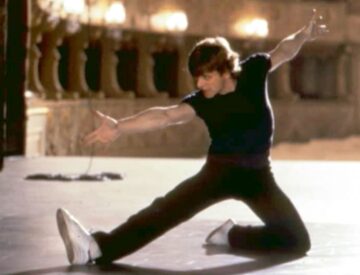 From the moment Baryshnikov landed in New York he was hungry to learn new roles and to have works created for him. In quick succession, he performed Frederick Ashton’s La Fille mal gardée, Roland Petit’s Le Jeune Homme et la Mort, John Butler’s Medea, Antony Tudor’s Shadowplay, Michel Fokine’s Le Spectre de la Rose, Jerome Robbins’ Other Dances, Alvin Ailey’s Pas de Duke, a total of about two dozen new roles in two years according to the book Baryshnikov at Work. His most significant collaboration was with the modern-dance choreographer Twyla Tharp, who created Push Comes to Shove, a work in which he revealed a new, vaudevillian side, around Baryshnikov’s talents. This ballet provided the audience with the first inkling of Baryshnikov’s new “American” persona. In 1977 and early 1978, he also débuted in two essential male roles by Balanchine: Prodigal Son and Apollo. Neither début took place at New York City Ballet, nor did he learn the choreography or receive coaching from Balanchine.
Still, during his first four years in the US, during which he was based at American Ballet Theatre, the bulk of his performances was in the same nineteenth-century repertoire he had been dancing in Russia—a raft of Giselles and Coppélias and Bayadères.
more here.
Enjoying the content on 3QD? Help keep us going by donating now.