
by Mary Hrovat
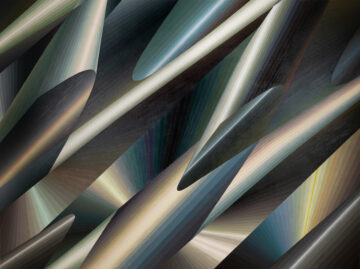
I recently went to see a painting that I love but hadn’t seen for about 40 years, Samia Halaby’s Boston Aquarium. It had been important to me when I was an undergrad at Indiana University in the 1980s, and I’d thought I might never see it again in person. When I learned that it was on display at Indiana University’s art museum, the Eskenazi Museum of Art, I was incredulously joyful at the prospect of immersing myself once again in its color and light.
Boston Aquarium is a large abstract painting (72 1/4 × 95 3/4 inches, oil on canvas). Halaby completed it in 1973. I remembered it for years as a dark painting overall, but its darkness is suffused with light and color. When I first saw it in the mid-1980s, I was studying astrophysics. Although the universe is mostly dark, light—ancient light in particular—is a central concern of astronomy, and the sense of rays of light in the painting was one of the things that drew me to it.
I remember visiting it frequently and losing myself in its shapes and colors, but it’s difficult to remember, this many years on, what exactly I saw in it. I think the helicoid shapes reminded me of the curves of the conic sections I learned about in my calculus classes. Some of the arrangements of colors in the painting might have been evocative of stellar spectra. Overall the painting gave me an expansive sense of moving through vast spaces.
∞
At some point I lost track of Boston Aquarium. I moved away from Bloomington briefly after I graduated, and when I returned, I couldn’t find it at the art museum. (I did find another painting by Halaby in a similar style, Red Green Steel, which I also loved.) In the early 2000s, I wrote to the art museum to ask about it and received the disappointing news that there was no record of the university owning it. I assumed it had been on loan when I’d seen it in the 1980s.
Over time I learned a bit about Halaby herself, a Palestinian-American artist, scholar, and educator who received an MFA from IU in 1963 and was an assistant professor here from 1969 to 1972. I found some of her other work online and eventually bought a book that contains some of her writing and reproductions of many of her paintings. I was intensely interested in her other geometrically inspired painting but also in the subsequent development of her art. So when I learned a couple of years ago that a retrospective exhibit of Halaby’s paintings was being prepared at IU’s art museum, I was excited at the prospect of seeing more of her work, across her entire career to date. In addition, I hoped that Boston Aquarium might be borrowed for the occasion.
Ultimately, however, the university’s administration decided to cancel the exhibit, on short notice and with inadequate explanation. The exhibit was developed in conjunction with Michigan State University’s Broad Museum, in East Lansing, and was on display there late in 2024, but I couldn’t get there to see it. I was so disappointed at losing the chance to see more of Halaby’s work. I thought I’d probably never see Boston Aquarium in person again.
∞
But late this spring I was astonished and elated to learn, purely by chance, not only that IU’s art museum owns the painting, but that it was once again on display. It’s been fascinating to re-acquaint myself with it again after such a long time away from it.
One of the things that struck me on my first few visits was the degree to which the painting rewards close attention. The overall shape and sense of it were immediately familiar, but there were details I had forgotten. I enjoyed exploring the painting, noting the relationships between the shapes and appreciating all the subtle gradations of color. I now know that the painting had its origins in a visit Halaby made to the Boston Aquarium. I can see suggestions of fish in some of the shapes; I can see light sifting through water, shining on their backs. Overall, though, the painting has the same effect on me as it had when I was a student: It offers a visual space through which I feel I can travel. And each time I see it, it beguiles me as it did 40 years ago.
In a 1987 essay, Halaby described the delight she has always taken in seeing and picturing. She wrote that “Practice and development have transformed this delight into a conscious feasting of eyes and mind on the visible world.” In Boston Aquarium, I think she has shared that sense of feasting on the visible world with viewers. Its distillation of reality absorbs my attention in a way that feels both restful and energizing.
∞
The artist wrote that she shaded the shapes in Boston Aquarium so that none would become background. I see the painting as a world that can be entered at any point and explored to my heart’s content. The way my eye travels through the work has given me the sense that I’m reading it. Unlike reading a page, however, reading the painting is a nonlinear experience. It has patterns, but they’re not hierarchical or ordered in any obvious way except by their own subtle relationships. These aspects of it are deeply pleasing to me.
As I thought about the painting this summer, and mentally drafted sentences about it, I found myself referring to it as a poem rather than a painting. Poetry is increasingly a focus of attention for me, and I’m intrigued by this crossing of wires between the visual and the verbal. My mind was also caught by something else Halaby wrote in that 1987 essay: “The visual language of picturing refers more directly to reality than the more socially developed language of the written or spoken word.” This sentence reminded me that even concretely descriptive words—sparrow, thunderhead, kiss, sunshine—are more or less arbitrary symbols. Letters once had meaningful connections to the physical world, although these associations were long ago lost to simplification and standardization. Writers are in that sense a few steps further from the physical world than visual artists.
My mental use of the word poem instead of painting might have arisen from my sense that I was reading the painting. But also I think that poetry might lean toward the visual language of picturing—more so, at any rate, than other forms of verbal language. Although poets use words rather than more physically immediate materials to create images of particular things, they often form these images so that they gesture toward a concept or experience that is difficult to express directly. They make an implicit or explicit comparison, perhaps, or they write around something in such a way that what is said makes the unsaid visible. In addition, poets often use words in unexpected or unconventional ways that suggest new connotations of familiar terms. They work at the edge of what can be said. Moreover, they use the sounds and rhythms of language, the physical feeling of the words, possibly in analogy to the way that painters use color and light and shape.
Perhaps I’m simply seeing my current interests in the painting, as I did when I was young—poetry this time instead of a dark universe suffused with light. I don’t know. I hope not. I think I’m gaining a deeper sense of what the painting might mean. Most importantly, I’m still overjoyed that I can once again engross myself in its visual language.
∞
More information
Eskenazi Museum of Art, Indiana University, Bloomington
Samia Halaby: Centers of Energy, edited by Elliot Josephine Leila Reichert and Rachel Winter, with contributions from Samia Halaby (Hirmer, 2023)
Samia Halaby: Five Decades of Painting and Innovation, Maymanah Farhat, with essays by the artist (Booth-Clibborn, 2014)
The essay “Reflecting Reality in Abstract Picturing,” by Samia Halaby, appears in Centers of Energy, the book that accompanies the 2024 retrospective exhibit. It was originally published in the journal Leonardo (vol. 20, no. 3, pp. 241–46, 1987).
∞
You can find more of my writing at MaryHrovat.com.
Enjoying the content on 3QD? Help keep us going by donating now.