
Shai Tubali at Big Think:
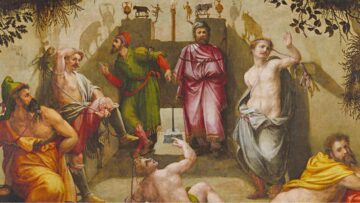 Alone figure stands at the edge of the Universe and hurls a spear into the unknown, only to find the edge wasn’t an edge after all. A demon tells a chronically ill person that every moment of their life — every high, every hardship — will repeat forever, exactly as it is. A 16-year-old boy tries to travel alongside a beam of light, hoping to catch up, but no matter how fast he goes, it never slows. Someone is offered the chance to live in a simulated paradise, but there’s a catch: Once inside, they’ll forget it isn’t real. And a human falls in love with a consciousness that has no body, no boundaries, and no need for them.
All five scenarios are drawn from what is classically termed thought experiments. They range from Lucretius’ spear flung at the edge of the Universe — one of the earliest on record (1st century BCE) — to the vision of eternal recurrence that gripped the chronically ill Nietzsche. From Einstein’s boyhood attempt to chase a beam of light, to Robert Nozick’s 1974 Experience Machine. And even to a sci-fi film: Spike Jonze’s Her, a tale of futile, aching love between a man and a bodiless mind.
The essential practice of a thought experiment is deceptively simple: picture a situation in the imagination, let it run its course — or intervene in some way — then watch what happens and draw a conclusion.
More here.
Enjoying the content on 3QD? Help keep us going by donating now.