
Niko Kolodny in the Boston Review:
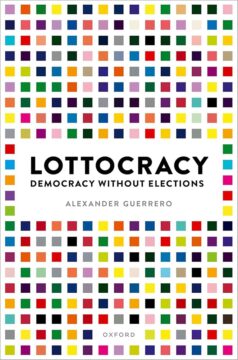 When democracy seems everywhere in crisis, it may sound paradoxical, to say the least, that the solution to our troubles is to scrap elections altogether. But that is precisely what political philosopher Alexander Guerrero proposes in his bold and illuminating book, Lottocracy: Democracy Without Elections. We should select political officials not by voting, he contends, but by lottery from among the entire adult citizenry.
As radical as it sounds, the idea, indeed the reality, of “sortition”—using random selection to select political officials—is nothing new. Nor is it the prerogative of any particular political persuasion. The Athenians used such a system more than two thousand years ago. The Trinidadian Marxist C. L. R. James celebrated this system when he argued, echoing Lenin, that “every cook can govern.” The idea has seen something of a popular revival in recent years thanks to the writing and advocacy of people like political theorist Hélène Landemore and Belgian historian David Van Reybrouck. And it has been put into practice in a variety of deliberative and citizens’ assemblies, including in Europe and the United States. What sets Guerrero’s analysis apart is that he has thought through how such a system might work in modern societies in exhaustive detail. The result is a landmark argument that must be reckoned with.
More here.
Enjoying the content on 3QD? Help keep us going by donating now.