
Frances Wilson at the New Statesman:
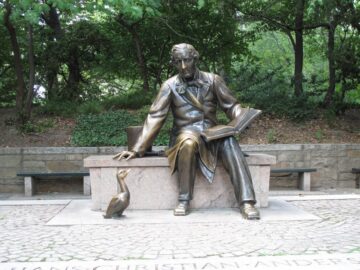 There once was an ugly duckling, so despised by the other birds that he fled the farm to explore the wider world. But because of his very great ugliness he was taunted there too, until one day he caught his image reflected in a pond and he had turned into a beautiful swan. The Ugly Duckling, first published in 1843, was one of Hans Christian Andersen’s many autobiographical fairy tales: “It matters nothing if one is born in a duck-yard,” he wrote, “if one has lain in a swan’s egg.”
Andersen’s subject, from the start, was the outsider destined for greatness. “At school,” he recalled in The Fairy Tale of My Life, the third of his three memoirs, “I told the boys curious stories in which I was always the chief person, but was sometimes ridiculed for that.” His stories were miniature epics (The Princess and the Pea is 300 words long) and his characters, like the author himself, solitary figures of spiritual greatness for whom the world is a place of inexplicable cruelty. Other versions of Anderson’s life can be found in his first published fairy tale, The Tinderbox, in which a clever soldier discovers the magic formula for wealth and success; The Steadfast Tin Soldier, in which a one-legged, love-sick toy falls from a window, is swallowed by a fish, and then thrown into a stove where he melts into a heart-shaped lump; and The Little Match Girl, where a frozen, homeless child, on her last night on Earth, gazes through a window at a happy bourgeois family.
more here.
Enjoying the content on 3QD? Help keep us going by donating now.