
Lewis Hyde at Harper’s Magazine:
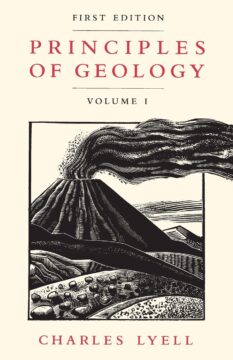
Charles Darwin had no trouble discarding Adam and Eve, but that did not dispose of a problem he shared with Lyell: how to build a theory when a key element—the apparent infinity of time—defies comprehension. By my reading, several strategies arose. The first was to split infinity into tiny pieces, spans of time short enough to understand and work with. That is to say, Lyell and Darwin invented a kind of integral calculus, a method of adding together a series of infinitesimals, of minute changes that can, over “the lapse of ages,” produce huge consequences. Minute after minute, little waves hit a granite cliff, or year after year, the wings of pigeons vary slightly. Then, in the fullness of time, a wide pebble beach replaces the cliff, and a pigeon with an astounding fantail replaces its ancestor—or even, after an “accumulation of infinitesimally small inherited modifications” over “an almost infinite number of generations,” a bird appears that is not a pigeon at all but an entirely new species.
A second strategy begins with the obvious fact that the geological record has distinct periods. A cliff by the seashore reveals layers of limestone, sandstone, and cobbles, each presumably a distinct chapter in the history of the earth. If the years it took to write each chapter could be determined, then it would be easier to speak of those otherwise “very remote eras.”
more here.
Enjoying the content on 3QD? Help keep us going by donating now.