
by Adele A. Wilby
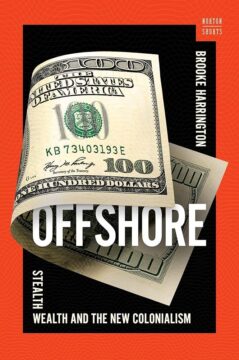 The Paradise, Pandora and Panama Papers, exposing secret offshore accounts in global tax havens, will be familiar to many. They are central to the work of economic sociology professor, Brooke Harrington. She has spent many years researching the ultra-wealthy and several books on the subject have been the result. Her latest book Offshore: Stealth Wealth and the New Colonialism is a continuation of her research; it focuses on ‘the system’, the professional enablers who support and advise the ultra-wealthy and make it possible for them to store and conceal their phenomenal fortunes in secret offshore accounts.
Offshore accounts should be of interest to everyone, particularly because any discussion of offshore finance is inevitably qualified by the word ‘secret’. As Harrington argues, the reasons are clear: secrecy ‘confers impunity: freedom from accountability, both to social norms and the law. Offshore ‘secrecy havens’ make it possible for some corporations, and a small group of individuals – including the world’s approximately three thousand billionaires – to escape constraints the rest of us take for granted. Freedom from taxation is just the beginning’. Offshore wealth allows the super-rich to live in what some economists refer to as ‘fiscal paradise’, a ‘transcendent plane of existence’, beyond the norms, rules and regulations that govern society.
To convey the staggering scale of offshore finance, Harrington cites the Berkely economist Gabriel Zucman: an end of 2022 estimate puts the sum of an astounding $12 trillion in private household wealth hidden in offshore accounts, roughly 12 per cent of all the wealth produced in the world that year, an amount, Harrington points out, that is a ‘central feature of the world economy’. To make sense of ‘the economic and political inequality spiralling out of control worldwide’ access to the secretive world of offshore finance was crucial and she went to remarkable lengths to do so.
As Harrington discovered, the ‘wealthier people are, the more difficult they are to study’; few are willing to speak to ‘nosy sociologists’. Nevertheless, inspired by the twentieth century sociologist C. Wright Mills’ work on power elites, which advocated a research method of a ‘hybrid biography and scientific inquiry’, Harrington employed the method of ‘immersive ethnography’, a useful method for studying groups ‘resistant to transparency’. Since Harrington identified the pivotal role of wealth managers in facilitating offshore financial secrecy, she trained for two years to become one herself. The research strategy paid off. She gained firsthand knowledge and access to experts in the business of wealth management. At the time of writing this book, she had compiled a corpus of research consisting of 79 interviews with wealth managers in 19 countries. Her research is ongoing.
With her access to the world of the super-rich Harrington gained deep insight into the thinking of those who orbit the ‘fiscal paradise’. It is obvious that many view themselves as exceptional, as ‘deserving exemption from the rules that bind the rest of us as members of society’. They also have total disregard for taxpayer funded goods and services. Take for example the former CEO of Starbucks, billionaire Howard Schultz. In a congressional testimony Schultz described himself as a ‘self-made man’ from humble origins, who worked hard to earn his money. But Harrington notes, he failed to acknowledge taxpayer funded subsidised housing he lived in or other infrastructural works and public goods that provided the basis for his success in the first instance. Nor did he mention that his wealth was connected to the profits from Starbuck’s success at offshore tax avoidance in the UK and US, aided by Dutch tax shelters.
But Schulz is not alone in this behaviour. The fortunes of Google founders Sergey Brin and Larry Page have been built on public funds allocated by the US National Science Foundation and the taxpayer-financed internet. The world’s wealthiest man, Elon Musk too is a recipient of taxpayer funded subsidies, while at the same time using what Harrington refers to as ‘aggressive wealth management techniques’ to pay little or no tax for years. Unsurprisingly, Musk opposes legislation that would require billionaires to pay their fair share of taxes. As Harrington puts it, for many elites like him, ‘freedom mostly means the liberty not to be taxed’.
Stashing cash and avoiding taxes in anonymous and shell accounts in places such as the Cayman Islands, the Jersey Islands, and in the US states of South Dakota, Nevada, Wyoming, and even Washington DC. might be seen by some as a smart move to promote ‘harmless’ self-interest, but Harrington’s research suggests this is not the case.
When presenting her research, Harrington approaches her subject like that of a biographer writing about a ‘complex, interesting, powerful and dangerous person’. Her goal is to make accessible ‘complicated legal and financial affairs to nonspecialists’ and she succeeds. For her, this is an important matter, a matter of public interest. As her interviews with wealth managers reveal, their clients’ ideologies and strategies are antithetical to democracy. ‘Offshore finance’ she writes, ‘is not just about naughty celebrities and tax avoidance: it is the platform for an elite insurgency opposed to basic principle like equality before the law, economic stability, free markets, and social solidarity’’. Indeed, for Harrington ‘secretive networks of offshore finance are linked to extremism – best captured in the phrase ‘libertarian anarchism”, an ideological perspective that considers it an ‘offence to liberty’ that they should be expected to pay their fair share to society. ‘Offshore’ Harrington writes, ‘is a refuge from what these elites see as society’s illegitimate claims on them and their wealth’.
Many of the wealth managers Harrington interviewed share this ideological perspective, with one referring to the ‘confiscatory tax regimes’ as, ‘state-sponsored theft’, declaring that ‘we are among the very few who will stand up to that’. Furthermore, as her research shows, these world-wide financial elites often support authoritarian regimes, and wealth managers are involved in hiding the sources and wealth that authoritarians have secretly hidden away. Harrington reveals stark data: in oil rich countries, like the UAE, Saudi Arabia, Venezuela, up to 50 percent of their country’s total economic wealth is held in offshore accounts. Russian elites hold 60 percent of their wealth in private offshore accounts.
The attitudes of wealth managers and the ultra-wealthy to taxes and politics, Harrington argues, are not confined to authoritarians. Current and former heads of state and corporate leaders also exhibit a distain for democratic governance and ideals of equality. Moreover, a new status symbol has emerged within these social strata: impunity from unpaid taxes in what Harrington refers to as ‘elite exceptionalism’. She observes that today, ‘elites now openly refuse any obligation to the societies that allowed them to become wealthy and powerful: instead, they express radically anti-democratic and anti-egalitarian positions, without fear of sanction’. One wealth manager commented that the ultra-wealthy now represent a ‘transnational community with its own rules and culture’, a ‘closed shop of the wealthy’. They socialise, intermarry, and consolidate their families and therefore their global wealth and power. So confident are they in their status the wealthy elite they see themselves as ‘super-human’ and ‘semi-divine’ with ambition to ‘reshape the world in their image’.
Harrington also likens offshore finance to a ‘zombie colonialism’ a metaphorical reference for how colonial and imperial institutions continue to shape today’s economy. Offshore finance, she writes, ‘operates through the decayed yet seemingly indestructible corpus of imperial infrastructure’. Including the US as a former colony, 83 percent of financial centres in the world today are former British colonies, repurposed to serve the interests of the global super-rich.
The Spanish, Italians, Germans and Portuguese also engaged in colonialism. How then to account for the British Empire becoming the birthplace of offshore finance? Harrington advances three propositions: its tax system, its legal system, and the London-based administrators’ strategy of encouraging the economic independence of former colonies. As incentives to encourage settlers, the British kept the taxes low in the colonies, while the indigenous people bore the tax burden of funding the infrastructure. Though these policies were not designed with offshore finance in mind, they inadvertently laid the foundations for its emergence.
It was, Harrington argues, an accident of history that these colonies became modern offshore financial hubs. Modern welfare states, big government programmes in the pre- and post-World War II era demanded more taxes from the wealthy. Small territories with small populations, and staffed by local people educated in colonial schools, provided the basis for the offshore system that is now in place, a ‘colonization-as-cloning-strategy’. Fees paid to colonies for financial services provided a source of economic independence to places such as the British Virgin Islands and Caymen Islands. ‘The new empire of offshore finance,’ she writes, ‘was literally built atop the older structures of British imperialism’.
There is though irony in these offshore havens. While unimaginable wealth accrues in bank accounts and employment opportunities become available, these territories are hit by two phenomena: the ‘finance curse’ and the ‘paradox of plenty’. In the former, offshore wealth rarely ‘trickles down’ to locals. Instead, the government prioritises serving the interests of the wealthy. According to Harrington, this leads to financial and social insecurity, political corruption, and subsequently crime and violence in the more remote countries dependent on offshore finance. In the case of the ‘paradox of plenty’ wealth managers manoeuvre democratic processes in the interests of foreign private wealth as in the British Virgin Islands. Despite its over four hundred thousand companies and $1.5 trillion in assets, most of the local population has failed to benefit from the wealth on the island; tax and social security contributions continue to be deducted from the pay cheques of the local workers.
Ultimately, Harrington identifies wealth managers as central actors who provide the financial services to wealthy clients, linking the elite to their enormous wealth and to one another. Given a system that clearly functions and thrives on global social and economic inequality and poses a threat to democracy, the question that remains is: what is to be done?
On this issue, Harrington admits that effecting change in this system is challenging and difficult. Despite her damning indictment of offshore wealth, her proposed solutions are modest. There is no suggestion of radical overall of the system as might be expected given the widespread levels of economic and social inequality the system perpetuates. New legislation to close loopholes that prevent tax evasion, she argues, is one such possibility. Targeting the behaviour and practices of the professionals who serve the ultra-wealthy seems the most plausible course of action, as has been the case with the EU and UK banning international law and tax experts from providing financial services to sanctioned Russian oligarchs. Yet she is sceptical that legal measures alone will impact on curtailing offshore financial skullduggery. Instead, rather optimistically, she puts more hope in changing social norms, such as public shaming in the media. Social stigma, she argues, is a powerful tool and more likely to deter the elite from engaging in tax evasion.
Though a slim volume, Harrington’s book offers an insightful, multilayered account of offshore wealth. Her ethnographic methods demonstrate the potential of immersive research in opaque worlds, and she makes clear the broader implications of a finance system that promotes the interests of the international financial elite with little benefit to most of us. Offshore finance, she shows, is about more than the ultra-wealthy and their power. It is about democracy, equality and the common good, and demands greater public scrutiny.