
Jennifer Egan at the Paris Review:
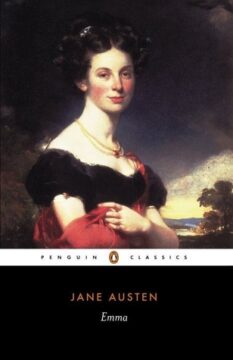 One of Jane Austen’s many mind-bending skills was her ability to wrest so much drama from a world that was, by present-day standards, almost unfathomably static. Austen’s novels are preindustrial time capsules from an era before even trains, gas lights, or telegraphs—the first in a stampede of inventions that transformed nineteenth-century life and are vividly present in the work of many novelists emblematic of that century. Born in 1775, a year before American Independence, Austen has preserved for us an epoch when indoor illumination required candles, remote communication took place by messenger or mail, and locomotion meant walking or engaging at least one horse—more if, like Emma’s protagonist and namesake (and indeed every woman in that novel), you didn’t ride, and needed a carriage to travel any distance.
Austen’s fourth published novel is the most physically constricted of her works, which makes it also the most virtuosic. Unlike Austen’s other protagonists, Emma Woodhouse never spends a night away from home. That home is in fictional Highbury, “a large and populous village almost amounting to a town,” whose sixteen-mile distance from London might as well be six hundred.
more here.
Enjoying the content on 3QD? Help keep us going by donating now.