
Clifford Thompson at Commonweal:
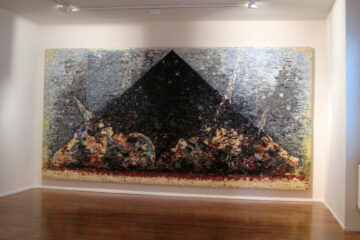 Why abstract art? The question is not rhetorical, especially as a point of entry into the visionary work of Jack Whitten, whose career spanned six decades before he died in 2018. One possible answer: the need to say what cannot be said according to the usual rules—rules for perspective, light, scale, and all the rest, but also, and maybe most importantly, rules for representing the world in a way that the world has already recognized. What looks real, what is real, may not be the same for you as it is for me. That makes it vitally important for artists to paint, sculpt, or draw the world as they see it, regardless of the rules. And that is particularly true when the rules—inside the world of art schools, galleries, and museums and, most especially, outside it—constitute the very evil that makes their work necessary.
That was certainly true for Whitten, the African American son of a coal miner and a seamstress, born in 1939 and raised in segregated Bessemer, Alabama. Here is how segregated: Whitten and other Black students were prohibited from visiting art museums, so they toured the area’s coal mines and steel mills instead. The first member of his family to attend college, Whitten became a premed student at Alabama’s Tuskegee Institute before shifting his focus in 1959—ironically, given the restrictions placed on him during boyhood—to art.
more here.
Enjoying the content on 3QD? Help keep us going by donating now.