by Christopher Hall
His old age fell on years of abundant harvest.
There were no earthquakes, droughts, or floods.
It seemed as if the turning of the seasons gained in constancy,
Stars waxed strong and the sun increased its might.
Even in remote provinces no war was waged.
Generations grew up friendly to fellow men.
The rational nature of man was not a subject of derision.
It was bitter to say farewell to the earth so renewed.
He was envious and ashamed of his doubt,
Content that his lacerated memory would vanish with him.
Two days after his death a hurricane razed the coasts.
Smoke came from volcanoes inactive for a hundred years.
Lava spread over forests, vineyards, and towns.
And war began with a battle on the islands.
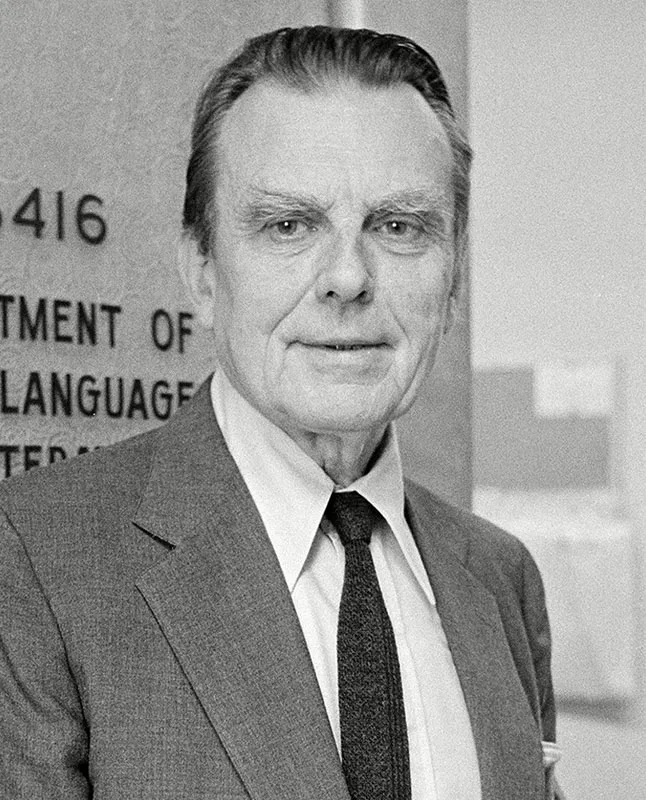
This poem, “A Felicitous Life” by Polish Nobel Laureate Czeslaw Milosz (pictured), has perplexed me. It’s a cliché to say of any poem that its calm surface gives way to great depths when pierced; I’m not sure, especially of Milosz’s poetry, that we aren’t meant to stay treading the water. But a mystery here surely remains. The central figure – is he a kind of anti-scapegoat/human sacrifice, someone whose continued life was necessary to keep the evils of the world at bay? A Messiah figure whose promises of paradise were only redeemable so long as he lives – and whose return is not prefigured? I’m tempted by these ideas, but they seem overblown.
The lesson here may simply be that history doesn’t end. Most of they calamities in the poem except for war and that strange but familiar “derision of reason,” are natural – earthquakes, flood, volcanoes, and it may be that the universe simply doesn’t want us to rest for long. But knowing the life Milosz lived – born in 1911 in what was then the Russian empire, surviving both the World Wars, accommodating as best he could life under Soviet occupation until he sought asylum in France, finally ending up in Berkeley in the Sixties – we are apt, I think, to wonder if these lacerated memories aren’t stand-ins for of other kinds of disasters.
If we’re going to take it easy, and we ought to, on Francis Fukuyama, we might ask legitimately why history didn’t end we he thought it should. We may joke that liberal democracy is the worst system except for all the others, but in the absence of perfect answers, you could be forgiving for thinking it’s about as near a reasonable kludge as we’re going to get. The standard lefty response, and one I still largely agree with, is “ah yes, but capitalism,” and yet one wonders if that’s all there is to it.
As I was thinking about this poem, I came across a trenchant and negative review of the work of anthropologist David Graeber. Graeber believed, and thought that the anthropological and archeological record could demonstrate, that humans used to exercise a lot more imagination concerning social constructs. History did not linearly move from egalitarian hunter-gather societies into urban, agriculturally driven hierarchies. There was, instead, constant experimenting and movement back and forth between systems; kings are only kings because we imagine them to be so, and if we could recuperate some of this imaginative playfulness, perhaps we could think our way out of our current mess. The reviewer here, Luke Kemp, after eviscerating the scholarly quality of Graeber’s work, notes that there’s a dark current underlying his thinking:
Graeber holds a strangely dark vision of humanity. It is a vision in which deep down all of us secretly dream of domination. Our primordial political nature is an authoritarian one, in which the cosmos itself is ordered into kings and subjects.
It is also a vision that requires us to think of humans as breathtakingly stupid. We get stuck because 5,000 years ago different groups for different reasons each gave too much power to rulers, leading to us to forget that we were playing make-believe tyrants. Different groups made that same silly mistake again and again across the Near East, China, and the Americas.
Kemp believes that this vision runs counter to Graeber’s ostensibly optimistic view, but there’s more to this “dark vision” that we ought to explore. The question is simple: why, as the 21st century has progressed, have masses of people gone back to embrace so many of the worst, most discredited political ideas in history? Are we, indeed, stupid? And why hasn’t any one been able to offer a credible alternative vision that isn’t “more of the same?”
I’m thinking not just of the failure, which Mark Fisher noted, of the ability to think of a world beyond capitalism, but more generally of a world that could be better. And not just better in pedestrian ways – “I’d like a world where people aren’t murdered or humiliated or starved into submission, where everyone has what they need and enough of what they want” – but rather something that’s systemically better, that guarantees all of these things and doesn’t falter in their delivery.
But that’s the issue, isn’t it? The end of history is a matter of stasis; things could not possibly get better, and so the only way forward if we want change, and we always will, is into worse. The force which propels the disintegration in Milosz’s poem is ambiguous, and hails from nowhere except everywhere. Is there a force which, as Judge Holden says at the end of Blood Meridian, has set its will against us? That Conspiracy Against the Human Race that Ligotti talks about? If there is, is there any point of trying to imagine our way through it?
Even if we could, there’s reason to think that imagination in a variety of forms may be at a nadir at the moment. As I write, the most recent COP summit is ending in utter and absurd failure, while El Nino and climate change are working together quite efficiently to bring the temperature of the ocean to that of a decent hot tub. Is the impending, and by now only mitigable (we’ll see by how much) slow-rolling apocalypse buzzing in our minds so much that we’re collapsing into a form of mental tinnitus? Perhaps, but it may also be that when we are chronically unable to imagine ourselves moving forward, even if it could be into years of abundant harvest and consistent seasons, we are helplessly pulled into the stupid and brutal organisational modes of the past.
No one who’s lived through the Trump years – with the exception of those detained, brutalized and murdered by his immigration Gestapo and his other extra-legal profanations – should even begin to speak about trauma of the same kind experienced by Milosz and millions upon millions of others who have suffered and died under barbarous systems of control. But I do, at times, think about the idea of secondary trauma – in this case, the trauma that results from knowing how often, and how badly, things have gone wrong, even if they haven’t gone wrong for us personally. Trauma is repetition and recurrence, the failure of the past to remain in the past. Is it plausible that the failure of imagination, the inability to think ourselves forward, emerges not out of individual, but of a cultural, universal lacerated memory?
Imagination and memory are not distinct faculties. Imagination must construct its future out of the bits of the past, and memory is inflected by imagination’s desires, fears, and other assorted static. The people who live in utopia must be able to imagine nothing new and remember nothing worse. The man who endured envy of those who could and shame at his inability to do so did right thing by dying before his could act on these impulses. Still, it didn’t matter.
Enjoying the content on 3QD? Help keep us going by donating now.