
Kevin Ng at Los Angeles Review of Books:
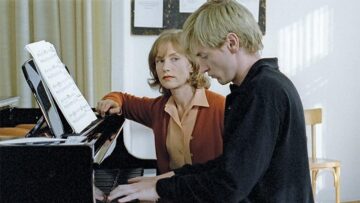
WHEN ELFRIEDE JELINEK won the 2004 Nobel Prize in Literature, the Swedish Academy recognized “her musical flow of voices and counter-voices in novels and plays that with extraordinary linguistic zeal reveal the absurdity of society’s clichés and their subjugating power.” It was a fitting description for a writer who studied piano and organ at the Vienna Conservatory, a mainstay of a society obsessed with its storied musical past. But a conventional musical career was not to be: she had a nervous breakdown at age 21, moved back to her parents’ home, and reemerged as a writer.
Jelinek is best known in the English-speaking world for her 1983 novel, The Piano Teacher (notably, the original German title is Die Klavierspielerin, or “The Piano Player”—the title character receiving a promotion in translation). The novel, which Jelinek acknowledges as autobiographical, is in some ways an exorcism of her musical demons. Like Jelinek, The Piano Teacher’s Erika suffocates under the control of a domineering mother with outsize musical ambitions for her daughter; Erika’s only outlet comes through increasingly disturbing rituals of self-mutilation, voyeurism, and sadomasochistic sexual encounters.
Erika finds no transcendence in the Schubert sonatas she loves so much; instead, the fastidious discipline of the piano and of Vienna’s classical music tradition manifests in emotional and sexual repression and in an ugly, violent will to domination. In Joachim Neugroschel’s 1988 translation, music spreads “like poison gas”; Erika’s violin “moans,” “chokes,” and “shrieks,” while “the bloody bowels of strings and wires” of her Bösendorfer piano “excrete” and “spurt.” The controlled, classical symmetry of Schubert or Mozart offers Erika no escape from the grime and decay of the people around her. Music is simply a reflection of humanity’s rot.
More here.