
Yasemin Saplakoglu at Quanta Magazine:
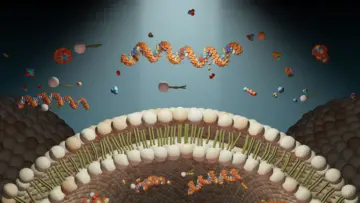
By the mid-20th century, it became possible to probe life’s origins through chemistry, molecular biology, and genetics. Hypotheses exploded. Scientists clashed over which type of molecule — RNA, lipids, proteins, and metabolites are prime suspects — could have started it all. The arguments have gone on for so long, without resolution or unifying insight, that some experts have considered the field to be in crisis.
“There’s nothing more exciting for a scientific field than a moment of crisis,” said Betül Kaçar, an astrobiologist and evolutionary biologist at the University of Wisconsin, Madison. “That’s when I think breakthroughs happen.”
A new wave of origins-of-life researchers, fed up with the tradition of bickering, have unshackled themselves from the idea that a single type of molecule started it all. Their open-minded approach has coincided with a change in scientific understanding. Experiments have shown that the precursors to many of life’s ingredients may have formed easily under the conditions on early Earth. What is harder to explain is how these molecular processes became a stable evolutionary system continuous with the vast diversity of life we see on the planet today.
More here.